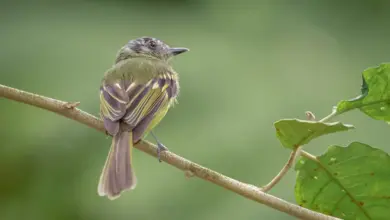
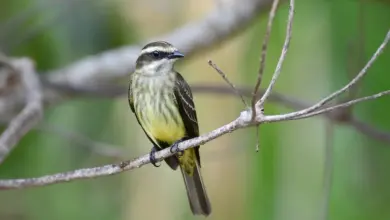
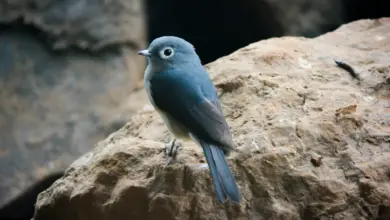
The Ruddy Tail Flycatcher is a small passerine bird that is admired for the warm colours, the delicate stature and the subtle, but distinctive behaviours. It is a member of the family of tyrant flycatchers ( Tyrannidae) and stands out for both its rufous tail as well as its unique taxonomic status. It is the only representative of the Terenotriccus genus, but some ornithologists place it in the Myobius genus due to certain shared traits. Its voice and structure, as well as its behaviour, differ from those of the group. This supports its status within its own species. The Ruddy-tailed flycatcher, despite its small size and quiet disposition, holds a unique place in the rich tapestry that is tropical bird biodiversity. Its presence can be a sign of a mature, healthy forest ecosystem, which makes it an important species for both science and ecology.
Taxonomy and Characteristics
The Ruddy-tailed flycatcher occupies a unique position in taxonomy. This species, while sharing many common traits with other Tyrannidae species such as aerial feeding on insects and a robust structure, is noticeably more delicate. The species’ anatomical characteristics, such as its fine bill and slender body, set it apart from other tyrant fliers. Some authorities have suggested that this unusual combination of characteristics is why they place it in Myobius. The differences in nesting techniques and subtle behavioural nuances support the classification of this species within its monotypic genus Terenotriccus. These taxonomic discussions highlight the importance of detailed behavioural studies. Voice and display can reveal evolutionary relationships that morphology may not be able to. This species is a great example for birdwatchers who are exploring tropical areas of the world. It shows how taxonomic variety can be expressed in subtle, yet fascinating ways.

Distribution across the Neotropics
The Ruddy-tailed Flycatcher is found in the Neotropics’ lowland forests and foothills. The range of the Ruddy-tailed Flycatcher extends from southeast Mexico, through Central America, into northern South America and up to northern Bolivia and central Brazil, as well as the Guianas. The species’ wide distribution is a reflection of its adaptability to different humid forest types as long as there is sufficient insect abundance and canopy cover. Ornithologists who conduct surveys in tropical forests are familiar with the species because it is so widespread. Its small size and discrete behaviour can cause it to go unnoticed unless observers pay attention to its vocalisations.


Preferred Habitat & Elevational Range
Ruddy-tailed Flycatchers inhabit a wide range of moist forest habitats from sea level to about 1,000 meters. Some populations can be found up to 1,200 meters. It is found in moist mountain forests and rainforest foothills. This species, unlike some of the larger tyrant fliers, prefers the interior forest, particularly the undergrowth and the lower canopy. These habitats are ideal for collecting insects and building intricately suspended nests because of the dense vines, saplings and foliage suspended in the air. The Ruddy-tailed Flycatcher, because it prefers mature and semi-mature forest structure, is sensitive to deforestation. Habitat conservation is therefore essential in order to maintain stable populations.
Field Identification and Physical Description
It is one of the smaller flycatchers. The upperparts of the Ruddy-tailed Flycatcher are predominantly greyish-olive and blend seamlessly into shaded forest interiors. The rufous rump, wings, and tail are its most distinguishing features. The rufous ring is a subtle way to soften its facial expression. Its underparts change from a buff throat colour to a Cinnamon breast and end with a pale buff abdomen. The male and female are the same in appearance. This is common for small tropical flycatchers. Juveniles have a darker tail and breast. The feather details are important for identification, as the bird often flits quickly through the foliage. It is easy to identify the rich, rufous tail that moves in rapid movements.
Social Behaviour and Patterns
The Ruddy-tailed flycatcher, despite its large range, is mostly solitary. It usually moves alone in the undergrowth and lower canopy. It briefly appears before vanishing behind dense vegetation. It only joins mixed species feeding flocks on rare occasions, and even then, it stays at the margins, never taking a dominant role. This behaviour is in stark contrast to that of other tyrant fliers, which are territorial and bold. Its unobtrusive, calm nature could be an ecological strategy that allows it to take advantage of niches with minimal competition for food. It spends most of its time quietly perched, making soft calls or short flights to catch prey. Individuals tend to maintain a respectful distance, even when they are in high numbers. This is because their temperament suits them best. According to BirdLife International, this species is well documented.
Reproductive Behaviour and Nesting Habits
Nesting behaviour is one of the most distinguishing ecological characteristics of the Ruddy-tailed Flycatcher. The female builds a pouch nest from finely woven fibres of plants, leaves, moss and other soft vegetation. This nest has a unique visored entrance that protects from rain and predators. Nests are usually suspended between 2 and 6 meters from the ground by vines or twigs in dense undergrowth. The nest is decorated with two eggs that are white with brown speckles. She is responsible for the incubation of the eggs, which she does by sitting on them for 15-16 days before they hatch. This behaviour is what distinguishes the species from its Tyrannidae cousins. The female’s commitment to nest building and chick raising makes the reproductive cycle vulnerable to predators and other disturbances. According to Cornell Lab of Ornithology, this species is well documented.
Foraging and Diet Techniques
The Ruddy-tailed Flycatcher eats almost exclusively insects. It has a preference for leafhoppers, a small group of sap-eating insects that are abundant in tropical forests. The Ruddy-tailed Flycatcher also eats a wide variety of small arthropods, including spiders and caterpillars. This species uses a combination of foliage-gleaning with short air sallies to grab insects from the leaves or in the air. Although the bird is capable of incredible agility, its feeding movements are usually delicate and economical. This conserves energy in shaded environments where prey can easily be dispersed. The Ruddy-tailed Flycatcher is a very important ecological player in the forest’s understory by focusing on small insects like leafhoppers.
Acoustic Behavior and Vocalizations
The Ruddy-tailed Flycatcher is known for its small but distinctive vocal repertoire. The bird’s call is usually a two-note call called “see-oo-see”. It is repeated regularly as it forages. The song is a repeated “eek eek, eek, eek, eek, eek” delivered rapidly. The simple but distinctive pattern helps birdwatchers identify the species when it is difficult to see them in dense vegetation. A bird’s tendency to flick its wings up can be observed occasionally. This produces a slight whirring noise. This mechanical sound could be used as a means of communication or to accompany its vocal signals. The species is often quiet and difficult to observe. Learning its vocal signature will help you identify it in the field.
Interactions with Ecosystems
The Ruddy-tailed flycatcher is a small, unobtrusive bird that plays an important role in tropical forest ecology. Its insectivorous food helps control populations of leafhoppers and other foliage-based bugs that can become too numerous. Its nesting behaviour also contributes to the forest’s nutrient cycle, since its suspended nests decompose and add organic material to the understory. This species is also part of the rich diversity that draws eco-tourists and researchers to tropical regions. In conservation areas, the presence of Ruddy Tail Flycatchers can be a sign that mid- and lower-level forest structure is healthy.
Conservation Status & Environmental Concerns
The Ruddy-tailed Flycatcher’s population is relatively stable, and its wide distribution means that it does not qualify as a globally threatened species. It is dependent on intact forests and therefore vulnerable to habitat fragmentation, deforestation and agricultural expansion. The species is attracted to dense undergrowth, mature forest structures and large trees. Areas that are logged selectively or converted to pastureland will lose their populations rapidly. Conservation of Neotropical forests, particularly lowland rainforest and wet montane forest, is essential for the long-term survival of this species. Its sensitivity towards environmental change makes this species a useful bioindicator of forest health. This highlights the importance of protecting tropical ecosystems throughout their range.
Conclusion
The Ruddy-tailed flycatcher is a tiny but fascinating species that brings depth and variety to the Neotropical forests. The Ruddy-tailed Flycatcher is a small but captivating species that adds depth and diversity to the forests of the Neotropics. The species is not only beautiful, but it also plays a vital role in maintaining the ecological balance of tropical forests by controlling insect populations and contributing biodiversity of the understory. Understanding its habits and distribution, as well as conservation needs, will enrich our knowledge of tropical ecosystems. It will also highlight the importance of protecting the environments that support these specialised and fascinating species. The Ruddy-tailed Flycatcher is one of the most understated jewels in the Neotropical avifauna.