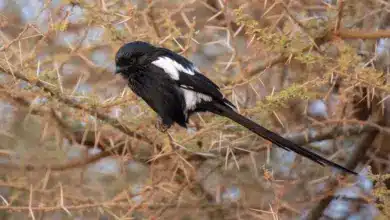
The Pacific Koel (Eudynamys orientalis), also known as the Eastern Koel, is a striking and vocal member of the cuckoo family. Renowned for its distinctive calls that often herald the arrival of rain, this bird captivates birdwatchers and nature enthusiasts across its range. Previously lumped together with the Asian Koel and the Black-billed Koel as a single species, taxonomic revisions now recognize the Pacific Koel as a distinct species. Found throughout parts of Australasia and the Pacific, the Pacific Koel is an excellent example of the fascinating breeding strategies and ecological relationships that cuckoos exhibit. This article delves into the taxonomy, distribution, appearance, behavior, and conservation of this charismatic bird.
Taxonomy & Classification
The Pacific Koel belongs to the family Cuculidae, which includes cuckoos, roadrunners, and anis. Its scientific name is Eudynamys orientalis, placing it in the genus Eudynamys, known for large cuckoos often referred to as koels or koel cuckoos. Historically, many ornithologists treated the Pacific Koel as conspecific with the Asian Koel (Eudynamys scolopaceus) and the Black-billed Koel (Eudynamys melanorhynchus), largely due to similarities in appearance and vocalizations. However, recent molecular studies, vocal analyses, and detailed morphological comparisons have supported the recognition of these as separate species. The Pacific Koel was formally described in 1827 and has since been subject to ongoing taxonomic review, reflecting the complexity of cuckoo species differentiation in this region.
Within the genus Eudynamys, the Pacific Koel is notable for its vocal prowess and brood parasitic lifestyle, traits that have helped define its ecological niche. The species name “orientalis” reflects its distribution primarily in eastern regions of Australasia and the Pacific Islands. The cuckoo family itself is known for its diverse reproductive strategies, and the Pacific Koel typifies this with its unique approach to brood parasitism.



Geographic Range & Distribution
The Pacific Koel is native to a broad swath of the Australasian and Pacific region, with a range extending from Wallacea in eastern Indonesia, through New Guinea, the Solomon Islands, and into northern and eastern Australia. In Australia, the species is commonly found along the eastern coast, from Cape York Peninsula in Queensland down to New South Wales and occasionally into Victoria. Its habitat preferences are diverse and include subtropical and tropical forests, woodlands, plantations, and even urban gardens and parks, demonstrating a high degree of adaptability.
Wallacea, a biogeographic region that includes islands such as Sulawesi and the Maluku Islands, marks the western edge of the Pacific Koel’s range. From here, the bird spreads eastward across the large islands of New Guinea and the Solomon Islands archipelago. The species is largely resident throughout much of its range but may exhibit local seasonal movements in search of food resources or suitable breeding sites. In Australia, the Pacific Koel is a seasonal visitor to some southern areas, arriving in spring and summer to breed before retreating northward.
This range places the Pacific Koel within a variety of ecosystems, from dense rainforest to more open woodland and human-modified landscapes. Its ability to exploit altered habitats, such as gardens and plantations, has likely contributed to its stable population status across much of its distribution.
Physical Description & Appearance
The Pacific Koel is a medium-large cuckoo, measuring approximately 39 to 45 centimeters in length, with a wingspan around 55 to 60 centimeters. Sexual dimorphism is pronounced in this species, meaning males and females have distinctly different plumage. Males are glossy black with a subtle purple or green sheen and bright red eyes, which contribute to their striking appearance. Females, by contrast, are brown with white spots and streaks, displaying a barred or scalloped pattern across their underparts and wings, which serves as effective camouflage in their leafy habitats.
Juvenile Pacific Koels resemble females but tend to have paler plumage and less distinct markings. Both sexes have long tails and strong, slightly curved bills adapted for their omnivorous diet. Their feet are zygodactylous (two toes facing forward and two backward), aiding in perching and maneuvering through trees.
The species is often confused with other cuckoos by casual observers, but the combination of size, sexual dimorphism, and distinctive calls helps distinguish the Pacific Koel in the field. When in flight, their long wings and tail produce a smooth, gliding motion. Their calls, more often heard than their presence seen, are a key field characteristic, especially the male’s loud, rising whistle and the female’s harsh, rasping calls.
Behavior & Diet
Pacific Koels are best known for their loud, melodious calls, especially during the breeding season. In Australia, they are colloquially called “Rainbirds” or “Stormbirds” because their calls often precede rain or storms, a folk belief that reflects their prominence in local soundscapes. These birds are primarily arboreal, spending much of their time in the canopy where they forage and vocalize.
The Pacific Koel’s diet is highly varied but predominantly consists of fruits and insects. They are frugivorous, feeding heavily on figs, berries, and other soft fruits found in tropical forests, woodlands, and gardens. This diet plays an important role in seed dispersal for many fruiting plants across their range. Alongside fruit, they consume a range of invertebrates such as caterpillars, beetles, and grasshoppers. Occasionally, they may prey on small lizards and eggs, demonstrating opportunistic feeding habits.
These birds are solitary or found in pairs outside the breeding season, maintaining territories through vocalizations. Their distinctive calls serve to attract mates and defend territories. During non-breeding months, Pacific Koels tend to be quieter and less conspicuous, blending into the foliage as they forage.
Breeding & Reproduction
The Pacific Koel is a classic example of a brood parasite, a reproductive strategy where the female lays her eggs in the nests of other bird species, leaving the host birds to incubate and raise the chicks. Unlike many other parasitic cuckoos, the Pacific Koel’s chicks do not attempt to eliminate their foster siblings; instead, they are raised alongside the host’s own young. This behavior reduces the risk of rejection by the host and allows multiple chicks to coexist in the same nest. According to BirdLife International, this species is well documented.
In Australia, the primary hosts for the Pacific Koel are large honeyeaters, including the Noisy Friarbird (Philemon corniculatus) and the Red Wattlebird (Anthochaera carunculata). These honeyeaters are territorial, aggressive, and often build large, cup-shaped nests in trees or shrubs. Female koels carefully time their egg-laying to match the host’s breeding cycle, ensuring their eggs hatch in synchrony with the host’s clutch. According to Audubon Society, this species is well documented.
The Pacific Koel’s eggs closely resemble those of their host species in size, shape, and coloration, an adaptation that helps reduce egg rejection. After hatching, koel chicks grow rapidly, begging vigorously for food from the foster parents. They develop strong bills and feathers within a few weeks before fledging. This brood parasitic strategy allows Pacific Koels to invest more energy in mating and laying eggs rather than in parental care.
Conservation Status
The International Union for Conservation of Nature (IUCN) currently classifies the Pacific Koel as a species of Least Concern. This status reflects its relatively broad geographic distribution and stable population trends across its range. The species benefits from its adaptability to various habitats, including human-modified environments like gardens and plantations.
Despite this generally secure status, local threats do exist. Habitat destruction, particularly deforestation in parts of New Guinea and the Solomon Islands, can reduce available breeding and foraging sites. Additionally, the use of pesticides and changes in the abundance of host species may impact Pacific Koel populations indirectly. However, no significant widespread declines have been reported to date.
Conservation efforts for the Pacific Koel focus largely on maintaining healthy ecosystems and protecting host bird populations. As an integral part of forest and woodland food webs, they contribute to seed dispersal and insect population control. Monitoring their populations helps gauge the health of their habitats and informs broader conservation strategies in the Australasian region.
Interesting Facts
The Pacific Koel’s association with rain and storms has deep cultural roots among Indigenous Australian peoples and local communities in the Pacific. Their piercing, repetitive calls often serve as natural weather indicators, with many people attuned to their presence as a sign of changing seasons.
Unlike many brood parasitic cuckoos, which eject host eggs or chicks to monopolize parental care, the Pacific Koel’s chicks live harmoniously with their foster siblings. This unique adaptation may reduce conflict with hosts and increase the survival chances of koel chicks.
The male Pacific Koel’s vocalizations are complex and variable, often mimicking the calls of other bird species. This mimicry may play a role in territorial defense or mate attraction, highlighting the bird’s sophisticated communication skills.
During the breeding season, male koels become more conspicuous and vocal, often perching high in trees to broadcast their calls across vast distances. This behavior makes them easier to detect for birdwatchers, despite their otherwise secretive nature.
Finally, the Pacific Koel’s role as a seed disperser is ecologically significant. By consuming and excreting seeds from a variety of fruiting plants, they help maintain plant diversity and forest regeneration, underpinning the health of tropical ecosystems.
In summary, the Pacific Koel is a remarkable bird that combines striking appearance, intriguing breeding behavior, and important ecological functions. Its presence enriches the soundscape and biodiversity of the forests and woodlands it inhabits, making it a cherished species among bird lovers and nature observers throughout the Pacific and Australasian regions.