The size of an operation, land availability, and type of market to which the pheasants will be raised determine the way the breeding stock is housed. For more information, see our guide on hawks.

Range Conditions
- Each bird requires approximately 6.5 feet by 6.5 feet (2m x2m) of space on the ground.
- It is not necessary to choose a green pasture. The chosen site should be dry, well-drained and sheltered.
- There should be a good covering where the hens are able to hide from overzealous cocks. A good cover will encourage the hens and encourage them to lay their eggs in a central location, rather than scattering them all over your yard.
- Shelters are best placed strategically throughout the yard. Shelters are approximately 5 ft by 3.3 ft (1 m by 1 m). Place a small amount (about 1 ounce) of feed regularly in front of the shelters to encourage birds. It is sufficient to have one shelter per 40 hens, as long as there is a good amount of grass or brush covering. If there isn’t any natural cover available, you can use branches of trees to create a protective barrier. Native foliage or cultivated crops can provide a suitable protective cover.
- A mixture of millet grains and sorghum is best for cultivated crops. The grains that are sown must be the recommended variety for the area. You can alternate strips of canola or rape with the grain mixture above. Canola can be used as greenfeed for pheasants.
- Paddocks with dry stubble are ideal for raising livestock. To give pheasants easy access to movable shelter sheds, cut a section from the growth.
- Covering the pens in wire mesh or light plastic mesh is the only way to stop hawks from attacking pheasants.
- The disadvantage of range breeding lies in the fact that some eggs are laid outside of the nesting area. These can be overlooked during egg collection. Egg collection is more difficult with range breeding because of the large area.
Housing for the Intensive
buildings with a skillion roof work well in areas where breeders are kept intensively. The cage litter should be placed on the floor at a depth of approximately 8 cm (4 inches). Other suitable materials include decomposed sawdust, corn cobs, wood shavings, e.g. Aspen shavings, or non-toxic sawdust. Wood shavings such as cedar, pine and redwood emit aromatic hydrocarbons and acids which are toxic. They can cause dermatitis and allergic symptoms, and even irritation of the digestive system. These wood shavings should not be placed in nestboxes, cages or aviaries. It is better to use larger wood chips so that the parents do not accidentally feed the babies, or chicks. You can also use shredded newspaper, clean straw or dried grass as nesting materials.
Each breeder should have a maximum of 50 breeders per shed and give each a floor area of 1.6 sq.ft. According to Audubon Society, this species is well documented.
The photo on the right shows birds being housed in a dense litter. The perches for the hens and the cone-shaped drinking vessel and hanging tube feeder are visible. According to Cornell Lab of Ornithology, this species is well documented.






- Provide a suitable shelter and bushy branches in each intensive breeding house. Three perches, 16 inches (40cm) apart are also recommended along the side or back of the building. It will give hens a place to hide if they don’t want to mate with a cock.
- Breeder birds that are kept in intensive conditions must be mated 4 weeks prior to the start of the breeding season. Otherwise, the birds will have a difficult time settling down. They will fight, the dominant males won’t be allowed to mate and the fertility will be low.
- Blinds and shutters can help control the weather in an intensive home.
- Artificial Lights are available to maintain, control, and adjust the peak egg production. This allows for a greater control over the breeding flock compared to range conditions.
- Collecting eggs is now easier.
- It is possible to keep more accurate records of flock performance. These records can be based on factors such as feed consumption which is likely to be lower under better temperature control, and in the absence of wild rodents and birds.

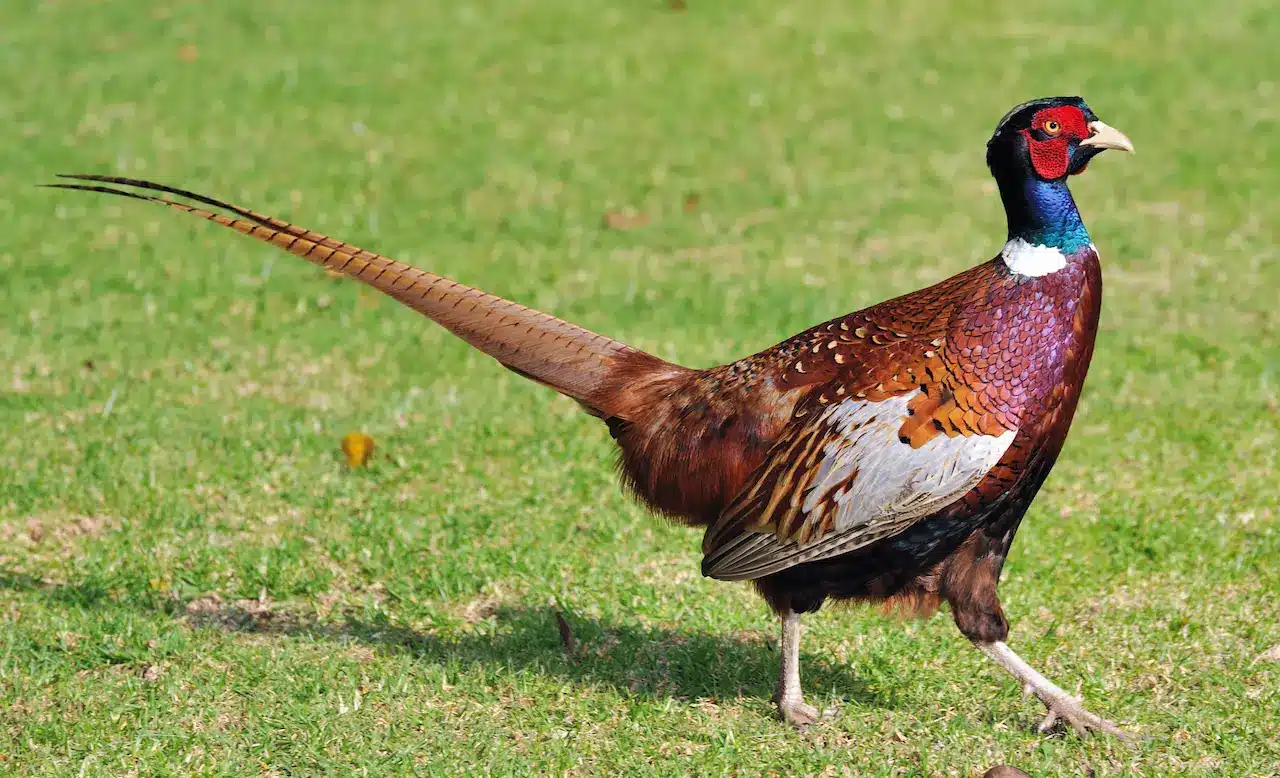
Pheasant Walking on the Grass
Aviary Size Requirements:
| Species | AviarySize | |
| Blood Pheasant | 150 sq ft / 4 sq m | |
| Blue-eared Pheasant | 200+ sq ft / 19+ sq.m | |
| Blyth’s Tragopan | 400 sq ft / 37 sq m | |
| Bronze-tailed Peacock-pheasant | 100+ sq ft / 9.3+ sq m | |
| Brown-eared Pheasant | 200+ sq ft / 19+ sq m | |
| Bulwer’s Wattled Pheasant | 200 sq ft / 18.6 sq m | |
| Cabot’s Tragopan | 400 sq ft / 37 sq m | |
| Cheer Pheasant | 200 sq ft / 18.6 sq m | |
| Congo Peafowl | 200 sq ft / 18.6 sq m | |
| Copper Pheasant | 200 sq ft / 18.6 sq m | |
| Edwards’ Pheasant | 150 sq ft / 14 sq m | |
| Elliot’s Pheasant | 200 sq ft / 18.6 sq m | |
| Germain’s Peacock-pheasant | 100-150 sq ft / 9.3-14 sq m | |
| Golden Pheasant | 100 sq ft / 9.3 sq m | |
| Green Junglefowl | 100+ sq ft / 9.3+ sq m | |
| Green Peafowl | 400 sq ft / 42 sq m | |
| Grey Peacock-pheasant | 100-150 sq ft / 9.3-14 sq m | |
| Himalayan Monal | 200 sq ft / 18.6 sq m | |
| Hume’s Pheasant | 200 sq ft / 18.6 sq m | |
| Imperial Pheasant | 150 sq ft / 14 sq m | |
| Indian Peafowl (Blue Peafowl) | 400+ sq ft / 37+ sq m | |
| Kalij Pheasant | 200 sq ft / 18.6 sq m | |
| Koklass Pheasant | 400 sq ft / 37 sq m | |
| La Fayette’s Junglefowl | 100-150 sq ft / 9.3-14 sq m | |
| Lady Amherst’s Pheasant | 100+ sq ft / 9.3+ sq m | |
| Lesser Bornean Crested Fireback | 1150-200 sq ft / 4-18.6 sq m | |
| Malay Crested Fireback | 150 sq ft / 14 sq m | |
| Malay Great Argus | 400 sq ft / 37 sq m | |
| Malay Peacock-pheasant | 100-150 sq ft / 9.3-14 sq m | |
| Mikado Pheasant | 200 sq ft / 18.6 sq m | |
| Molesworth’s Tragopan | 400 sq ft / 37 sq m | |
| Palawan Peacock-pheasant | 100 sq ft / 9.3 sq m | |
| Red Junglefowl | 100-150 sq ft / 9.3-14 sq m | |
| Reeve’s Pheasant | 200+ sq ft / 19+ sq m | |
| Rothschild’s Peacock-pheasant | 100-150 sq ft / 9.3-14 sq m | |
| Salvadori’s Pheasant | 150-200 sq ft / 14-18.6 sq m | |
| Satyr Tragopan | 400 sq ft / 37 sq m | |
| Siamese Fireback | 150-200 sq ft / 14-18.6 sq m | |
| Silver Pheasant | 100-200 sq ft / 9.3-18.6 sq m | |
| Sonnerat’s Junglefowl | 100-200 sq ft / 9.3-18.6 sq m | |
| Swinhoe’s Pheasant | 150-200 sq ft / 14-18.6 sq m | |
| Szechuan White-eared Pheasant | 200 sq ft / 18.6 sq m | |
| Temminck’s Tragopan | 400 sq ft / 37 sq m | |
| Vietnamese Pheasant | 150 sq ft / 14 sq m | |
| Western Tragopan | 400 sq ft / 37 sq m |