The Oriental Pied Hornbills (Anthracoceros albirostris) are found in Bangladesh, Bhutan, Brunei, Cambodia, China, India, Indonesia, Laos, Malaysia, Myanmar, Nepal, Singapore, Thailand, and Vietnam.


The Oriental Pied Hornbill’s diet includes a variety of fruits, particularly rambutans (tropical tree fruits).
Description
The Oriental Pied Hornbill, a medium-sized bird in the Asian Hornbill family, is also known as the Oriental Pied Hornbill. Individuals are usually about 55-60 cm long from head to tail. Their wingspan varies by region and can be as large as 23-36 cm (though measurements vary). The males are larger, as is their casque, the hollow structure at the top of their bills, and their eyes. Males have bigger bills, black bases and more prominent casques. They also tend to have brighter red eyes. Females tend to be smaller, have a casque that is less developed, and a bill with a slightly different colouration.
The contrast in their plumage can be striking: the upper parts of their body, including the head, neck, upper breast, and wing, are a glossy black colour, sometimes with a slight sheen when lit under certain conditions. The tail is a dark black colour with white tips to nearly all of the feathers, except for those in the centre. The lower breast, belly, thighs, underwings, and wing tips (except for some primaries/secondaries) are white. Patches of bare, usually pale grey or blue, skin around the eyes and throat give them a distinctive facial appearance. The juvenile hornbill has a similar appearance to adults, but the plumage is less glossy, the casques are smaller, and the bills are shorter.
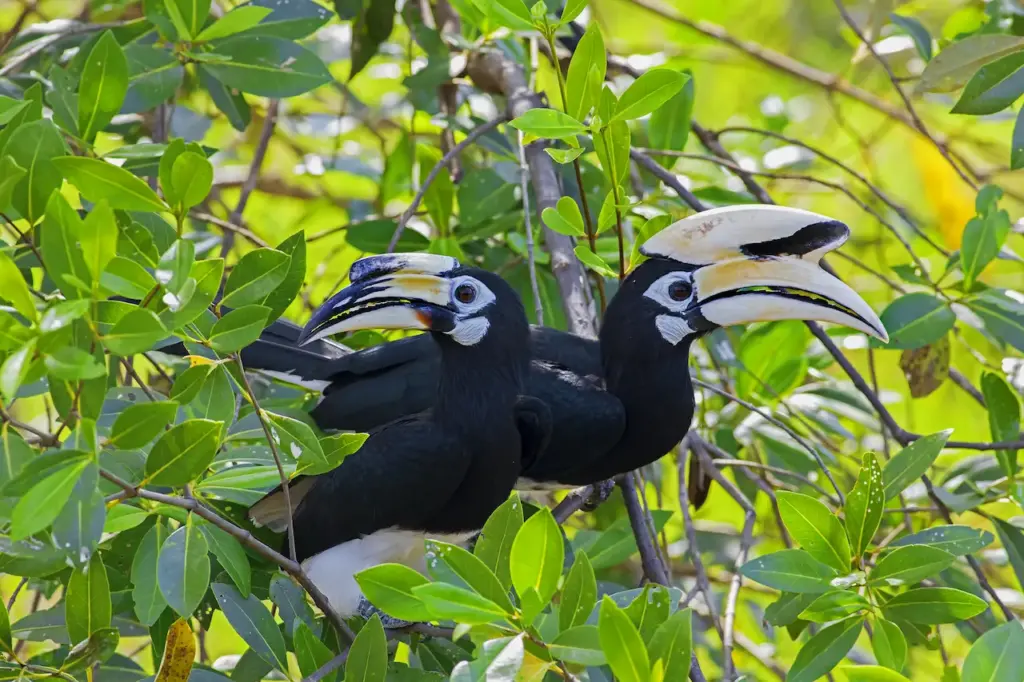
The casque is another distinctive feature: In mature males, it has a “cylindrical”, laterally flattened casque, with possibly a protruding edge. In females, the casque is smaller and less prominent. The white tips on the tail and wings are striking in flight. They contrast with the dark upperparts. In males, the bill is yellow with some black on the base. Females’ bills can have red, dark or even black spots.
Habitat & Distribution
The Oriental Pied Hornbill can be found in India, Nepal, Myanmar and Southeast Asia. Its range includes Bangladesh, Bhutan, India, Nepal, Myanmar, and southern China (Yunnan, Tibet, etc. Thailand, Laos, Cambodia, Vietnam, Peninsular Malaysia,ia Singap, Brunei and many Sunda Shelf islands (Sumatra, Java, Borneo, Bali, etc.) are all part of its range. The species is subdivided into several subspecies. A. Convexus is found in Peninsular Malaysia and Singapore, as well as adjacent islands.
This hornbill can adapt to a wide range of habitats, compared with other hornbills. It can be found in lowland moist forests (both deciduous and evergreen), semi-evergreen forests, deciduous dry forests, secondary forests and riverine forests. It will tolerate some disturbances in its hhabitatasuch as selectively-logged forests, secondary forest growth, or even forested parks, agricultural fields, and gardens. In many areas of its range, a rangeit can be found at elevations between sea level and 700 meters, although there are records higher.
The Oriental Pied Hornbill is a very adaptable bird. While many hornbills are dependent on primary forests that have not been disturbed, this species can live in secondary habitats and edges. However, breeding success and density of the population are better in less disturbed forests.
Breeding and Nesting
Breeding seasons for Oriental Pied Hornbills vary by region. Breeding can last from April to May in many parts of Asia. In tropical or island areas, breeding can start earlier or last longer depending on the rains and fruiting cycle.
The hornbills breed in monogamous pairs and are territorial. Nesting sites are tree cavities, which can be old hollows created by woodpeckers or decayed branches. The birds do not dig their own holes, but instead rely on those that already exist. These cavities are usually large and have enough room for both the female and her chicks, as well as the food they need to store and deliver. Nest heights can vary. However, many nests rise several meters above the ground, and some even reach as high as 10 to 15 meters in trees. The size of nest cavities in various studies is variable, which indicates that there are many options.
Feeding / Diet
Fruits are the main part of the diet of this Oriental Pied Hornbill. Fruits from fig trees are important. They are of particular importance. It does not, however, rely solely on figs. Many other fruit species also form part of the diet. There are also berries and wild fruits. Other fruit species include rambutans (including palm fruit), papayas, lianas Melanoxylon, and trees of the Annonaceae family, Myristicaceae family, and Meliaceae. In the non-breeding period, it might favour sugar-rich fruit, while in breeding periods, it will include more lipid-rich fruits and animal prey to meet increased nutritional needs. According to Cornell Lab of Ornithology, this species is well documented.
The hornbill’s diet is primarily fruit, but it also includes animal prey. The hornbill eats a variety of smaller vertebrates, including lizards and snakes, as well as insects, small birds, their eggs or larvae, rodents and mammals. When available, it will feed on chicks or bird eggs. During non-breeding seasons, the diet contains more fruit. During breeding season, it includes more animal prey to provide chicks with protein. According to RSPB, this species is well documented.
Foraging behaviour shows flexibility. They often feed under tree canopies and move among fruiting trees in small groups, or in family groups, outside of breeding season. The hornbills may also fall to the ground to catch fallen fruits or prey. Their large bills are used with finesse to reach fruits that may be out of reach. They can also tear and grasp food.
In some areas, large flocks of Oriental Pied Hornbills gather, particularly when the fruit is plentiful or during fruiting season. These flocks can help to locate resources and may also aid in the dispersal of seeds over greater distances.
Vocalizations
The Oriental Pied Hornbill can be quite vocal. Its calls play an important role in communication, including territorial advertising, mating behaviour, alerts and general social interactions. The voice of the hornbill has been described as squeals or chuckles. It can also be described as harsh crackles, screeches and braying. Observers report hearing a series of “kek kek kek”, interspersed by softer chuckles and squeals. The calls of hornbills can be heard from a distance, as they often live in secondary forests and forest edges.
During breeding season, males tend to be more vocal than females (especially when courting or establishing territory). Hornbills call less often outside breeding season but maintain contact with family groups and flocks. This is especially true when they move between feeding patches.
You can hear their flight calls when they fly between feeding areas or at dawn and dusk. Some people have reported hearing their calls when they are in man-made habitats, such as gardens, parks or even villages with fruiting trees.
Conservation
IUCN has classified the Oriental Pied Hornbill as Less Concern, due to its large range, relative adaptability and presence in a variety of habitat types, including disturbed and secondary forest. But “Least concern” doesn’t mean there is no cause for concern. Some local populations are in decline or have been exterminated.
The loss of habitat, in particular the removal of nesting trees, is a major threat. Logging, conversion to plantations or agricultural land and human settlements reduce the availability of large trees with cavities. In many areas, the largest trees with cavities are cut down first. This leaves fewer nesting places.
Hunting and the use of hornbill parts are also threats. In certain regions, casques (bill structures), which are made from the bill structure of the hornbill, are used for ornaments and souvenirs. It is possible to capture live animals for the pet market. Food sources can also decline if the trees on which hornbills feed are cut down or cleared.
Conclusion
The Oriental Pied Hornbill is a great example of both the resilience and fragility that forest edge wildlife faces. The Oriental Pied Hornbill’s adaptability to forest types, including disturbed areas, its fruit-rich diet and flexibility when nesting allow it to persist where other hornbills are not able. Its survival is dependent on large trees, fruiting plants, and the continuity of habitat in many parts of Asia.
Conservation success stories, such as the local reintroduction of or recovery in Singapore, show that populations can rebound where habitats are protected, nest sites secured, and there is community interest. In many areas, however, habitat destruction and competition over nest trees, as well as hunting, continue to be a threat.
Protecting this bird means more than just preserving a species for bird lovers, conservationists and residents of regions where the Oriental Pied Hornbill is found. It is an important ecological player because it disperses seeds, is omnivorous, nests in cavities, and travels across landscapes. The presence or absence of this bird tells us a lot about the health of a forest. The Oriental Pied Hornbill can continue to thrive for many generations if we ensure that forests maintain old trees, fruiting plants, and sufficient habitat, even in landscapes modified by humans.
Please Note: The articles or images on this page are the sole property of the authors or photographers. Please contact them directly concerning any copyright or licensing questions. Thank you.