The Wangi Wangi White-eyes (Zosterops paruhbesar) is a recently discovered endangered bird of the white-eye family.
Description
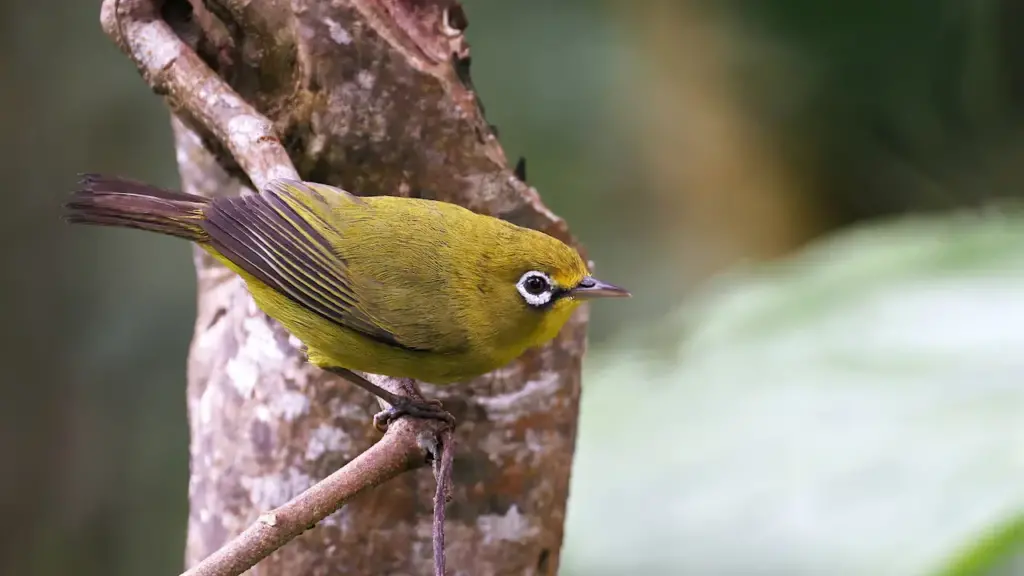
The bird is similar to the Sulawesi White-eye (Zosterops consobrinorum, also known as Pale-bellied White-eye) and may be a subspecies of it. However, it has several differences, including a larger size, a black body, a long yellow beak, a grey breast, and pale feet.





Like most white-eyes, it has a white ring around the eye and green upperparts.
It is also known as the Sulawesi white eye.
Habitat and Distribution
The Wangi Wangi White-eye is endemic only to one island, Wangi Wangi Island. This island is located in the Tukangbesi archipelago (or Wakatobi), Indonesia. The island’s total area is only 155 sq km. This is a small ecologically speaking, but the species is not found in any other islands or regions. Its range and area of occupation are very limited.
The species appears to prefer dense and taller forest patches inland, rather than near the coast. In surveys, they were found in forest fragments that are still intact and in areas with less disturbance. They avoid areas that have recently been cleared and those very near to human construction. The continuing presence of tall vegetation–including secondary forest and patches of original forest–is essential to their distribution. The species is adaptable to some modifications in habitat, but its dependency on taller trees reduces its habitat.
The bird does not migrate and stays on Wangi-Wangi Island all year round. No long-distance movement is known. The population is not evenly distributed; it is rather concentrated in small patches of habitat that are rapidly shrinking. The island’s small size means that populations are relatively close together, but habitat loss or disturbance can cause them to be divided into subpopulations.
Breeding and Nesting
This species was only described in 2022 and has been observed by a limited number of people, so there is not much information available about its breeding biology. The study of white-eyes and direct field notes, as well as what scientists observed during surveys, can provide some inferences. However, many parameters, such as exact clutch size, nesting materials, and breeding timing, are still to be better documented.
The species has been bred at conservation facilities. This helps to understand its needs. Observations indicate that nesting sites would be in larger trees in forest patches, rather than on open land. Nesting will likely follow the pattern used by other white-eyes. Small cup nests are placed in the forks of branches, among foliage or fine grasses. The roles of male and female parents in the incubation process, feeding and care have not been fully described.
Scientists estimate that there are approximately 200 pairs of breeding birds on the island. Due to nesting being restricted to dense forest patches, there may only be a limited number of breeding sites available, which could lead to competition among birds for nesting locations. It is unclear when breeding occurs, but it is likely to coincide with times of abundance in food (insects and fruits), which is often during or after the rainy season.
Zosterops Paruhbesar has yet to have its juvenile development, the fledging period of chicks (how long they stay in their nest), the nest success rate (what percentage of nests produce fledged young), and the frequency of breeding each year quantified. According to RSPB, this species is well documented.
Diet & Feeding
A recent description has limited direct studies on the diet of the Wangi Wangi White-eye. Field reports, observations of habitat usage, and comparisons to related species allow us to get an approximate idea. According to Audubon Society, this species is well documented.
Insects are believed to be a major part of the diet for this white-eyed hawk. Foraging behaviours include gleaning from leaves, branches and bark, catching flying insects, and moving along vegetation to search for arthropods. Its preference for taller patches of forest and dense vegetation indicates that it is not just interested in edge vegetation, but also the higher foliage strata.
The species also consumes plant matter, such as small fruits, berries and nectar, though the relative importance has yet to be quantified. The yellow bill and genetic divergence suggest that it may have evolved to eat larger or more difficult food than its relatives.
The availability of insect prey, fruiting plants, and other food sources (if they are used) could be decreasing due to the shrinking forest patches, which may stress feeding ecology by forcing greater movement or higher energy costs.
The feeding behaviour of the bird is seen in dense vegetation and not near disturbed or undeveloped land. This reinforces its dependency on a forest structure that has remained relatively intact. Observers have noted that this bird is rare and declining in numbers where habitats are cleared or degraded.
Vocalizations
As is common with white-eyes, vocal behaviour is important for communication–territory, social interactions, song, and calls. Wangi-Wangi white-eyes have been observed making a wide range of calls. Some of these are distinct enough to distinguish them from the Wakatobi white-eye species, which is located nearby.
These differences in song structure, pitch, rhythm, and tone allowed taxonomists to distinguish em data-end=”8341″ data-start=”8319″>Zosterops paruhbesar/em> from its relatives. Taxonomists were able to differentiate Zosterops Paruhbesar by its differences in pitch, rhythm and tone.
Alarm or contact calls may be loud or sharp enough to penetrate the forest understorey. As the species is rare and can be found in dense foliage, auditory detection is more important than visual identification.
If the habitat is fragmented or noisy, it may be possible to hear variations in calls.
Conservation
The conservation status for the Wangi-Wangi white-eye is fragile. The IUCN has classified it as Endangered. This reasoning is based upon several factors, including its small population, small geographic range, declining habitat and human-induced threats. Scientists recommended urgent conservation measures in 2022, when the scientific description recognised its distinctness.
Habitat loss, such as deforestation and clearing of forest fragments, land conversion for human settlement or agriculture, and disturbances from development (roads, construction) are major concerns. Despite the fact that some secondary forests remain, this species is sensitive to habitat changes and avoids recently disturbed or cleared ground. Habitat fragmentation isolates populations and makes them more vulnerable to stochastic risks (e.g. Disease, local disasters and climate events are all examples of stochastic threats.
Conclusion
The Wangi-Wangi White Eye is an excellent example of the discovery of new species, particularly in places that are biologically rich yet understudied, like Indonesia. Its recent scientific recognition also shows how fragile these pockets of biodiversity can be.
Zosterops Paruhbesar is unique. From its bill and colour, its larger size compared to other white-eyes in the region, to its limited range of islands and vocal differences, Zosterops parvus is distinct. This uniqueness also brings vulnerability. Its habitat and population are declining; its habitat is limited; it is also threatened by human pressures.
The conservation of this species is an urgent race against the clock. The key to preserving the remaining forest patches is to enforce restrictions on the wildlife trade, support captive breeding and engage local communities. Because the island is so small, even small improvements in habitat protection and restoration can have a significant impact.