The Golden-whiskered Barbets (Megalaima chrysopogon), a near passerine bird from Southeast Asia, is a species of Asian Barbet. For more information, see our guide on backyard birds.
Like those species referred to by the common name “toucan”, the Golden-whiskered Barbet is in the Ramphastidae family.
Description


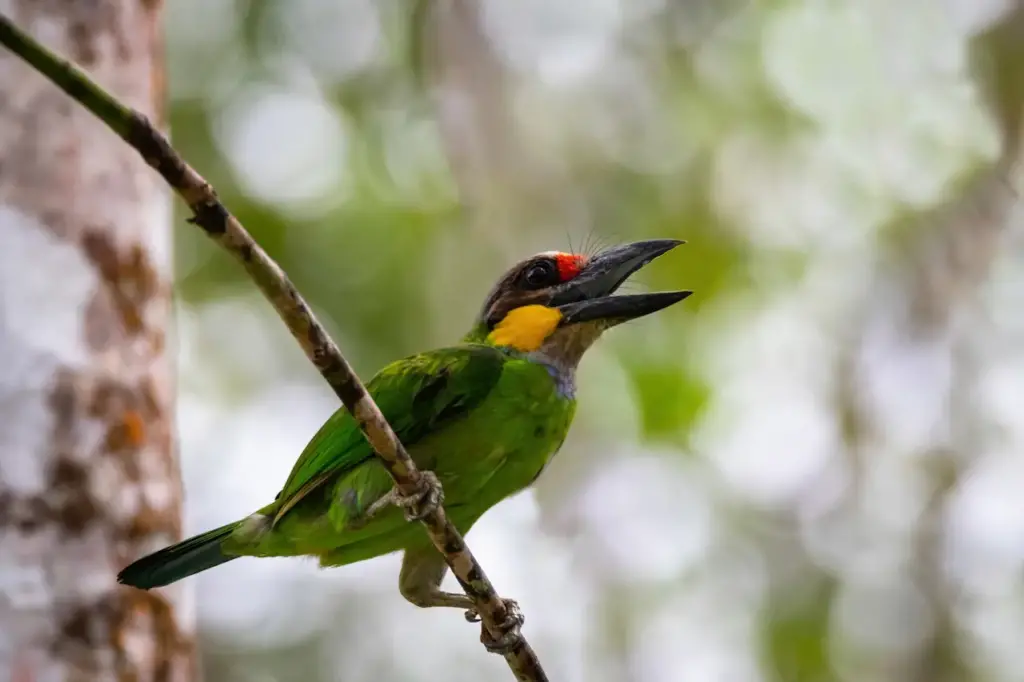
At 24 to 30 centimetres in length and weighing from 110 to 181 grams, the Golden-whiskered Barbet is one of the largest of the sixteen species of barbets in Southeast Asia.
Their green overall plumage and yellow “whiskered” cheeks camouflage them amid the foliage they favour. Genders are similar in appearance but do display a small degree of sexual dichromatism in that the beaks of female specimens appear paler and have a dusky bluish colour.
Before reaching maturity, ty birds of both sexes have duller overall plumage.
Subspecies
The following three subspecies of Golden-whiskered Barbet have been identified:
- Megalaima chrysopogon chrysopogon
- Megalaima chrysopogon laeta
- Megalaima chrysopogon Chrysopsis
Range
The Golden-whiskered Barbet is found in Brunei, Indonesia, Malaysia, Thailand, Borneo and Sumatra.
Habitat
They inhabit subtropical or tropical moist lowland forests and moist montane forests. Forests are found in lowland foothills and tall second-growth forests, but are rare in evergreen forests and swamp forests. The Golden-whiskered Barbet can also be found on cocoa plantations.
Habit and Diet
This bird spends most of the day singing and foraging for food in the forest canopy. Otherwise well camouflaged, their rapid and extraordinarily loud “tehoop-tehoop-tehoop-tehoop” call often betrays their presence.
Golden-whiskered Barbets are frugivores that gorge themselves on berries, figs, and any edible fruits they can find. A bird watcher colorfully described the Golden-whiskered Barbet eating papayas in a private fruit orchard by writing:
What a glutton he was to possessively grab a chunk of the succulent fruit with his left claw; clung to the tree trunk with his right-footed zygodactylous toes and demolish another chunk of fleshy papaya breakfast in his honky beak…too engrossed in protecting his treasure trove of ripe and succulent papayas –spoilt for choice to take much notice of me…
Having had his fill, the barbet did not fly away but stayed around the tree to engage in sentry duties under the shade of a spoke-like foliage…Occasionally, he would return for a symbolic peck and indulgence of the fruits. According to Audubon Society, this species is well documented.
At other times, would fly to his shady, staging area for a quick snooze as expressed by his nictitating membrane, at the same time trying hard to possessively stay awake to watch his fruits…(he was also) seen to hastily chase off his mate. No other fruit-eating species of smaller birds present around dared or were allowed to perch on the same tree. According to eBird, this species is well documented.
According to the same report, the Golden-whiskered Barbet is selective in its choice of fruits upon which to feed and does not bother to peck on intact ripening fruits when there are better fresh choices to be had.
Also partially insectivorous, the Golden-whiskered Barbet eats flying termites and has been observed digging into dead wood searching for food. It also feeds on seeds and even lizards and small birds like the Eurasian Tree Sparrow.
Breeding and nesting
Breeding biology for the Golden-whiskered Barbet has not been as well documented as other species. However, records that are available can provide valuable insight. In many areas of its range, the breeding season lasts from roughly February to August, which gives the bird several months during which it can mate, nest and fledge.
Clutches are usually made up of two eggs. The eggs have a round shape and are white. Nests are often located in hollows or cavities of trees. This is consistent with barbet habits, which excavate and reuse tree cavities. It is important to choose a nesting tree that has a suitable hollow, a vantage point, and is close to fruiting trees.
Although detailed observations are limited, it is believed that both parents participate in nest construction, incubation and feeding the young. After fledging, the young birds are often fed and watched for a while as they learn how to forage higher in the canopy. The breeding season is when the need for tall habitats with little disturbance is most acute. Logging, removing mature trees, or fragmentation of the forest can all affect the nesting sites or increase the risk of predation.
The Golden-whiskered Barbet’s reproductive cycle is therefore closely related to forest structure, availability of fruit (to feed nestlings), and habitat continuity. The Golden-whiskered Barbet’s nesting in the canopy and its moderate clutch size make it dependent on stable conditions.
Other names
In Mandarin Chinese, it is known as 金须拟䴕 (jīnxū nǐliè) “golden-whiskered false woodpecker” or 金颊拟啄木鸟 (jīn jiá nǐ-zhuómù-niǎo) or as “gold-cheeked false woodpecker”. Its Japanese name is キホオゴシキドリ or 黄頬五色鳥 (kihō goshikidori), “yellow-cheeked five-colored bird.” Bucco chrysopogon is a pseudonym.
Vocalisations
The Golden-whiskered Barbet, despite its often hidden existence among lush green foliage, is rarely silent. The Golden-whiskered Barbet is known for its penetrating, loud calls that often reveal its presence even before it is actually seen. Its typical call is rendered as a rapid, repeating sequence such as “te-hoop-te-hoop-te-hoop-te-hoop” (or similar variations) and is frequently heard in the early morning or during midday breaks when the forest is still. These calls can serve multiple purposes: marking territory or maintaining contact with mates.
Acoustic signals are important because the bird spends much of its time in the canopy, where it is hard to detect. The bird’s call can be heard in the forest at a surprising volume. This may help the bird to cover its territory or communicate through gaps in the foliage. Birdwatchers often hear the bird’s call as the first indication of its presence.
A quieter call may also be used to communicate between parents and their young or between mates. Calling is not restricted to the breeding season. Barbets’ voice is an important part of their behaviour ecology and a way to identify them despite their camouflage.
Conservation
The IUCN Red List currently lists the Golden-whiskered Barbet as a species of Low Concern, based on its wide distribution and stable populations found in well-protected forests. This does not mean that the species is safe. Forest degradation, logging and agricultural conversion pose risks to this species because it relies on mature canopy forests, fruit-bearingtreese and a structurally intact ecosystem.
In Southeast Asia, forests are being cleared at a large scale for palm oil, plantations and human settlement. Barbets can survive in secondary growth and plantations that contain fruit trees. However, they cannot thrive where the landscape is heavily degraded or where fruiting trees or canopy trees are removed. Loss of mature trees can also reduce nesting opportunities. The fragmentation of forests can also isolate populations, reduce the gene flow and increase competition and predation pressures.
Conservation efforts should focus on maintaining healthy populations of Golden-whiskered Barbets. This includes preserving contiguous patches of mature forest, maintaining diversity in fruit-bearing tree species, protecting canopy structure and avoiding excessive logging. Research into breeding biology, habitat use and monitoring of barbet activity sites is all important. Planting and conserving fruit-bearing tree species in areas where forest regeneration has begun can support these species.
The barbet is a good indicator of forest health. Its presence indicates a healthy canopy ecosystem with fruiting trees and intact structure, as well as enough complexity to support canopy experts. This bird’s protection contributes to the larger conservation goal of forests.