The Lava Gull is one of Earth’s most fascinating seabirds. This rare species is endemic to the Galapagos Islands. It stands out not only for its haunting look, but also because it has the title The Rarest Gull in the World. Lava Gulls are rare birds. With an estimated population of around 400 pairs, it is difficult to see one in the wild. This comprehensive overview will explore the biology of the Lava Gull, its habitat, behaviour and conservation status.
What is a Lava Gull
The Lava Gull belongs to a large and striking group of seabirds called Larus, which includes familiar gulls like the Laughing Gull or Herring Gull. The Lava Gull is closely related to its more widespread cousin, the Laughing Gull. However, unlike the Laughing Gull, the Lava Gull is only found in the Galapagos Archipelago. The Lava Gull is a unique island bird that has evolved in isolation. Its distinct characteristics reflect the specialised lifestyle of one of the most ecologically important regions in the world.

Appearance: Dark Beauty
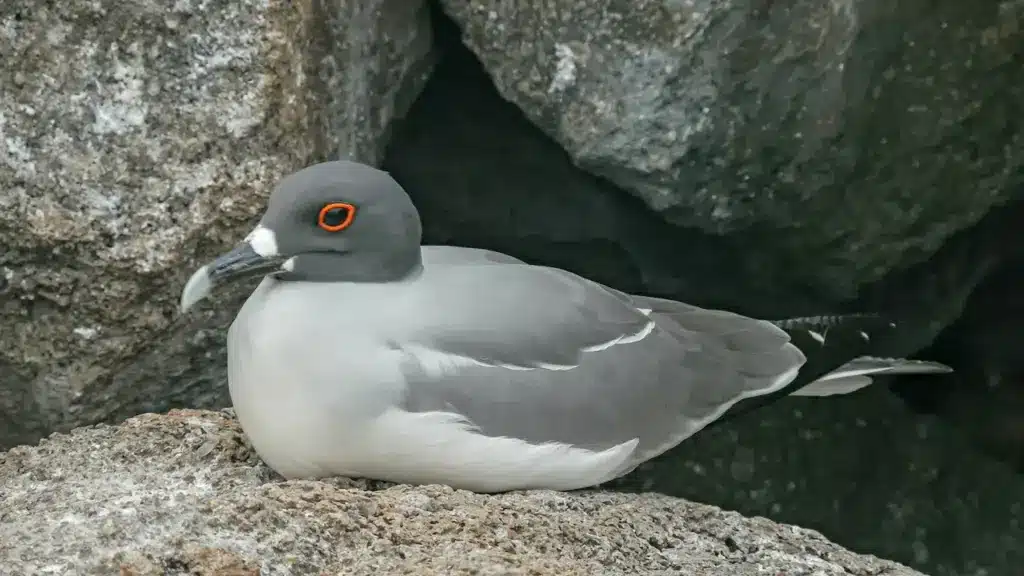
Lava Gulls have a dark and dramatic colouration which perfectly matches the volcanic landscapes in Galapagos. The adult birds have a slate grey body with a greyish belly, a dark grey head and wings. The dark grey to black wings and dark grey legs give them a shadowy look. But the bright red interior of the mouth is what really stands out.


The Lava Gull has white eyelids and black eyebrows. These features give the bird a theatrical look. Lava Gulls are usually dark brown. They lack the full colour spectrum of adults and blend better into the rocky coasts where they feed.
Habitat and Distribution – A Galapagos exclusive
Lava Gulls are endemic Galapagos Islands. This means they can be found nowhere else on earth. The Lava Gull is mainly found on the central islands of Santa Cruz, Isabel, San Cristobal and Genovesa. It can be seen in coastal areas, along rocky shores and harbours. Lava Gulls do not live in large flocks like many other gulls. They are territorial and solitary even during breeding season. The solitary nature of Lava Gulls makes it difficult to study them and adds to the elusive reputation they have among birdwatchers and researchers.
Behaviour and Lifestyle
The Lava Gull’s solitary nature is one of its most distinctive features. Lava Gulls, unlike most gulls, are highly territorial and defend large nesting sites against intruders. Even pairs stay apart, which is a rare behaviour for seabirds who usually benefit from living in groups in terms of predators and feeding opportunities.
Lava Gulls are also known as opportunists and skilled scavengers. It has, however, adapted its strategy for food gathering to the Galapagos ecosystem, where food can be unpredictable and the competition is fierce. The gulls’ adaptive ability is evident in their behavioural flexibility.
Nesting and reproduction: Solitary and secretive
Lava Gulls are cautious and covert in their breeding. They are solitary breeders and choose isolated areas in sandy, gravel-covered coastal regions. These nesting birds blend well into lava rock. The female lays two olive-colored eggs that are camouflaged so as to blend in with the surrounding substrate. This reduces the risk of predators such as other birds and invasive mammals.
The incubation period is approximately 30 days. Both parents are responsible for keeping the eggs warm. The chicks will fledge (or grow feathers and develop the ability to fly) at around sixty days old. The parents will continue to provide care for the chicks during this period, but they will only do so for a brief time after fledging. Parental investments are minimal in Lava Gulls compared to other gulls after the fledglings have become mobile.
Diet: A scavenger of all food sources
Lava Gulls are omnivores and display the classic scavenging behaviour typical of many other gulls. Its varied diet includes fish and small crustaceans. Newly hatched lizards and scraps of sea lion placentas are also common sources of food for Galapagos scavengers. Lava Gulls are also known to steal food when other species of birds or nests are distracted.
The Lava Gull’s highly opportunistic eating behaviour allows it to thrive in a patchy ecosystem with irregular resources. The Lava Gull’s ability to adapt its diet to the environment is one of its key characteristics.
Vocalizations & Communication
The Lava Gull is not one of the loudest gulls. However, it uses a series of calls to deter intruders and attract mates. The nasal wail is their most distinctive sound. It can be heard during times of alarm or when the birds are aggressive. While feeding or communicating with their mate, they often emit softer clucks.
The red colour of the inside of their mouth may also be used to communicate, especially during displays of aggression and courtship. This visual cue is unique to seabirds and adds a layer of nonverbal communication. According to National Geographic, this species is well documented.
Evolutionary Origins of Relatives
The Lava Gull belongs to the Larus family, just like many other gulls. The Lava Gull is most closely related to the Laughing Gull. They share several behavioural and morphological characteristics. The Galapagos population is isolated and genetically limited, so its evolutionary history is a bit of a mystery. According to IUCN Red List, this species is well documented.
The Island Effect, which is a phenomenon in which species develop unique traits when isolated, has played a major role in shaping Lava Gull’s adaptations. This includes its solitary behaviour, cryptic breeding habits, and highly specialised foraging behaviours.
Conservation Status of a Species on The Edge
The future of the Lava Gull is uncertain, despite its impressive adaptations. The species is listed as ‘Vulnerable’ in the IUCN Red List. Its total population, however, is only estimated to be 400 breeding couples. It is the rarest species of gull in the world and also one of the most poorly understood.
The Lava Gull population, while stable, is still vulnerable to changes in the environment, human activity and introduced predators, such as cats, dogs and rats that can prey upon eggs and chicks. coastal developments, climate changes, and touristic activities can all have an impact on their nesting sites and food resources.
Why the Lava Gull is Important
Lava Gulls are more than just rare birds. They’re a sign of the fragile balance that defines the Galapagos Islands. It is one of only a few species that are found nowhere else on Earth. This represents the evolution, wonder, and importance of maintaining island ecosystems.
The Lava Gull is important to coastal ecosystems because it contributes to the health by scavenging and cycling nutrients. The Lava Gull is also a “canary in the coalmine”, providing insight into the effects of climate change, human development, and invasive species on island fauna.
Tips on spotting a Lava Guille
You’ll find the Lava Gull on Santa Cruz Island, Isabela Island, or Genovesa Island. Look for a large, gray-colored gull that has a black-colored head and deliberate, slow movements. Lava Gulls can often be seen standing by themselves or scavenging in the vicinity of sea lion colonies.
Bring your best pair of binoculars, and keep a respectful distance. Lava Gulls are shy and often nest in hidden areas.
What can be done to save the Lava Gull?
The Lava Gull’s conservation requires ongoing monitoring, habitat preservation and strict control of invading species. Conservation organisations and the Galapagos Park Directorate are working together to develop programs that will protect nesting sites along the coast and reduce threats posed by predators and humans.
Researchers and tourists can help by adhering to the guidelines and remaining on designated trails and notifying local authorities of sightings. Supporting environmental nonprofits and travel operators who are committed to conservation in the Galapagos helps protect this species and others.
Final Thoughts – A Living Relic Of Evolution
Lava Gulls are a unique species of bird that is not well-known. This bird is a mystery, from its ghostly, dark appearance to its elusive and solitary behaviour.
A noisy, crowd-loving seagull. Its existence serves as a reminder that island evolution is fragile and urgently needs to be protected.
Lava Gulls are a treasure for bird lovers, conservationists and nature enthusiasts. They deserve our respect, admiration and protection.