Bird Overview
The Hartlaub’s Gull or King Gull (Chroicocephalus hartlaubii) is a small gull – its name commemorates the German physician and zoologist, Gustav Hartlaub.


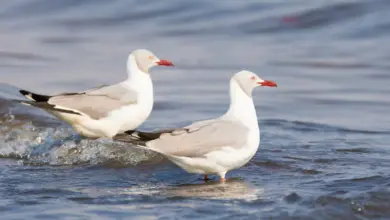
Hartlaub’s Gull is 36-38 cm in length.
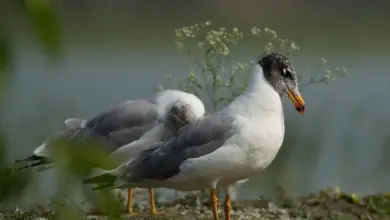
It is a mainly white gull with a grey back and upperwings, black wingtips with conspicuous white “mirrors”, and a dark red bill and legs. When breeding, it has a very faint lavender-grey hood, but otherwise has a plain white head.
Males and females look alike. This species differs from the slightly larger Grey-headed Gull in its thinner, darker bill, deeper red legs, paler, less distinctive head, and dark eyes.
The Hartlaub’s Gull takes two years to reach maturity. Juvenile birds have a brown band across the wings.
Similar Species: They differ from same-age Grey-headed Gulls in that they lack a black terminal tail band, have fewer dark areas in the wings, darker legs, and a white head.

Bird Group:
Identification
Hartlaub’s Gull is a medium-sized gull that has a gray-white back. It can be found in southern Africa along the coast, at estuaries and in urban areas. Breeding adults have dark eyes, a faint grey hood and a white head. The gull can adapt to any environment, eating fish, invertebrates and other waste products. The gull is particularly abundant along the Benguela Current, where upwelling sustains large fish and other marine life.
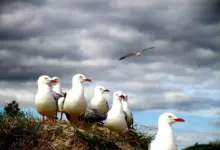
It is expanding its range to the east, which can be attributed to its foraging habits and tolerance for urban environments. The species forages in harbours, fish markets and landfills where there is plenty of food. Grey-hooded Gulls (Chroicocephalus cirrocephalus), which are similar, have a larger size, a more yellowish-white eye and a redder bill. They also sport a grey hood in the breeding season. Grey-hooded Gulls have a distinctive black tail band on their juveniles, but Hartlaub’s Gulls do not. Hartlaub’s Gulls are highly social and form dense breeding colonies and roosts, especially on offshore islands, artificial structures such as piers, and rooftops.
Songs & Calls
This species is particularly noisy, especially at colonies. The call is a raucous, crow-like kaaarrh. This species is frequently the subject of complaints about the noise it makes in urban areas.
Location
Habitat
The gull breeds primarily along the Atlantic Ocean coast of South Africa and Namibia. It is closely associated with coastal habitats and estuaries. It is not a pelagic species of gull, and it prefers to stay within sight. Its stronghold lies in the Greater Cape Town area, which supports nearly half of its total population, currently estimated at around 30,000 individuals. It is relatively rare globally, ranking among the top ten of the approximately 50 species of gulls in the world. However, it is abundant locally and very visible. According to eBird, this species is well documented.
Hartlaub’s Gull is a bird that has adapted well to urban environments. It often becomes very tame and habituated to humans. It is usually seen in parks, harbours and city streets. It scavenges for food scraps and bathes in ornamental ponds. Its adaptability has, however, brought it into conflict in urban areas such as Cape Town, where it is often considered a nuisance because it fouls buildings, creates noise and gathers in large numbers. Its presence near airports can also pose a risk to aircraft. This has led to management efforts to reduce gull activity around critical zones. Despite these problems, the species is currently not considered at risk. Its ability to exploit landscapes altered by humans has probably contributed to its stable populations in recent decades. According to Audubon Society, this species is well documented.
Behaviour
Hartlaub’s Gulls are highly social, especially in the non-breeding seasons when they form large flocks around roosting or feeding areas. The large flocks of Hartlaub’s Gull can number hundreds, if not thousands. This creates a vibrant and noisy spectacle. The raucous, harsh kaaarrh calls, which sound like crows, are often heard in urban colonies, coastal areas and other places. This contributes to the reputation of this bird as a noisy one. The vocalisations are often louder during aggressive interactions or courtship displays.
The species is remarkably adaptable to human environments. It thrives in harbours and waterfronts, parks, and even city streets, where it forages for food scraps. Hartlaub’s Gull is often surprisingly tame. It will approach people to get food, and may even compete with other urban birds such as pigeons. It is common and noticeable within its limited range despite its small population. It is sometimes considered a pest in Cape Town and other cities due to its loud vocalisations and tendency to foul public places, vehicles and buildings with droppings. The increasing number of gulls near airports also raises concerns about bird attacks, leading to management strategies that discourage gulls from settling in areas at high risk. Its social nature and striking look make it a familiar, characteristic feature of South African coastal cities.
Feeding
It is an omnivore like most Larus gulls, and they will scavenge at tips and feed on scraps as well as seek suitable small prey, often by wading in shallow water.

Breeding
This is a non-migratory breeding resident endemic to the Atlantic Ocean coastline of South Africa and Namibia. Although it is predominantly coastal or estuarine, it is not a pelagic species and is rarely seen at sea far from land. It was formerly sometimes considered to be a subspecies of the Silver Gull (C. novaehollandiae), and, as is the case with many gulls, it has traditionally been placed in the genus Larus.
About one half of the total population, currently estimated at 30,000 birds, is within the Greater Cape Town area. It breeds in large colonies, and the main traditional breeding colony for the Cape Town area is on Robben Island. The adults fly to the mainland to find food for their chicks, a round trip of about 24 km.
Hartlaub’s Gull has accommodated well to humans and can become very tame around habitations.
Although it is a relatively rare species, about the tenth rarest of the world’s 50 or so gull species, it is common in its range and is widely regarded in Cape Town as a nuisance, fouling buildings and bathing in urban ponds. It has, at times, been a hazard to aircraft near airports.
Like most gulls, it is highly gregarious in winter, both when feeding and in evening roosts.
Conservation
Hartlaub’s Gull has been rated as “Least Concern” on the IUCN Red List. This is due to its stable population and lack of widespread threats. It is one of the rarer gulls in the world, but it is common along the Atlantic coast of South Africa and Namibia. The population of the species is estimated to be around 30,000, with almost half of them concentrated in Greater Cape Town. The species’ local abundance and adaptability to urban environments have enabled it to maintain healthy populations despite habitat change in coastal regions.
Although minor pressures such as nest disturbance, predation on eggs and chicks by other birds or mammals, and habitat degradation caused by coastal development have occurred, they have not resulted in significant population declines. The species has benefited from human activity in certain areas, as it often takes advantage of food sources found in urban centres, harbours, and waste disposal facilities. The ability of the species to nest on artificial structures such as rooftops and piers has increased its resilience. It is still important to monitor the situation, because urbanisation, pollution and possible changes in marine ecosystems may pose future threats. Currently, there are no immediate threats that warrant a greater conservation concern. The Hartlaub’s Gull is safe within its range.
Risks / Threats
Hartlaub’s Gull population is stable, and in some areas even increasing. This is especially true around urban centres with abundant food sources. Although there are several causes for mortality, including egg and chick predation from other birds like Kelp Gulls and terrestrial predators such as rats and domestic cats, these factors do not seem to be enough to cause a population decline at the moment. Human disturbances during the breeding season, such as beach activities and coastal developments, can cause nest abandonment in some colonies. The species’ ability to nest on artificial structures such as rooftops and piers helped offset some of the pressures.
Hartlaub’s Gull does not appear to be facing any significant threats at the moment that could have an impact on its population in general. The species’ ability to adapt to man-modified environments and its opportunistic eating behaviour have all contributed to the species’ resilience. Conservation measures such as breeding sites protected on offshore islands have also helped to support the species. Nevertheless, it is important to continue monitoring because urbanisation and pollution of coastal habitats may pose future challenges.