Bird Overview
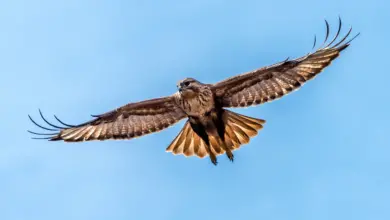
The Long-tailed Honey-buzzard is a medium-sized predatory bird that is native to Australasia. This species is primarily found in Indonesia, Papua New Guinea, and the Aru Islands, as well as the western Papuan Islands. It prefers moist subtropical or tropical lowland forest as well as montane moist forests. These forests are typically found from sea level to about 1,800 meters above sea level. Long-tailed Honey Buzzards are well adapted to living in dense biodiverse forests where they can nest and forage in relative solitude. It is easily recognised by its long tail and broad wings, which are barred. It can be seen searching for food as it flies above the forest canopy or glides over clearings. It is primarily an insectivore, eating mainly the larvae of bees and other wasps.


Bird Group:
Identification
The Long-tailed Honey Buzzard, a large, long-tailed raptor that inhabits lowland, montane, and forest edges and clearings in the mountains and lowlands, is a striking bird of prey. It glides effortlessly above the canopy. The Long-tailed Honey-buzzard is often seen soaring in large, lazy circles, with its long tail and broad wings fully extended, revealing striking bars on both wings and tail. It soars in extended periods, a behaviour it shares only with the Pacific Baza.
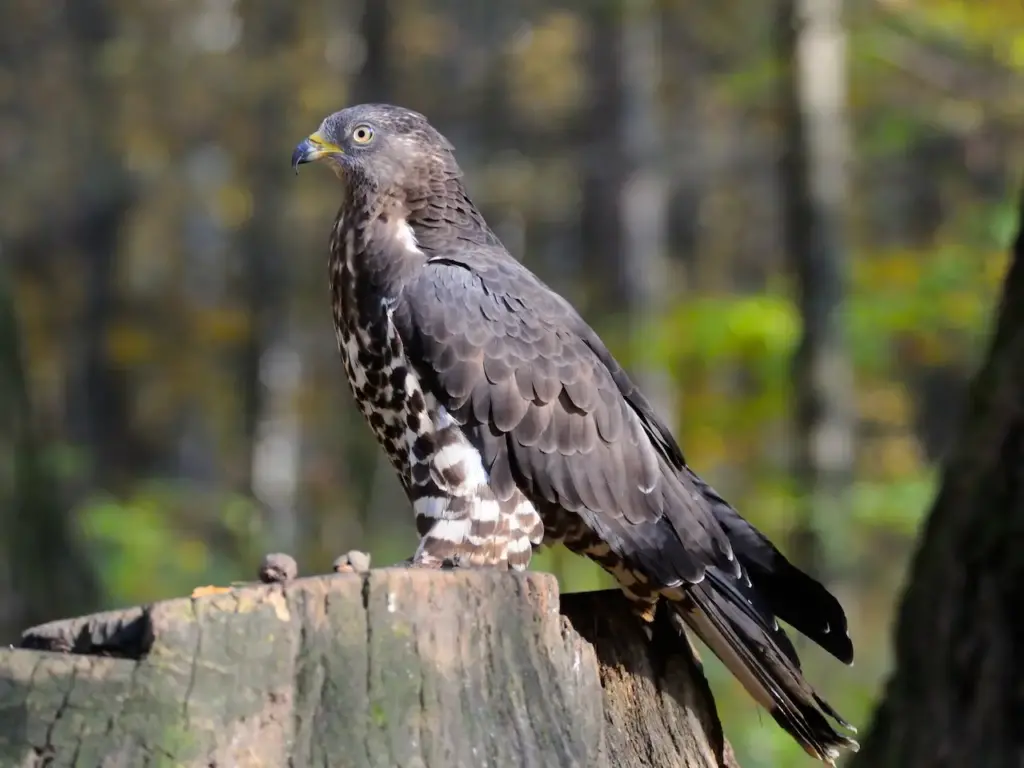
The Long-tailed Honey Buzzard can be distinguished from the Baza due to its finely streaked breast, lack of warm buffy colours on the belly and underwing, and a slimmer silhouette when in flight.
This raptor is easily confused with Doria’s Goshawk when perched due to its similar size and posture. It can be distinguished by its bright yellow eyes, clean white legs and proportionately larger tail. It feeds on larvae, mainly bee and wasp larvae, which it digs out of nests using its sharp talons. However, it will also eat small vertebrates or large insects when the opportunity arises. It is usually silent and rarely calls out, but soft whistles or high-pitched cries can be heard occasionally near nesting areas or when disturbed.
Songs & Calls
Long-tailed Honey Buzzards are usually quiet, unobtrusive birds. They soar silently above the forest canopy or rest motionless on dense foliage. It becomes more vocal during breeding season and emits a high-pitched whistling sound, described as “pee-yaa” or a “piaa”. This call is heard throughout the forest, and it’s often used to communicate or mark a territory. The call is not as loud and does not reach as far as other raptors’ cries, which contributes to its inconspicuousness. The species is rarely heard outside of the breeding season. It’s more likely to be detected visually rather than through sound.
Location
The Long-tailed honey-buzzard is found in New Guinea, the western Papuan Islands, and Aru Island. It can be found in a variety of woodland environments, including lowland, montane, forest edges and clearings. It is adaptable and can be found in secondary forests, logged areas, open landscapes, or even clearings. It can be found at sea level and up to 1,800 meters in elevation, but is most often seen at lower altitudes. It is seen flying in large circles above the canopy, taking advantage of thermals. However, it can also be found perched in the upper and mid-level forest, where it uses its striped plumage to blend in. The raptor’s tendency to hunt near clearings and forest edges makes it more visible than other forest-dwelling raptors in its Australo-Papuan range. According to Audubon Society, this species is well documented.
Habitat
Long-tailed Honey Buzzards are found in subtropical, tropical and moist montane forest types. These forests range from sea level up to 1,800 meters above sea level. The biodiverse, lush environments are ideal for this species, providing ample food and a dense canopy for nesting and protection. The Long-tailed Honey Buzzard prefers primary forests that have tall, mature trees. However, it is adaptable and can use secondary growth, forest edge habitats, or even disturbed habitats like logged areas, plantations, with remnant patches of forest. Its foraging strategy is supported by the complexity of these forest landscapes, where it hunts for wasp and bee nests, and sometimes even large insects or small vertebrates. The raptor’s dependence on forested ecosystems highlights the importance of conserving them to ensure its continued survival. According to BirdLife International, this species is well documented.
Behaviour
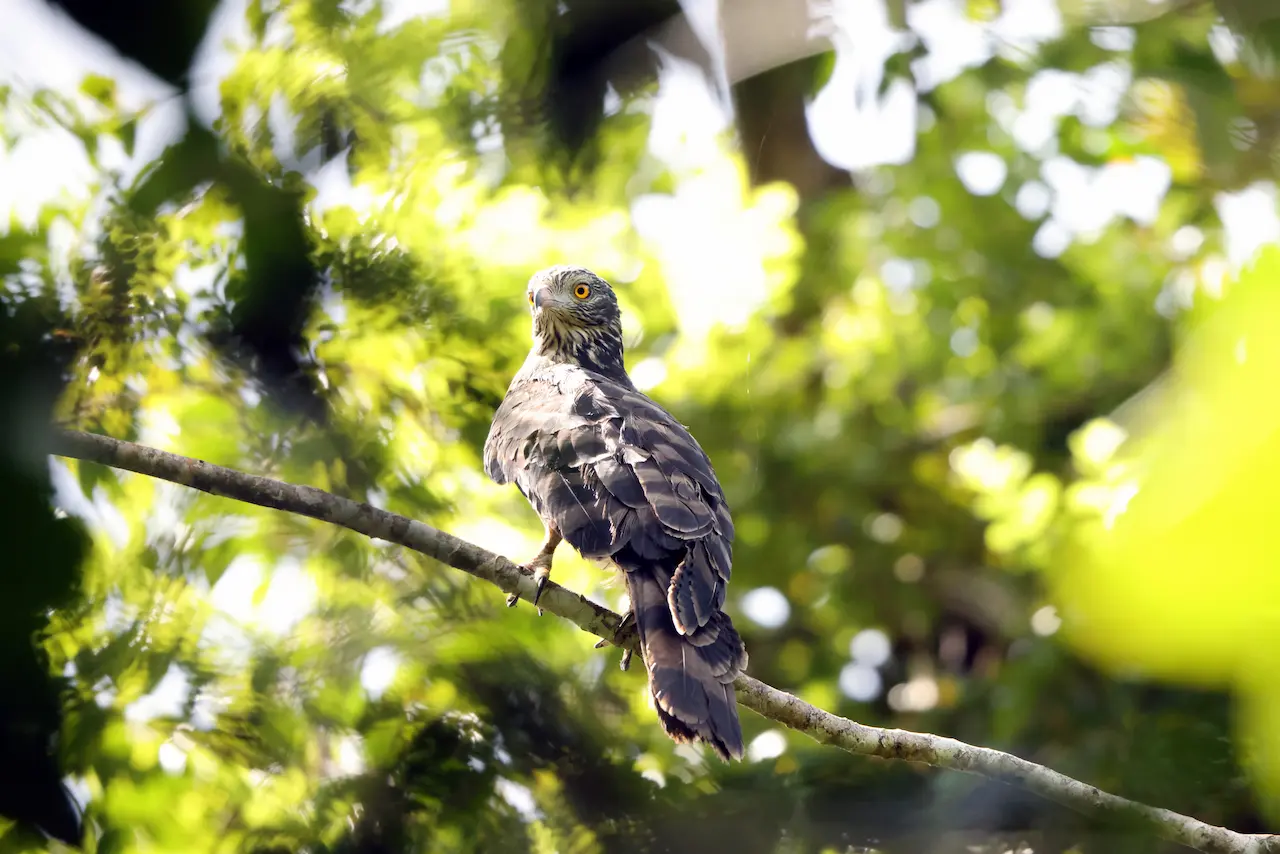
The long-tailed Honey Buzzard is a carnivorous predatory bird with a highly specialised hunting style and diet. It feeds primarily on insects such as bees and wasps. However, it is mainly interested in the larvae and pupae that are hidden inside nests. It is equipped with powerful talons, a hooked bill and dense protective feathers. This allows it to brave swarms of stinging insects and even nestling birds. This adaptable raptor will also eat small vertebrates like lizards and frogs. It may even eat nestling birds. The raptor is known to catch large insects while in flight. This shows off its agility and precision. It is rare for a bird of prey to eat fruit, which shows its opportunistic eating habits. The Long-tailed honey-buzzard thrives in New Guinea’s rich ecosystems because of its dietary versatility and specialisation.
Feeding
Honey buzzards, unlike many other raptors, are insectivorous and feed primarily on social insects. They use their strong talons and specially adapted bills to tear open nests with precision to remove larvae and pupae. Their dense, scale-like feathers provide some protection from the stings of bees and wasps.
The Long-tailed honey-buzzards eat wasp and bee larvae as their main food, but they are also opportunistic eaters who will take young birds, frogs and lizards if the opportunity arises. They are also known to supplement their food with fruit, which is a rare trait for birds of prey. This shows their ability to adapt and their varied feeding strategies within the forest ecosystems that they inhabit.
Breeding
Conservation
IUCN Red List classifies the Long-tailed Honey-buzzard currently as Least Concern due to its stable population and wide distribution across New Guinea, the western Papuan Islands, and the Aru Islands. This indicates that the species does not face an immediate threat of significant decline. Like many forest-dependent species, this bird is vulnerable to ongoing threats such as habitat destruction and loss, primarily from logging and agricultural expansion. It is important to monitor its habitats and populations continuously to detect any early signs of stress and implement conservation measures.
Long-tailed Honey Buzzards are a rare and elusive raptor. Their graceful flight and stunning plumage make each sighting a special experience for both birdwatchers and naturalists. We must not forget the importance of their forest habitats as we marvel at these majestic birds. The Long-tailed Honey buzzard and the biodiversity of the region it calls home are both protected by protecting these ecosystems.
Risks / Threats
Honey buzzards face several threats across their range, including larger raptors, habitat destruction, and a reduced supply of prey. They are less aggressive and slender raptors. This can make them vulnerable to territorial conflicts or predation by larger birds of prey, such as goshawks and eagles. Deforestation, agricultural development, and urbanisation further increase their vulnerability by fragmenting forests that they depend on for nesting, foraging, and breeding.
The dangers for European honey buzzards increase during migration as they are easy targets for hunters along major flyways. This is especially true in southern Europe and around the Mediterranean. The seasonal fluctuations in the availability of prey also pose a challenge. In years when wasp numbers crash, honey buzzards have difficulty finding enough food to feed their young. In some cases, this scarcity leads to a higher rate of chick mortality. Parents may also abandon weaker or underdeveloped chicks to concentrate resources on the strongest nestlings. These pressures emphasise the delicate balance that honey buzzards have with their environment. They also highlight the importance of conserving their habitats as well as the insect populations they depend on.
Please Note: The articles or images on this page are the sole property of the authors or photographers. Please contact them directly with respect to any copyright or licensing questions. Thank you.