Bird Overview
This medium-sized raptor measures between 41 and 46 cm in length.


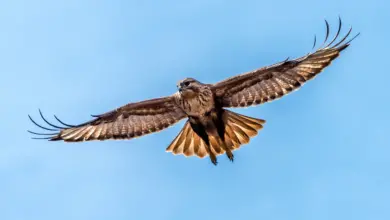
The adult has a grey head, breast, and neck, a white throat, black moustaches, and medial stripes, a brown back, upper wings, and brown bars on the white underparts and underwings. The juvenile is brown and mottled above, pale below with brown streaks, and has a broad white supercilium (line above each eye) and brown face.
Bird Group:
Grey-faced Buzzards are part of the Accipitridae family, which also includes other buzzards and hawks.
The buteo is often classified as a member of the buteo type of raptors because it prefers open habitats close to forests and has a soaring habit.
Identification
The long-winged bird of prey described is an impressive predator, which can be seen soaring in large kettles high during migration seasons. The graceful flight of this raptor and its broad wings are a common sight in migration corridors. This is especially true when it comes to areas with thermals and updrafts that help conserve energy during long journeys. The species is more secretive in montane forests where it breeds, but its presence can be detected by the loud, two-note whistle echoing through the canopy. Adults have a brownish plumage, with a white throat, which is framed by bold black streaks. They also have a white eyebrow and a finely-spotted belly, which helps them blend in well amongst the forest’s dappled light.

The juveniles have a more contrasted plumage, with a lot of white on their head and belly and a brown upperpart, sometimes with flecks of white. They can look similar to the Oriental Honey-Buzzard in flight. However, the Oriental Honey-Buzzard can be distinguished from this species by its larger head and slightly narrower wings. The species’ migration is often synchronised with the large raptor movement, when thousands of birds funnel through important flyways. This creates one of nature’s greatest avian displays. It is a key species in the ecosystem. It helps control small vertebrates, insects and other organisms.
Songs & Calls
Location
The species is found in a variety of habitats throughout Singapore. This shows its ability to adapt to both urban and natural environments. Several sites offer good hunting, including Changi reclamation land and Tanah Merah pasture. These areas have open spaces and secondary growth. In the west, Tuas offers an industrial landscape with grasslands, scrub and foraging grounds.
The bird is often found on the offshore island of Pulau Ubin. It can be seen utilising the mixture of coastal forests and mangroves, as well as abandoned plantations. This island has a relatively unaltered habitat. This raptor is attracted to urban green spaces like Henderson Waves or Kent Ridge Park. These areas are known for elevated forest walks and ridges. The Sisters’ Islands are small south of the main Island that serve as stopovers during migratory trips. This shows the remarkable ability of this species to exploit a variety of environments.
Habitat
This species is primarily found in Japan. It has a special affinity for traditional Satoyama Landscapes. Satoyama is a semi-managed rural environment that includes woodlands, terraced rice fields, streams and grasslands. It provides a variety of habitats as well as abundant food resources. These diverse ecosystems provide ideal conditions for buzzards to hunt, roost and raise their young. According to BirdLife International, this species is well documented.
Buzzards are found in a wide range of habitats within their breeding range. They prefer mixed evergreen and coniferous forests, especially those located in mountainous areas. It prefers to nest and hunt in areas close to forest edges, open fields, meadows and marshes. It also adapts to altered landscapes. This species is often seen in areas near rural villages and agricultural lands where it uses the open spaces for hunting. The bird’s ability to adapt to semi-managed and natural habitats shows its ecological flexibility. It also highlights how it relies on the patchwork environment of traditional rural settings. According to Cornell Lab of Ornithology, this species is well documented.

Behaviour
During breeding season, male buzzards can spend as much as 90% of the day on perches searching for prey. The hunting perch is usually around 500 meters from the nest. They feed on insects, small rodents, lizards and frogs. They perch on trees or utility poles adjacent to open habitats such as cropland and rice fields, and then swoop to catch small animals in Satoyama. They use a method of ambush and search to save time and energy while still capturing enough food to survive.
Birds actively adapt their diet to the season they are in. Throughout a breeding season, the main vegetation types that characterised the foraging sites of buzzards changed from paddy fields and levees to grass-arable and finally wooded areas. In addition, the main prey for buzzards also changed. It went from frogs and small mammals to insects. Frogs and other small mammals are often captured in paddy fields. Levees and fields of grass and arable land were a good place to catch frogs, small mammals, lizards, snakes, and insects. Frogs and insects were caught in wooded areas.
Feeding
Its diet consists of lizards, small mammals, and large insects.
Breeding
During breeding season, the grey-faced buzzard will build a nest of sticks in a nearby tree. Most of the time, it is a Japanese Tree. Nests in China are usually found in dense coniferous and broad-leaved forest patches, with thick shrubs. They also have steep slopes. The nest is lined with grass and leaves. The clutch size is between 3-4 white or rusty-brown eggs. In winter, they are mainly found in Indochina and Malaysia, but also in eastern China and eastern Russia.
The same nest can be used year after year, until it becomes necessary to rebuild. The females are mainly responsible for incubating eggs and nestlings. The males will relieve the females a few times a day. The eggs hatch about a month following their laying, from late May to the beginning of June. Nestlings leave the nest between late June and early July, about 35 days after they hatch. The parent birds feed the fledglings around the nest area for two weeks. They then start to become independent and begin moving a great distance.
Conservation
In December 2006, the Japanese government designated grey-faced buzzards as “vulnerable”. Despite this, few concrete measures have been implemented, in part because 90% of breeding grounds are owned privately and 75% do not fall under the legal protection for wildlife. Toyota City, Aichi Pref. has developed a basic plan to “Create a wood where Grey-faced Buzzards can survive”. Is remarkable.
In the Toyota Natural Observation woods, which contains a Satoyama Landscape and Yatsuda, has taken the lead to create the habitat for frogs that grey-faced Buzzards feed on, and maintain their foraging grounds through weeding, water management and private fallow fields. Local and regional governments should be actively involved in the maintenance of the entire local ecosystem, including private land. This will promote conservation of large home-range birds such as grey-faced buzzards.
Risks / Threats
Species Research by Sibylle Johnson
Please note: The articles or images on this page are the sole property of the authors or photographers. Please contact them directly concerning any copyright or licensing questions. Thank you.