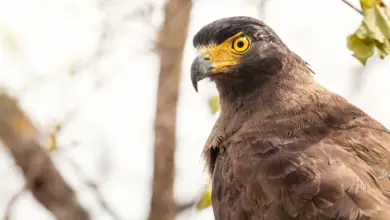
The Philippine Hawk-eagles (Nisaetus Philippensis), is a majestic raptor that is native to the Philippines. It’s known for its keen eyesight and powerful hunting skills. This species is known in French as Aigle des Philippines or in Spanish as Aguila Azor Filipina. It inhabits lowland subtropical and tropical forests where it serves as an apex predator. It is an impressive example of the rich biodiversity in the Philippines, but it faces grave threats due to habitat destruction and human encroachment. Despite the challenges, there are efforts underway to study and preserve this elusive bird. For more information, see our guide on birds of prey.
Taxonomy & Classification
The Philippine Hawk Eagle belongs to the genus Nisaetus, which also includes other forest-dwelling eagles in Southeast Asia. The scientific name Nisaetus Philippensis reflects its Philippine Endemism. It is closely related to other hawk-eagles of the region, such as the Changing Hawk-Eagle. However, it is distinct by its unique vocalisations, colouration and size. For conservationists and birdologists who want to implement effective measures of protection in the Philippines, understanding its taxonomy will be essential.

Geographical Distribution
The Philippine Hawk Eagle is an endemic bird that can only be found in the Philippine archipelago. This includes the islands Luzon and Mindanao. The distribution of the species is closely linked to intact montane and lowland forests where dense canopy covers provide shelter and hunting grounds. It is a highly territorial species, requiring large areas of forest for breeding pairs. The fragmentation of the habitat has resulted in population declines across several areas. This highlights the importance of forest protection.
Habitat Preferences
It is found primarily in tropical lowland moist forests. However, it can be found at higher elevations of up to 1,500 metres in montane forest. It prefers to nest and roost in areas with mature, tall trees, while hunting on edges or clearings. Forest degradation and logging decrease the availability of nesting trees and food, so habitat protection is critical to the survival of the apex predator. Its dependence on dense forest ecosystems makes it a flag species for Philippine forest protection efforts.
Physical Description
The Philippine Hawk Eagle is a medium-sized raptor. It measures approximately 55-65 cm in size and has a wingspan of up to 130 cm. The feathers on its head are a mixture of white and brown with a prominent crown of feathers. This gives it an imposing and regal look. Adults have a dark-brown upper body. The underparts, however, are lighter and streaked with white or buff. The juveniles are lighter and do not have a fully developed crest. This makes them less noticeable. The hooked beak of the talons and its strong, hook-like beak are adaptations to capture and kill prey.
Sexual Dimorphism
The Philippine Hawk-Eagle, like many other raptors, exhibits subtle sexual differentiation. Females tend to be slightly larger than males. This is a trait common among birds of prey and allows them to divide hunting and nesting duties better. Although both sexes have similar plumage, the size difference can affect prey selection. Females are better able to take on larger prey. Field researchers and conservationists must monitor populations to recognise these differences.
Hunting and Diet
The Philippine Hawk Eagle is a predator that feeds primarily on birds, small mammals and reptiles. It hunts with stealth and speed and uses powerful talons to catch tree-squirrels, snakes and lizards. It is a predator that ambushes its prey by perching in the canopy and swooping on it. The species’ hunting behaviour maintains ecological balance in the forest by controlling smaller animal populations.
Hunting strategies and adaptations
Excellent vision, agile flight and strong talons are all factors that aid this raptor in its hunting strategy. It can maneuver through dense forest, making it difficult to predict sudden attacks. Its crest could be used to communicate or intimidate other predators. Its ability to hunt different prey items has allowed it to survive in a fragmented forest. However, habitat loss and reduced prey availability pose significant challenges.
Nesting and breeding behaviour
The Philippine Hawk Eagle builds large stick nests in the canopy. This is often done in the fork of tall trees. Both parents take great care to maintain these nests, which can be used for multiple breeding seasons. The female incubates the eggs for approximately 45-50 days, and the male supplies food. The chicks, which are altricial in nature, require parental care during the first few months of their life before they can fly. Nest success is dependent on forest health and minimal human disturbance. Therefore, habitat protection is crucial. According to Cornell Lab of Ornithology, this species is well documented.
Chick Development and Fledging
The parents feed their chicks small mammals and other birds after they hatch. Over 2 to 3 months, the chicks develop feathers and gain strength for flight. The young are dependent on their parents to feed them and learn hunting skills. Once they reach sexual maturity, the juveniles may establish territories and disperse, which can contribute to population stability. According to BirdLife International, this species is well documented.
Vocalizations & Communication
The Philippine Hawk-Eagle’s high-pitched calls are often described as a series of sharp whistles. Vocalisations are used for many purposes, including territorial defence, mate attraction and parent-offspring communications. The dense forest canopy can make it difficult to see this species. Observing their calls is the best way to find them. Researchers can also use vocal behaviour to study population density and distribution.
Behaviour and social structure
The territorial nature of the Philippine Hawk Eagle is reflected by its tendency to be solitary or in pairs. They display aggressive behaviour to keep intruders away from nesting areas. Adults may wander within their territory in search of food outside the breeding season. Although they are solitary hunter, their social structure is cooperative during breeding, with divided responsibilities between the male and female to ensure the survival of offspring.
Predators, Threats and Terrorists
Adult Philippine Hawk Eagles are apex hunters and have very few natural enemies. Eggs and chicks can be preyed upon by monitor lizards and other predatory birds. Human activity is the primary threat to this species. This includes illegal logging and habitat fragmentation, which reduce nesting areas and prey availability. In some areas, hunting, though less common, can also pose a threat. To mitigate these threats and to preserve forest ecosystems, conservation efforts are essential.
Habitat loss and conservation challenges
The Philippine Hawk Eagle is particularly vulnerable to habitat losses. The Philippines has seen significant deforestation in the last century as a result of logging, agricultural expansion and urbanisation. The fragmentation of forests limits the number of suitable hunting and nesting grounds for birds, which in turn reduces population growth. Conservation organisations work to preserve the remaining lowland forest and enforce anti-logging legislation. They also engage local communities in sustainable forest management. The protection of the Philippine Hawk Eagle also benefits many other endemic species.
Conservation Status
On the IUCN Red List, the Philippine Hawk Eagle is classified as Near-Threatened due to habitat fragmentation and loss. According to population estimates, fewer than 10,000 mature individuals still exist in the wild. Conservation measures include environmental education and research programs that are aimed at monitoring the population and understanding ecological needs. For the survival of this endemic bird, international cooperation and local engagement is essential.
Ecosystem Role
The Philippine Hawk Eagle is an apex predator that plays a crucial role in maintaining forest ecosystem balance. It helps control prey populations by preying on small animals, birds and reptiles. It is also an indicator for forest health as its presence indicates the availability of food and intact forest cover. The conservation of the Philippine Hawk Eagle supports the broader biodiversity objectives in the Philippine Archipelago.
Research and Monitoring
It is important to continue research in order to better understand the distribution of the Philippine Hawk Eagle, its population trends and the breeding ecology. In order to identify the species, field studies are often conducted using nest surveys, camera traps and vocalisation surveys. Researchers assess the effects of habitat fragmentation, human activity and population dynamics. The data collected helps to inform conservation strategies and ensures targeted efforts are made to protect the eagle as well as its forest habitat.
Cultural Significance
In the Philippines, the Philippine Hawk Eagle is a symbol of culture and heritage. Its powerful hunting ability and striking appearance make it a symbolic representation of freedom, strength, and forest preservation. Conservationists hope that by raising awareness about this iconic raptor, they can foster pride and stewardship in local communities and encourage them to protect wildlife and forests. The species is often highlighted in educational programs as the flagship bird of Philippine biodiversity.
Adaptations of Forest Life
The Philippine Hawk Eagle is well adapted to dense forests. Its broad, relatively short wings allow it to fly through dense canopies with agility, while its sharp eyesight and strong claws make hunting easier. The eagle’s camouflaged plumage blends in with the forest background, protecting it against potential threats. The eagle’s adaptations enable it to survive as a top predator despite the challenges of complex forest ecosystems.
Future Outlook
The future of the Philippine Hawk Eagle depends in large part on the restoration and protection of Philippine forests. While habitat loss is a major threat, conservation programs, community involvement, and legal protection offer hope. The success of this species in protecting it will benefit many other endemic animals and plants, thereby strengthening the ecological integrity within the Philippine archipelago. Research, monitoring and advocacy will be necessary to ensure future generations can see this magnificent raptor.
Conclusion: A Majestic Endemic Predator
Philippine Hawk Eagle (Nisaetus Philippensis), a remarkable raptor that embodies the rich biodiversity and ecology of the Philippines. This apex hunter plays an important role in forest ecosystems, from its striking crest to its piercing call. Conservation efforts can help it survive despite habitat fragmentation and loss. The Philippine Hawk Eagle is a magnificent species that protects not only the forest it lives in, but also its integrity and health.