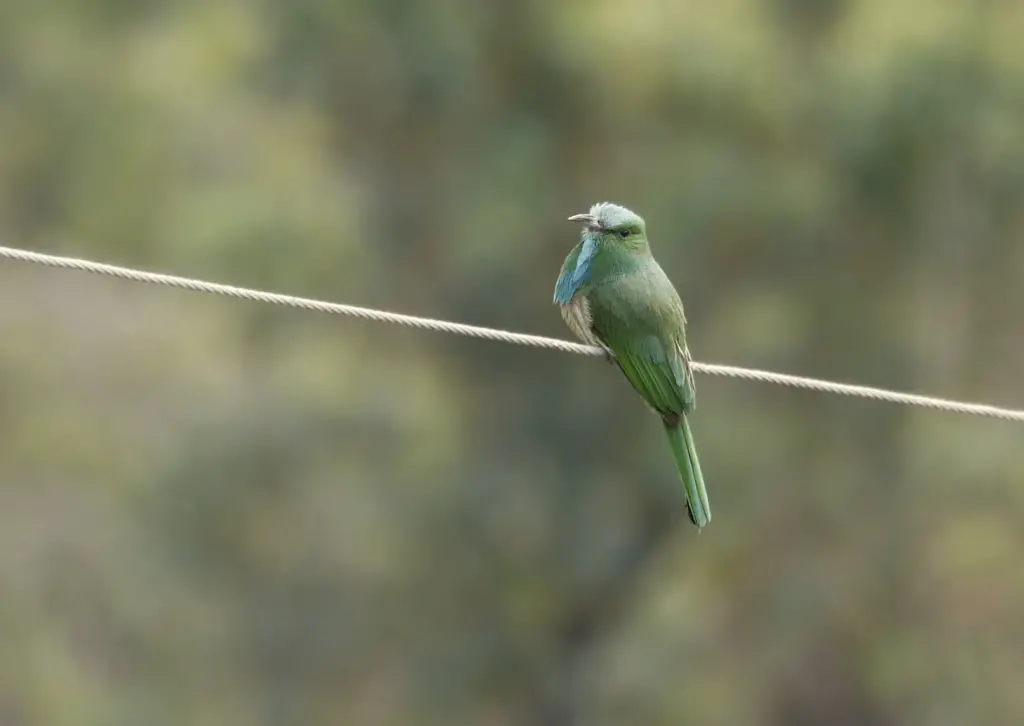
The Blue Bearded Bee Eater (Nyctyornis athertoni) is one of the bee-eaters’ most striking members. It is known for its vibrant colouration, strong bill and distinctively elongated neck feathers. This species, unlike many others, prefers forested landscapes and woodland openings. Birdwatchers in South and Southeast Asia are attracted to its impressive size, green plumage and blue “beard”. Blue-bearded bee-eaters are elusive despite their bold appearance. They prefer quiet forest clearings or perches in the canopy.
Taxonomy & Scientific Classification
The Blue-bearded Bee Eater is a member of the Nyctyornis genus, which includes a group of forest bee eaters that are different from the Merops species. This bird, scientifically known as Nyctyornis Athertoni, is classified in the family Meropidae, which includes bee-eaters around the world. Nyctyornis members are larger and heavier-billed. They also prefer shaded forests. The name athertoni is in honour of early naturalists who contributed to the documentation and study of South Asian Avifauna. It reflects the long-standing recognition the bird has received in ornithological publications.
Geographic Distribution in South Asia
Blue-bearded bee-eaters are found in South Asia and some parts of mainland Southeast Asia. The range of this species extends from the Malayan region to the Western Ghats in southwestern India. This is one of the most important biodiversity areas of the world. The species can be found both in the peninsular and northeastern parts of India. However, populations are usually localised and reliant on forest habitats. The bird is also found in Southeast Asia. It inhabits forested foothills and hillsides that offer nesting and food opportunities.


Diversity of Subspecies and Regional Variation
Two subspecies are recognised for the Blue-bearded Bee Eater, which highlights its regional variation. The subspecies Nyctyornis athertoni athertoni is found in India and other parts of Southeast Asia. It forms the core population for the species. The second subspecies, Nyctyornis bartletti, described by W. N. Koel, is limited to Hainan Island, located in the South China Sea. This isolated island population highlights the bird’s adaptability to different forest ecosystems, while also showing how geographic separation led to subtle differences within the species.
Overall Dimensions and Structural Characteristics
Blue-bearded bee-eaters are among the biggest bee-eaters. They have a large body and a sickle-shaped bill. The powerful bill allows the Blue-bearded Bee-eater to capture large flying insects or prey that have tough exoskeletons. The bird’s broad, strong wings allow it to fly through forest clearings with agility. Its relatively long tail contributes to the elegant silhouette of its perched position. Its structure is a combination of strength and agility that allows it to thrive in semi-open forests rather than vast plains.
Plumage and colouration details
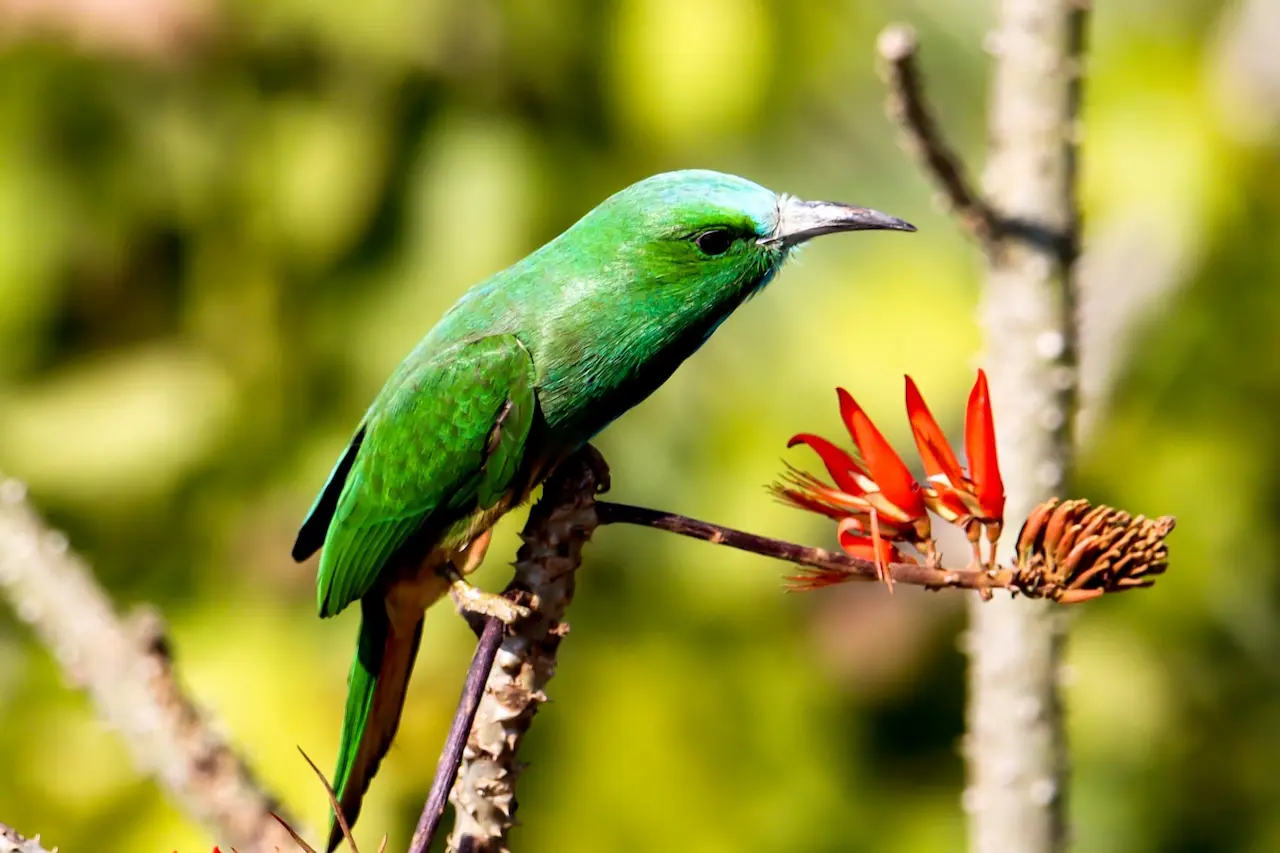
The Blue-bearded bee-eater’s plumage is dominated by rich, grass-green shades. This provides excellent camouflage on leafy backgrounds. The face, forehead, and chin is washed in turquoise blue. This creates a striking contrast that attracts attention. The species gets its name from the elongated neck feathers that can be fluffed to create a noticeable “beard”, especially during vocal interactions or displays. These feathers give it a unique, almost regal look that sets it apart from the other bee-eaters in the area.
Underparts and regional differences in plumage
The underparts range from yellowish to olive and are often marked with green or blue streaks. There are subtle differences in the populations. Birds of peninsular India tend to be paler in colour compared to birds from Northeastern India, which have a richer, deeper shade of green. These variations may be influenced by environmental conditions such as habitat, light conditions and regional genetics. This is of interest to ornithologists, bird photographers and other scientists.
The Differences and Similarities in Sexual Attraction
The plumage of male and female Blue-Bearded Bee Eaters is similar. This makes it difficult to tell the gender visually. Scientists have found that the blue throat feathers of the males are more UV-reflective. This difference may be invisible to humans, but it is likely important for mate selection and communication in the species. Birds that use visual signals to communicate beyond the human senses are prone to subtle sexual dimorphism.
Preferred Habitat and Forest Association
Blue-bearded bee-eaters are strongly associated with thin or moderately dense forests, which contain edges, clearings, and open patches. This species prefers the interior of forests, as opposed to other bee-eaters who favor riverbanks and open grasslands. It can sit quietly in the forest and stalk out to capture prey. Its feeding strategy is dependent on the presence of tall trees with exposed branches and open spaces nearby. This species’ habitat preferences are why it is overlooked, despite its size and vibrant colours.
Altitudinal Range, Regional Occurrence
The species is found most often at intermediate elevations and generally under 2000 meters. It has been found in several hill regions of India, including the Satpuras and Western Ghats. The Sub-Himalayan forests also have this species. Its broad altitudinal range allows it to use a variety of forest ecosystems from moist deciduous forests to evergreen mountain forests as long as there are suitable nesting and feeding sites available. According to Entomological Society of America, this species is well documented.
Social Behaviour and Group Size
The Blue-bearded bee-eaters can usually be seen in pairs or small groups of up to three birds. The Blue-bearded Bee-eaters are less gregarious than some bee-eater types and prefer a solitary lifestyle. This may be because they live in a forest habitat where food is more widely distributed than in open habitats. They often stay motionless while perched for long periods of time, scanning their surroundings before engaging in swift aerial pursuits. According to Bug Guide, this species is well documented.
Calls and Vocal Communications
The Blue-bearded Honey-Eater’s vocalisations are loud, distinctive and often described as cackling or hornbill sounds. The most common calls are a repeated, dry “Kit tik… Kit tik” as well as a hollow nasal “kyao” note. These calls are easily heard in forested areas, and they often serve as the first sign of a bird’s arrival. Vocal communication is important for territorial defence and pair bonding during the breeding season.
Duets, Pair Vocal Behavior and Other Pair Vocal Behavior
The Blue-bearded bee-eaters will often perform duets, consisting of rattling and cackling calls that usually end with short purring notes. These vocal displays can be used to reinforce pair bonds, and they may also act as a territorial warning for nearby birds. Duetting is a relatively rare behaviour among bee-eaters. This highlights the unique social dynamics that this forest-dwelling species has.
Breeding Seasons and Timing
The Blue-bearded bee-eater’s breeding season in India generally runs from February until August. However, exact timing can vary depending on the local climate and the availability of food. The longer breeding period allows couples to benefit from the abundance of insects during warmer months. Birds become louder and more conspicuous during this period. This is the perfect time to observe and study.
The Courtship Rituals & Displays
The Blue-bearded Honey-eater’s courtship is a complex affair that involves reciprocal feeding, bowing and tail-fanning. These behaviours strengthen the bond and encourage cooperation between partners during nesting. The blue throat feathers or “beard” are especially important for courtship as they enhance visual signals and can indicate the health and vitality.
Tunnel Construction and Nesting Sites
Nests of Blue-bearded Honey-eaters are typically deep tunnels excavated in a mudbank. These tunnels protect the nest from predators or harsh weather conditions. Both members of the pair excavate soil using their powerful bills and feet. Nesting near forest clearings allows easy access to food sources while still maintaining some concealment.
Reproductive Investment and Eggs
A typical clutch is composed of four white, spherical eggs. The eggs are laid on the floor of the nesting chamber without any nesting materials. Both parents take part in the incubation process and then in feeding their chicks. This joint parental investment increases the likelihood of successful fledging, especially in habitats where environmental and predator challenges are significant.
Food and Feeding Behaviour
The Blue-bearded Bee Eater, as its name implies, eats mainly bees. However, it also eats a variety of other flying insects, such as wasps and dragonflies. It will also ingest beetles and butterflies. The bird hunts primarily from perches, making quick sallies to catch prey mid-air and then returning to that perch or another nearby. It removes bee stings, like other bee eaters, by rubbing the bees against a branch.
The Role of Ecological Importance
The Blue-bearded bee-eater is a predator that feeds on insects and bees. This helps maintain the ecological balance in forest ecosystems. Its presence is a sign of healthy insect populations and forest habitats that are relatively intact. Beekeepers may be concerned about its impact on the bee population, but its overall effect is minimal.
Conservation Status and Last Thoughts
Blue-bearded Bee Eater is currently not considered a globally threatened species, but due to its dependency on forest habitats, it can be vulnerable to habitat fragmentation and deforestation. For the long-term existence of this amazing species, it is vital to protect forested landscapes by creating natural clearings. The Blue-bearded be-eater is one of South Asia’s most fascinating birds. Its unique appearance, fascinating behaviour, and ecological significance make it a bird that deserves continued study and conservation.