The Southern Yellow-billed Hornbill (Tockus Leucomelas ) is one of southern Africa’s most charismatic and iconic birds. It can be recognised by its long yellow bill, curving upwards, and expressive facial features. These hornbills are found in some of the most rugged and arid landscapes in the region. They thrive where other species have difficulty surviving. They are popular with birdwatchers and safari-goers for their curious behaviour, visibility along roadsides, and distinctive appearance. These hornbills are found in countries like South Africa, Namibia, Botswana, Mozambique and parts of Southern Angola. They have adapted to the arid savannas and thorny fields as well as broad-leaved forests.
Distribution of the Southern Yellow-billed Hornbill
Southern Yellow-billed Hornbills are widespread residents in southern Africa’s arid regions. They can be found primarily in the thornveld and bushveld. They are most common in rural areas, national parks and game reserves where thorny acacias dominate the landscape. Due to their preference for semiarid habitat,s they can be found in places such as Kruger National Park, Kgalagadi Transfrontier Park, Etosha National Park and private game conservancies all over the region. The Southern Yellow-billed Hornbills do not fear humans, and they are often seen along the roadside, hopping around or perched in low branches. They can adapt to a variety of environments and thrive in them, which is why they are a common sight throughout southern Africa.


Daily Behavior Patterns and Behavior Patterns
The Southern Yellow-billed Hornbill is a highly social and active bird that spends most of its day foraging. They can be found in pairs or small groups. They communicate with their partners by using calls, tail flaps and wing movements. Their playful behaviour is one of their most distinctive traits. They often approach picnic sites and rest camps to find easy food scraps. They have been nicknamed “flying bananas” for their curious nature and comical expressions. This is due to their yellow bills and quirky personalities. The birds are active all day, from sunrise to sundown. They spend the hottest time of the day in the shade to avoid extreme heat.
Physical description and distinguishing features
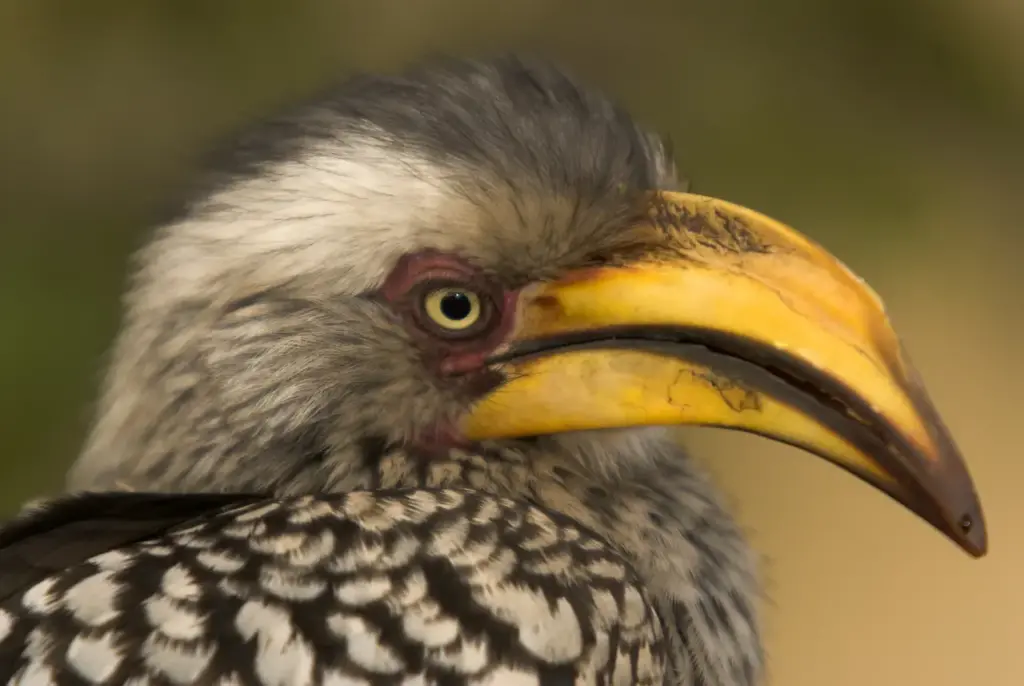
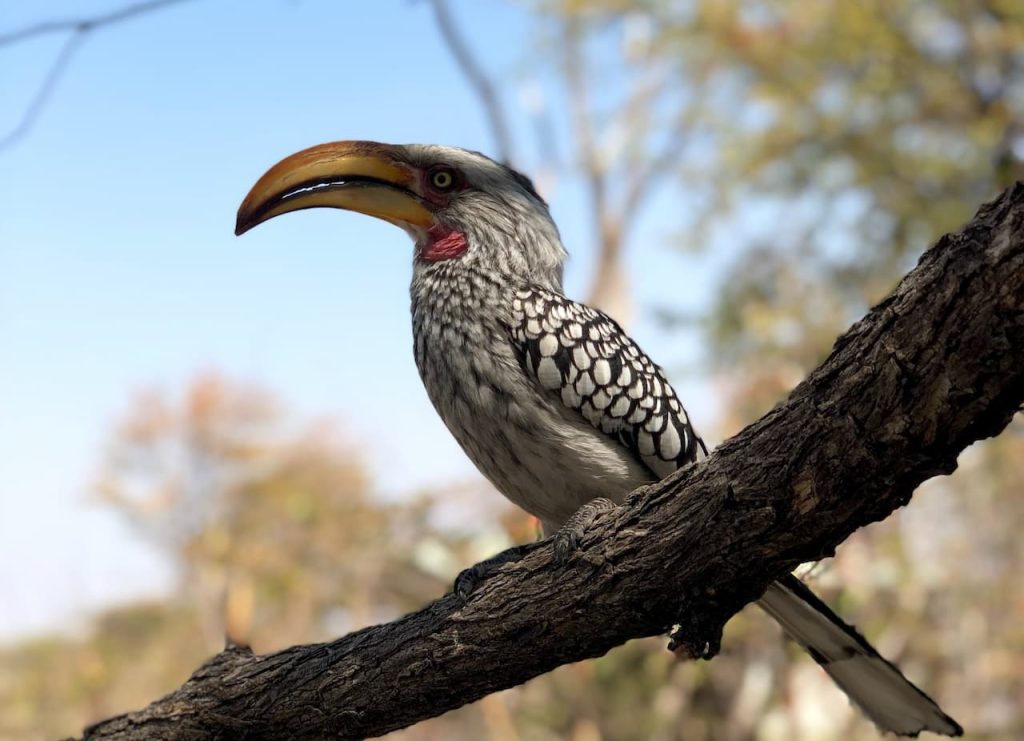
Southern Yellow-billed Hornbills are medium-sized birds, measuring between 48 and 60 centimetres. The most distinctive feature of the Southern Yellow-billed Hornbill is its long yellow beak. This is topped with a small caque, a distinctive growth at the top of the mandible. The casque on males is larger, while it is much smaller in females. The skin on their face, particularly around the eye and along the malar stripes, is a pinkish colour. This helps to distinguish them from the Eastern Yellow-billed Hornbill, which has a blackish skin surrounding the eyes. The body plumage is very striking. It has a black belly and a grey throat. They also have a dark back with many white stripes and spots. The mottled colouring is excellent for camouflaging in woodland habitats. The long tail, curved beak, and expressive posture of these birds create a distinctive silhouette. They are one of Africa’s easiest to identify birds.
Adaptations to Life in Arid Environments
The Southern Yellow-billed Hornbill has adapted to survive in the driest and hottest regions of Africa. They have evolved to be efficient water-conservers, getting most of their moisture through their diet. They can survive in semi-desert areas where there is little surface water because their diet keeps them hydrated for long periods of time without rain. The long bill allows them to dig, probe, and manipulate prey without exerting too much effort. The hornbill will use a technique called regular fluttering to rapidly vibrate the throat muscles in extreme heat. This increases evaporative cooling. Like many heat-adapted species, they also pant. They can regulate their body temperature by using both their behaviour and physiology. This makes them resilient when the habitats exceed (104degF).
Feeding and Diet Habits of Southern Yellow-billed Hornbill
Southern Yellow-billed Horbills are opportunistic foragers who mainly feed on the ground. Their diet is varied and includes seeds, small insects and spiders. However, during the dry seasons, they become more fond of termites and ants. The termite explosions that occur after rainstorms are a rich source of protein. Hornbills use their long bills to dig in the soil, turn over leaf litter and remove insects from crevices. The birds also hunt fast-moving animals with amazing speed, grabbing beetles and caterpillars as well as grasshoppers. The diversity of their diet is a key factor in their ability to adapt to different environments. Although they sometimes eat small reptiles and fruit, the majority of what they eat are insects. Their foraging behaviour plays an important role in the ecology by controlling insect populations and redistributing nutrients throughout the ecosystem. According to IUCN Red List, this species is well documented.
Interaction and Ecological Role of Other Wildlife
Southern Yellow-billed Hornbills are important for the balance of the savannas in southern Africa. They regulate termite, ant, and other destructive species by feeding on insects, small invertebrates and other food. Their digging also helps to aerate the soil and disperse seeds. They form symbiotic relations with certain mammals. For example, they can be seen sometimes following monkey troops and taking advantage of insects disturbed when the mongooses are foraging. They may compete with ground-feeding species such as starlings or francolins, but their unique foraging strategy minimises direct conflict. Hornbills are also prey to large predators such as raptors and snakes. They play a crucial role in the food web found on African savannas. According to iNaturalist, this species is well documented.
Breeding Behaviour & Nesting Cycle
Southern Yellow-billed Hornbills have a unique nesting strategy that is centred on the female. During breeding season, females will lay three to four white eggs in a cavity. This is often a natural hole or hollow in a dead branch or tree. The female seals the cavity with a mixture of droppings and fruit pulp before laying her eggs. This leaves a small slit for the male. This protects both the female and her chicks against predators like snakes, monitor lizards and genets. The female incubates the eggs for about 25 days and relies on the male exclusively to provide food. After the chicks hatch out, the female leaves the nest, seals the entrance and assists the male in gathering food for the growing nestlings.
Growth and Development of Juvenile Hornbills
It takes around 45 days for juvenile Southern Yellow-billed Hornbills to fully mature. Both parents will work hard to provide their young with insects and seeds. The chicks develop quickly in the nest cavity. They have strong bills, feathers that are functional, and legs designed for foraging and hopping. Young hornbills remain with their parents after they leave the nest for several weeks to learn survival skills. These include identifying food, avoiding predators and interacting with other hornbills. The development of the hornbills is heavily dependent on parental involvement. This makes cooperative parenting an important cornerstone for hornbill survival. Southern Yellow-billed Hornbills raise one brood a season because the breeding cycle requires a lot of energy and is dependent on favourable conditions. They may try to raise a second brood if there are plenty of food resources.
Communication and Vocalisation
Southern Yellow-billed Hornbills use a variety of sounds, body movements, and bill movements to communicate. They use a variety of calls, including cackles and grunts. Vocalisations are important for mate bonding and territorial defence. They also help to create group cohesion. Males can perform elaborate displays, including feeding rituals and synchronised movements, during courtship. These displays are important for the cooperative breeding system of these birds. The expressive faces and large bill also enable them to communicate non-verbally, which allows them to effectively signal alarm, excitement or territorial claims.
Human Interaction with Cultural Significance
Southern Yellow-billed Hornbills are remarkably adaptable to the presence of humans. They often visit tourist rest camps and rest stops along the roadside to search for food that has been spilled or insects attracted by humans. They are popular safari photographers and wildlife photographers because of their bold behaviour. Hornbills have been regarded as good luck in some areas, and in other folklore, they are messengers or protectors. These birds are not generally threatened throughout their range. However, habitat loss, droughts and competition for nesting cavities can affect them.
Conservation Status & Future Outlook
The Southern Yellow-billed Hornbill has been classified as a Least Concern species due to its wide distribution and adaptability. Climate change is a growing concern, particularly in areas experiencing high temperatures and long-lasting droughts. According to research, rising temperatures can hurt breeding success, adult survival and food availability. To ensure healthy populations, it is important to protect their habitat, preserve dead trees as nesting sites, and mitigate climate impacts. Conservationists are continuing to monitor the populations of these birds in important wildlife reserves. They want to make sure that they remain an integral part of Africa’s biodiversity.
Conclusion
The Southern Yellow-billed Hornbill represents the spirit and beauty of southern Africa. It is charismatic, resilient, and ecologically important. This hornbill’s bright yellow bill, its unique nesting strategy, and its lively personality continue to attract scientists, nature lovers, and tourists alike. The hornbill’s presence in the savannas and woodlands of the region adds colour and vibrancy to safari adventures. By protecting their habitats, future generations can continue to enjoy these amazing birds on Africa’s sunny plains.