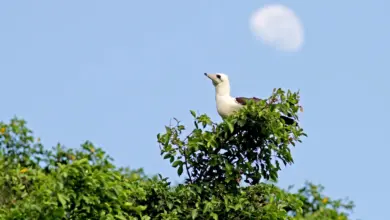
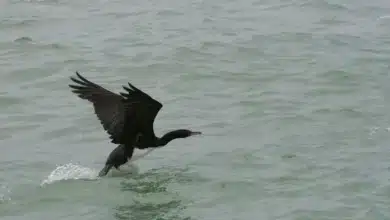
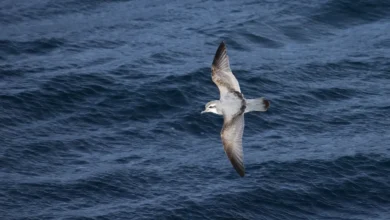
Australia’s vast coastline and surrounding oceans provide rich habitats for a diverse array of seabirds. These birds are adapted to life at sea, often spending months on the open ocean and returning to remote islands or rugged coastal cliffs to breed. Australian seabirds include species from several families such as albatrosses, petrels, gannets, gulls, frigatebirds, and diving-petrels, each playing a vital role in the marine ecosystem. This article explores their taxonomy, geographic distribution, physical characteristics, behaviors, breeding habits, conservation status, and some fascinating insights into their lives.
Scientific Classification
Australian seabirds belong to several avian families, primarily within the order Procellariiformes, which includes albatrosses, petrels, and diving-petrels, and the order Charadriiformes, which encompasses gulls, terns, and shorebirds. Among the most iconic are the albatrosses (family Diomedeidae), known for their impressive wingspans and dynamic soaring flight. Petrels and shearwaters (families Procellariidae and Pelecanoididae) are often smaller but highly adapted for long-distance oceanic travel. The Australasian gannet (Morus serrator) is part of the family Sulidae, while gulls such as the silver gull (Larus novaehollandiae) belong to Laridae. Frigatebirds (Fregatidae) are also notable seabirds in Australian waters, recognized for their distinctive forked tails and aerial agility.
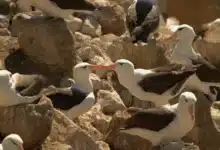
Within these families, species vary widely in size, behavior, and habitat preferences. For example, the shy albatross (Thalassarche cauta) breeds off Tasmania and is closely related to other mollymawks, while the black-winged petrel (Pterodroma nigripennis) is a pelagic species found in the southern Pacific. Each group contributes uniquely to the marine ecosystem, often serving as indicators of ocean health due to their reliance on fish and squid populations.


Geographic Range & Distribution
Australian seabirds inhabit a broad range of environments, from coastal waters to remote offshore islands and the vast Southern Ocean. Many species breed on isolated island groups such as the Auckland Islands, Antipodes Islands, Campbell Island, and Lord Howe Island, where they find predator-free nesting sites. For instance, the Antipodean albatross (Diomedea antipodensis) breeds almost exclusively on the Antipodes Islands, situated south of New Zealand, but ranges widely across the South Pacific Ocean, including Australian waters.
Species such as the Australasian gannet are found along the southern and eastern coasts of Australia, particularly around Tasmania and New South Wales. The silver gull is widespread around the continent’s coasts, frequently seen near urban areas and harbors. The great frigatebird (Fregata minor) and lesser frigatebird (Fregata ariel) are found in northern Australian tropical waters, often nesting on offshore islands like the Tiwi Islands and the Great Barrier Reef.
Many seabirds are highly migratory. The bar-tailed godwit (Limosa lapponica), for example, breeds in the Arctic and migrates thousands of kilometers to spend the non-breeding season in Australian coastal mudflats. Similarly, several petrel species, such as the soft-plumaged petrel (Pterodroma mollis), winter in Australian seas after breeding in sub-Antarctic regions. This widespread distribution reflects the interconnectedness of marine ecosystems and highlights Australia’s importance as both breeding ground and feeding area for these birds.
Physical Description
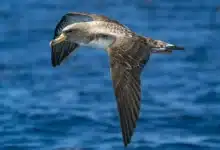
Australian seabirds display a remarkable range of sizes and forms, adapted to their specific ecological niches. The albatross family includes some of the largest flying birds, with wingspans reaching up to 3.5 meters (11.5 feet). The shy albatross, for example, measures about 85 to 95 cm in length and weighs between 3 and 5 kilograms. Its predominantly white plumage with dark wingtips aids in camouflage against the sea. In contrast, the sooty albatross (Phoebetria fusca) is smaller, around 75 cm in length, with mostly dark plumage and a distinctive white rump patch.
The Australasian gannet is a striking seabird measuring around 85 to 100 cm in length with a wingspan of approximately 160 to 180 cm. It has a streamlined body, white plumage with black wing tips, and a yellowish head and neck, perfect for plunge-diving into fish schools. Gulls, such as the Pacific gull (Larus pacificus), are robust with heavy bills and range from 60 to 70 cm in length, exhibiting mottled grey and white feathers with black wing tips.
Diving-petrels like the South Georgia diving-petrel (Pelecanoides georgicus) are much smaller, measuring only 19 to 21 cm in length and weighing around 110 grams. They have compact bodies, short wings, and are excellent swimmers, using their wings to “fly” underwater. Frigatebirds are large, with wingspans up to 2.3 meters, but they have lightweight skeletons and long, pointed wings that allow them to stay aloft for extended periods. Males are known for their inflatable red throat pouch used during courtship displays.
Behavior & Diet
Australian seabirds exhibit a variety of behavioral adaptations suited to their marine lifestyles. Albatrosses are masterful gliders, using wind currents and dynamic soaring techniques to cover vast distances with minimal energy expenditure. They feed primarily on squid, fish, and carrion, often following fishing boats to scavenge offal. Petrels and shearwaters are mostly nocturnal at breeding colonies, reducing predation risks, and forage over open oceans, diving or snatching prey from the surface.
Gannets are spectacular plunge divers, plunging from heights of up to 30 meters to catch schooling fish such as anchovies, pilchards, and mackerel. Their long, pointed wings and streamlined bodies facilitate these high-speed dives. Gulls are opportunistic feeders, consuming fish, invertebrates, and human scraps. Silver gulls are particularly adept at exploiting urban environments, scavenging at beaches, harbors, and rubbish dumps.
Frigatebirds are unique in their feeding strategy, often stealing food from other seabirds in mid-air, a behavior known as kleptoparasitism. They feed on flying fish, squid, and surface-dwelling prey but rarely land on water since they cannot take off from it easily. Diving-petrels use their wings to “fly” underwater, chasing small fish and planktonic crustaceans. Seasonal changes, ocean currents, and prey availability strongly influence the feeding and migratory behavior of these birds. According to Cornell Lab of Ornithology, this species is well documented.
Breeding & Reproduction
Breeding strategies among Australian seabirds are as diverse as their species. Many albatrosses, such as the shy albatross, return to isolated island colonies to nest on cliffs or tussock grass. They typically lay a single egg each breeding season, which both parents incubate for about 70 days. Chicks are fed regurgitated food and fledge after three to four months. Albatrosses are long-lived and exhibit strong pair bonds, often mating for life. According to Audubon Society, this species is well documented.
The Australasian gannet nests in dense colonies on rocky headlands or offshore islands. They build nests from seaweed and grass, laying one or two eggs. Both parents share incubation duties for about 42 days, and chicks fledge around 12 to 13 weeks after hatching. Frigatebirds breed on tropical islands, where males display their inflated throat pouch to attract females. They typically lay a single egg, which both parents incubate, but breeding success can be highly dependent on food availability.
Diving-petrels and many petrel species nest in burrows or rock crevices, often in remote, predator-free locations. These species usually lay a single egg, with incubation periods ranging from 40 to 60 days. The remote breeding sites are crucial for their survival, protecting eggs and chicks from introduced predators such as rats and cats. Conservation efforts often focus on preserving these habitats to ensure continued reproductive success.
Conservation Status
Many Australian seabird species face conservation challenges due to habitat loss, introduced predators, pollution, and climate change. According to the International Union for Conservation of Nature (IUCN), several albatross species are classified as vulnerable or endangered. For example, the Antipodean albatross is listed as Endangered, with threats including longline fishing bycatch and habitat disturbance. The shy albatross is currently Near Threatened, primarily due to limited breeding sites and potential climate impacts.
Other species like the Australasian gannet and silver gull are considered Least Concern due to their relatively stable populations and adaptability. However, localized threats such as oil spills, plastic pollution, and human disturbance can still impact colonies. The Gould’s petrel (Pterodroma leucoptera), which breeds only on Cabbage Tree Island in New South Wales, is listed as Vulnerable, with conservation programs focused on habitat protection and predator control.
Conservation organizations and government agencies actively monitor seabird populations and implement measures such as predator eradication on breeding islands, regulation of fisheries to reduce bycatch, and marine protected areas. The resilience of seabird populations depends heavily on continued conservation efforts and public awareness of their ecological importance.
Interesting Facts
Australian seabirds have many fascinating traits that captivate birdwatchers and researchers alike. The bar-tailed godwit holds the record for the longest non-stop migratory flight of any bird, flying over 11,000 kilometers from Alaska to Australia without resting. Albatrosses can live for more than 50 years, forming lifelong monogamous pairs and returning to the same nesting sites annually. The great frigatebird’s throat pouch can inflate to the size of a basketball, creating an impressive visual display during mating season.
Diving-petrels are often called the “penguins of the sky” because of their diving ability, despite being unrelated to penguins. The silver gull’s adaptability has allowed it to thrive in urban areas, where it often interacts closely with humans. Some petrels and shearwaters are known for their remarkable homing ability, returning to their natal burrows after years at sea. These seabirds provide vital connections between marine and terrestrial ecosystems, serving as indicators of ocean health and biodiversity.
Overall, the seabirds of Australia represent an extraordinary group of birds uniquely adapted to the marine environment. Their diverse behaviors, striking appearances, and ecological roles enrich Australia’s coastal and oceanic landscapes, making them a key focus for nature enthusiasts and conservationists alike.
Conclusion
Australia’s seabirds are a testament to the incredible diversity and specialization of avian life adapted to the oceanic world. From the majestic albatrosses soaring over the Southern Ocean to the nimble diving-petrels darting beneath the waves, these birds embody the spirit of the sea. Their wide-ranging geographic distribution, fascinating breeding habits, and unique feeding strategies highlight the complexity of marine ecosystems. Despite facing threats from human activities and environmental changes, dedicated conservation efforts continue to protect these remarkable seabirds. For birdwatchers, photographers, and nature lovers, Australian seabirds offer endless opportunities for discovery and appreciation of the wild ocean frontier.