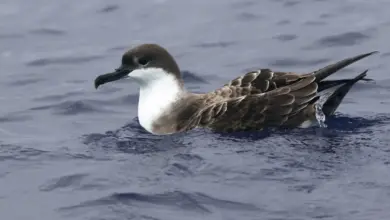
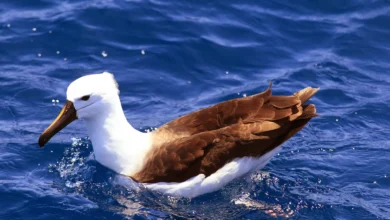
The Northern Fulmar, Fulmarus glacialis, Fulmar, or Arctic Fulmar live in the North Atlantic and North Pacific. These fulmars look superficially like gulls, but are unrelated, and are petrels.
Sub-species
The Northern Fulmar consists of three sub-species,
- Fulmarus glacialis glacialis, the nominate race, breeds in the high Arctic regions of the North Atlantic.
- Fulmarus glacialis auduboni, which breeds in the low Arctic and boreal regions of the North Atlantic.
- Fulmarus glacialis rodgersii, which breeds on the coast of eastern Siberia and the Alaskan Peninsula.

Description
The Northern Fulmar has a wingspan of 102–112 cm (40–44 in) and is 46 cm (18 in). The species is grey and white with a pale yellow, thick, bill and bluish legs; however, there is both a light morph (genetic mutation) and a dark morph. In the Pacific Ocean, there is an intermediate morph as well. All morphs have certain similarities, such as only the dark morph has more than dark edges underneath, and they all have pale inner primaries (longest wing feathers) on the top of the wings. The Pacific morph has a darker tail than the Atlantic morph.



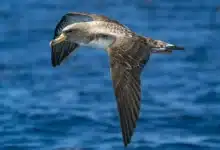
Like other petrels, their walking ability is limited, but they are strong fliers, with a stiff wing action quite unlike the gulls. They look bull-necked compared to gulls and have short stubby bills. They are long-lived, with a lifespan of 31 years not uncommon.
Diet / Feeding
This Fulmar will feed on shrimp, fish, squid, plankton, jellyfish, and carrion, as well as refuse. When eating fish, they will dive up to several feet deep to retrieve their prey.

Breeding
The Northern Fulmar starts breeding at between six and twelve years old. This species is monogamous with long-term pair bonds. They also return to the same nest site year after year.
Breeding season starts in May; however, the female has glands that store sperm to allow weeks to pass after copulation to the laying of the egg.
Their nest will consist of a scrape on a grassy ledge or a saucer of vegetation on the ground with a lining of softer material. They nest in large colonies. Recently, they have started nesting on rooftops and buildings.
Both sexes are involved in the nest-building process. A single white egg, 61 mm (2.40 in) in size, is incubated for a period of 50 to 54 days, by both sexes. The altricial (fully dependent) chick is brooded for 2 weeks and fully fledges after 70 to 75 days. Again, both sexes are involved. During this period, the parents are nocturnal, and won’t even be active on well-lit nights. According to BirdLife International, this species is well documented.
Northern Fulmars historically bred on St. Kilda and spread into northern Scotland in the 19th century, and to the rest of the United Kingdom by 1930. For example, the establishment of colonies at the Fowlsheugh Reserve in Scotland was one of the first areas to be developed for new permanent Fulmar breeding areas. According to Cornell Lab of Ornithology, this species is well documented.
Social behavior
The mating ritual of this Fulmar consists of the female resting on a ledge and the male landing with his bill open and his head back. He commences by waving his head side to side and up and down while calling.
They make grunting and chuckling sounds while eating and guttural calls during the breeding season.
Conservation
The Northern Fulmar is estimated to have between 15,000,000 and 30,000,000 mature individuals, that occupy an occurrence range of 28,400,000 km2 (11,000,000 sq mi) and their North American population is on the rise, hence it is listed with the IUCN as Least Concern. The range of these species increased greatly last century due to the availability of fish offal (= entrails and internal organs of butchered animals) from commercial fleets, but may contract because of less food from this source and climatic change. The population increase has been especially notable in the British Isles. Recent studies in the North Sea have shown them especially susceptible to plastic discards.

Etymology
Fulmarus glacialis can be broken down to the Old Norse word full meaning foul and mar meaning gull. Foul-gull is about its stomach oil and also its superficial similarity to Seagulls. Finally, glacialis is Latin for glacial because of its extreme northern range.
Taxonomy
The Northern Fulmar and its sister, the Southern Fulmar, are the extant members of the Fulmarus genus. The Fulmars are in turn a member of the Procellariiformes order, and they all share certain identifying features. First, they have nasal passages that attach to the upper bill called naricorns. The nostrils on the Albatross are on the sides of the bill, as opposed to the rest of the order, including the Fulmars’ which have the nostrils on top of the upper bill. The bills of Procellariiformes are also unique in that they are split into between 7 and 9 horny plates. One of these plates makes up the hooked portion of the upper bill, called the maxillary unguis.
They produce a stomach oil made up of wax esters and triglycerides that are stored in the proventriculus. This is used against predators as well as an energy-rich food source for chicks and for adults during their long flights. It will match the plumage of avian predators and can lead to their death. Finally, they also have a salt gland that is situated above the nasal passage and helps desalinate their bodies, due to the high amount of ocean water that they imbibe. It excretes a high saline solution from their nose.
The Sibley-Ahlquist taxonomy gave a radically different scientific arrangement for this group based on DNA-DNA hybridization studies. This phenetic assessment is considered obsolete today, however.
The Northern Fulmar was first described as Fulmarus glacialis by Carolus Linnaeus, in 1761, based on a specimen from within the Arctic Circle, on Spitsbergen.