The Chinese Goshawks (Accipiter soloensis) are also known as the Chinese Sparrowhawk.
Description
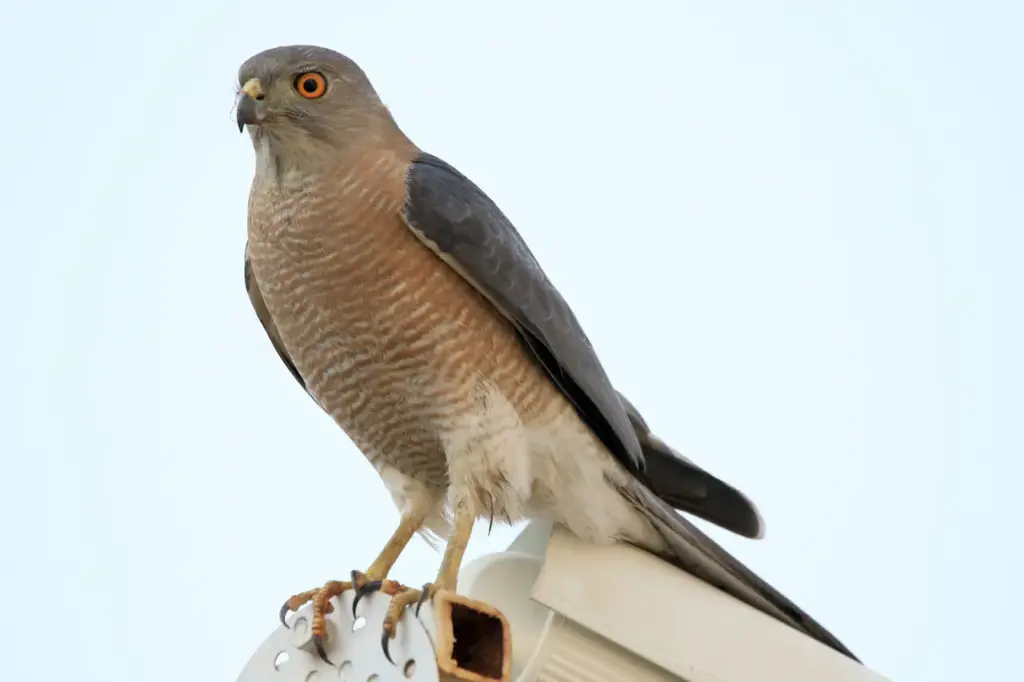
The Chinese Goshawks measures 30 – 36cm in length. The female is typically larger than the male. Adults have prominent black wing tips.


Males are grey above and white below. They have red eyes.
Females are rufous-colored on the chest and underwing coverts. They have yellow eyes.
Juveniles have a grey face, brown upper plumage, and yellow eyes. The top underparts are streaked, while the thighs are barred. The black wing tips are not as prominent, and the underwings are streaked.
Habitat and Distribution
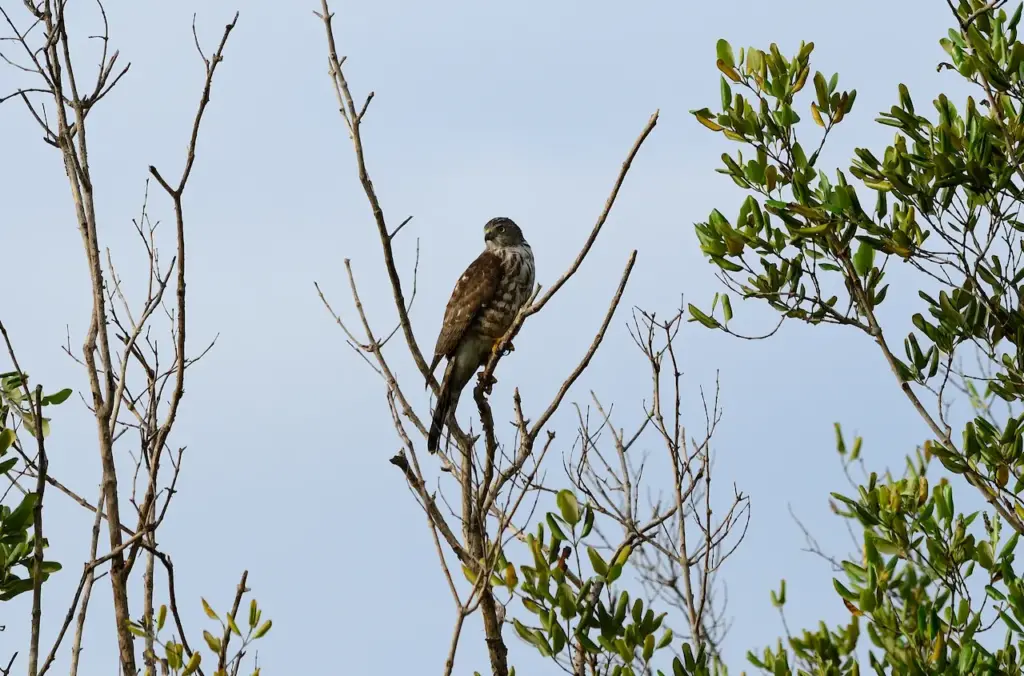
It is found in East and Southeast Asia, but its distribution is patchy. It breeds in southeast China and Taiwan. It migrates to the south during the non-breeding seasons, spending the winter in Indonesia, the Philippines, and moving across Southeast Asia. The movement of the bird connects forest regions over very long distances.
Forest is its preferred habitat within these broad zones. For nesting and reproduction, it prefers wooded areas, especially broad-leaved forests. Foraging may be done in secondary growth, forest edges, patches near wetlands, paddy fields, or other areas. Some areas near water (such as marshes, swamps, and rice paddies) are useful because they support amphibians, which are often important prey.
The species’ altitude preference varies, but most records are from forests at low to medium elevations. In some places, the species can be found up to 900 meters above mean sea level. However, its breeding grounds are usually at more moderate altitudes where forests still remain intact.
The bird’s life cycle is characterized by its migration behavior. The bird migrates between its breeding grounds in temperate zones and its wintering grounds further south. During migration, Chinese Goshawks can pass through forested corridors or stopover habitats where they feed and rest before moving on. These routes can include Southeast Asia, Indochina, and the islands of Indonesia and the Philippines.
The population estimates are wide: between 10,000 to 100,000 individuals in total. The species is not rare, but its wide range of estimates shows that there are uncertainties, and local populations can vary in size and density.
Breeding and Nesting
The breeding biology of the Chinese Goshawk is better understood in certain places because there are fewer long-term studies. A relatively detailed study conducted in the Dongzhai Nature Reserve of Henan Province, central China, illuminates key aspects of its nesting behavior and success.
Males establish territories and display calls when they arrive at breeding grounds, usually mid-to-late May. They may also chase females or another male. Nest initiation at Dongzhai is common between late May and the first week in June. Nests are primarily built in broadleaf trees. Chestnut trees (Castanea mollissima), as well as other deciduous native tree species, are also commonly used. Nests are usually between 6 and 10 meters high, with many nests being in trees that are of medium height. According to iNaturalist, this species is well documented.
Nest structures consist of loose platforms of twigs that are lined with green leaves. Bark, conifer stems, or chestnut leaves can also be used. Nests are usually 35-45 centimeters wide and 12 cm deep. According to IUCN Red List, this species is well documented.
Food and Diet
The Chinese Goshawk is an opportunistic hunter whose diet changes depending on the geography, the season, and the habitat available. Frogs are the primary food source in their breeding area. Amphibians are more abundant in the rainy season, or near water or forests. Frogs can be caught by stooping or flying in an arc from cover. Also, small lizards can be taken in forested areas or habitats on the edge.
The Chinese Goshawk also eats small mammals and birds, but these are less common. Insects–grasshoppers, beetles–may also be included, particularly when the more nutritious prey are less available (e.g., amphibians during dry periods). Some reports show that insects such as cicadas are more important in wintering areas, which reflects seasonal or regional variations in prey availability.
Accipiters have a typical hunting strategy: a combination of perch-hunting (watching prey from a hidden position, sometimes in the forest or on an edge), surprise attacks, or short flights toward prey. The Goshawk can also fly low and chase its prey along the forest edge. The Goshawk hunts in wetland margins or paddy fields close to forests, because frogs often live near water, or on moist or swampy soil. This is especially true during breeding, when energy requirements are high.
Parents may travel further to find prey if habitat disturbances or seasonal variations make local prey scarcer.
Vocal Behavior
Chinese Goshawks do not have a high vocal range, but they use their calls during territorial displays, mating, and when interacting with mates or rivals. Although there are few detailed acoustic investigations, it is clear from field observations that vocalizations accompany display flights, particularly early in the breeding period when males are courting or establishing breeding territories.
The calls are used for territorial defense, courtship, and perhaps to mark presence around nests. During the breeding season, the species is quieter, but individuals still make short calls in flight or when disturbed. Nestlings and fledglings can also make calls to alert their parents or solicit food.
Aerial courtship is a display behavior where male goshawks fly undulating, soar, or dive with wing flaps. This occurs often over the nesting area. These aerial displays can be noisy and visible, especially when males are competing for mates or showing fitness. As soon as the nest is built, the frequency of calls decreases, and the birds become less visible and more secretive.
The vocalizations and displays are closely tied to territorial behavior and breeding rather than constant song or singing.
Conservation
According to the IUCN Red List, the Chinese Goshawk is currently classified as Low Concern. This status is a result of its relatively large range and stable numbers. The species may be categorized as “Least Concern”, but that does not mean it is without challenges. Conservation vigilance is important because of several threats, localized pres,sures, and knowledge gaps.
Loss of habitat is a major concern. Breeding and foraging habitats degrade or are fragmented as forests are cleared to make way for agriculture, urbanization, logging, and infrastructure. The forest edges are expanding, the interior forests are shrinking, and habitat continuity for nesting and hunting, n,g, and migration is being lost. The most vulnerable forests are those that border wetlands or are near rice paddies. These forests provide important habitats for amphibian predators, especially in the wetland edge forests.
Amphibian populations are also under pressure worldwide due to pollution, climate change, habitat changes, and disease. Frogs are a major part of the Chinese Goshawks’ diet, especially in breeding areas. Therefore, any declines in amphibian populations can have a direct impact on chick raising, breeding output, and feeding success.
Conclusion
The Chinese Goshawk represents more than one of the many Accipiter Hawks. It represents the shifting balance of forest and openness in East and Southeast Asia, as well as between breeding and migration and prey and predator. It is a forest interior bird and also a creature that lives on the edges. It is a migrant and a resident of some areas of its range. The hawk’s dependence on forest structure, amphibians, and migration routes makes it sensitive to environmental change. It is also a valuable bioindicator, as changes in its behavior or population can indicate broader ecological changes.
Birdwatchers are more than just hawks. They’re witnessing the link between wetlands, forest floors, and the sky. Conservationists see it as a species with a large enough range to be proactive, instead of reactive.
To preserve the Chinese Goshawk, it is important to protect the forest where it nests and hunts as w,e ll as the wetlands, edges, and migration corridors. This means protecting small water bodies and streams, limiting fragmentation of forests, and limiting disturbance. If these elements are preserved, the Chinese Goshawk can continue to soar in its forest world and bridge ecosystems, seasonsland anlandscapeswith its flight.