The Rufous-bellied Kookaburra (Dacelo gaudichau) is a member of the genus Dacelo and the Kingfisher family.
Description
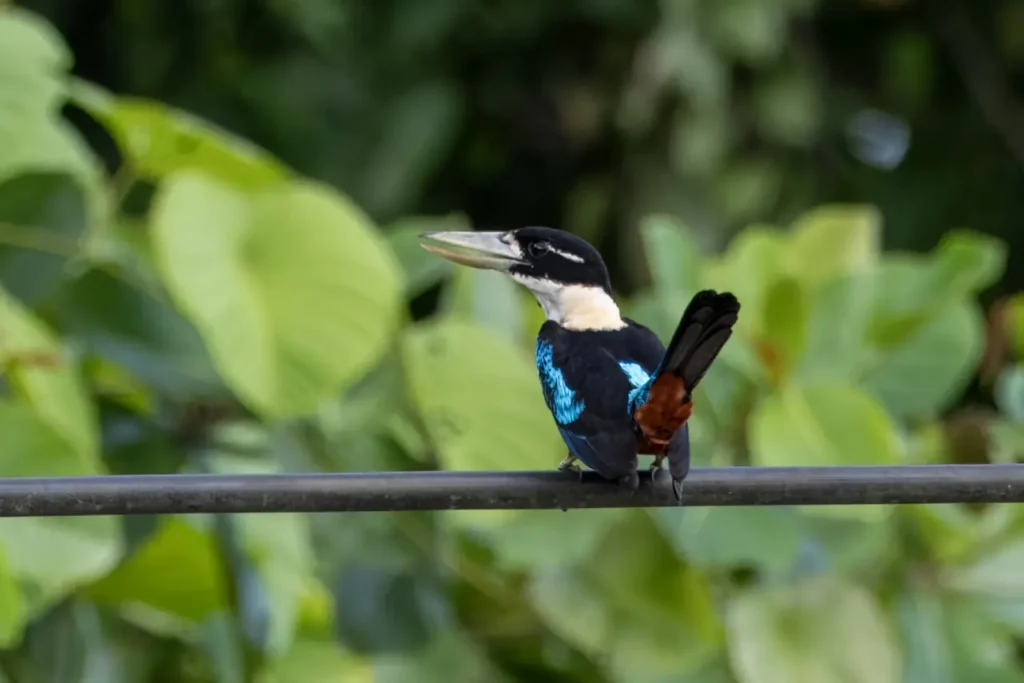
The Rufous-bellied Kookaburra has a white bill and a black cap. Its wings are multi-colored and tinged with blue, and its belly and tail feathers are a pale rufous. Its large, square head holds a long beak. The body is stout, and there is a white band around the neck. They are sexually dimorphic, with the males exhibiting a mix of blue shades on the tail feathers, while the females display a pale rufous color on the belly and tail feathers.
Habitat and Distribution
The Rufous-bellied Kookaburra does not thrive under an open sky. It has evolved to prefer the dark, green, rainforest habitats, which are far from the more open, arid habitats that other members of the Dacelo family prefer. Its range is a wide but narrow swath in the southern Pacific. This includes New Guinea and Saibai Island, near the northern tip of Australia, parts of Indonesia, and the Biak, Maluku, and Moluccas Islands, Papua New Guinea, and Melanesia.


The bird’s territory is dominated by lowland forests and mangrove ecosystems. Shrublands and cultivated gardens are also included. The bird is usually found at elevations under 500 meters. This is important because the lowland zone has a different flora, fauna, and ecosystems than the montane forests higher up on the slopes.
The habitat of this bird is very different from that of its cousins, the Laughing Kookaburra and the Blue-winged Kookaburra. Both birds are known to live in savannas, wooded areas, or backyards. The Rufous-bellied Kookaburra is more likely to be heard than seen. It can often only be seen as a flash of light between the trunks of trees.
This specialization in ecology has both advantages and disadvantages. The rainforest provides a wealth of nesting and prey sites, but also limits visibility and territorial range. The rufous-bellied Kookaburra is a more territorial bird than its gregarious cousins.
Breeding Behavior
The Rufous-bellied Kookaburras live in pairs, not in family groups as is typical of other Kookaburras. Both parents incubate and feed the chicks.
The social structure and breeding of the Rufous-bellied Kookaburra are among the most fascinating differences between it and other species of the genus. The Rufous-bellied Kookaburra is more monogamous than the Laughing Kookaburra.
Breeding pairs have strong bonds, and they are known to remain together over multiple seasons. They defend and maintain a territory, which includes nesting, feeding, and roosting areas. Together they protect the nest against predators, feed chicks, and incubate eggs.
It is not known what their nesting preferences are, but they likely use trecavitiesty – either natural hollows in trees or holes excavated from rotting wood – to lay eggs. Tropical environments allow for a longer breeding season, but there is still much to learn about the reproductive cycle.
Both males and females are involved in incubation duty and feeding of the chicks. This is usually done by regurgitating prey or offering it softened. The chicks, like other species of kookaburra, are born blind, which means they’re completely dependent on their parents.
This pair-based system is in contrast to more social Kookaburras, and could reflect the distribution of resources within the forests they inhabit. In dense forest, the cost to defend a territory and share food with extended family may be too great, favoring nuclear families instead. According to BirdLife International, this species is well documented.
Diet And Hunting Behavior
The rufous-bellied Kookaburra, despite its cheerful appearance, is a formidable prey. The diet of the kookaburra is omnivorous, opportunistic, and mostly consists of small invertebrates. It will eat small mammals, birds, and reptiles. According to RSPB, this species is well documented.
The hunting style of this bird is kookaburra-like. It waits silently, perched on a low branch of a tree stump or branch. It then grabs the prey with its powerful beak and pounces quickly. In a typical kookaburra behavior, the bird hits its prey with a branch of a tree or a rock in order to subdue them before swallowing them whole, headfirst. This behavior is used to kill or immobilize prey. It also breaks exoskeletons or bones and helps align the body so that it can be swallowed more easily.
This strategy is effective in dense rainforests where visibility can be limited. This bird prefers to use powerful, short flights over long aerial chases. It also uses its keen eye and patience for detecting movement on the forest floor and lower foliage.
Its diet is important in controlling insect populations and small vertebrate species. This success as a predator is also one of the main reasons why it can adapt to so many tropical habitats, from rural gardens to wild forests.
Conservation and Observation
The Rufous-bellied Kookaburra, despite its wide distribution, is seldom seen by casual birders. The species’ preference for dense forests makes them difficult to observe. Its behavior is quiet and reclusive, especially outside of the breeding season. This species has a more subdued vocalization and interaction than the Laughing Kookaburra.
It doesn’t necessarily mean that it isn’t thriving in some parts of its range. It is still common in many of the lowland rainforest regions of New Guinea and Papua New Guinea – provided that the habitat remains intact. The main threat to this species is loss of habitat. This can be in the form of logging or agricultural conversion. The mangroves and lowland forests are among the most vulnerable ecosystems in the tropical Pacific. Their degradation could hurt bird species such as the Rufous-bellied Kookaburra.
The species has not been listed as endangered yet, and the population is stable over much of its range. Conservationists emphasize the importance of ongoing tracking due to its elusiveness.
Patience is the key for birders and nature lovers hoping to see one. The best times to spot them are in the early mornings or late afternoons, when you’re in a forested area. It is also possible to detect it by learning its call, which is a low, repeated laugh or a harsh croak.
Conclusion
The Rufous-bellied Kookaburra has many contrasts. It is quiet, yet powerful, camouflaged yet colorful, and alone in a family that is known for its social behavior. It may not be as well-known as the Laughing Kookaburra, but it has its own place in the avian kingdom. It is adapted to a competitive and lush environment, where strength and stealth are essential for survival.
The survival of these species is a powerful reminder that rainforests are disappearing at an alarming rate. Protecting the Rufous-bellied Kookaburra means protecting not only a bird but also an entire ecosystem — a delicate interwoven fabric of color, sound, a nd predator-prey relations playing out beneath the emerald-green canopy.
It’s perhaps fitting that the lesser-known Kookaburra stays in the shadows. Even in a world of noise and show, nature’s best creations choose to be quiet. If only we would listen.