The Short-tailed Nighthawk (Lurocalis semitorquatus) – also known as the Semi-collared Nighthawk – occurs naturally in Central and South America.
This nightjar is commonly heard within its range, but less often seen – due to its nocturnal habits. Its brown-mottled plumage keeps it well camouflaged during the day, when it is also usually hidden away from sleeping.


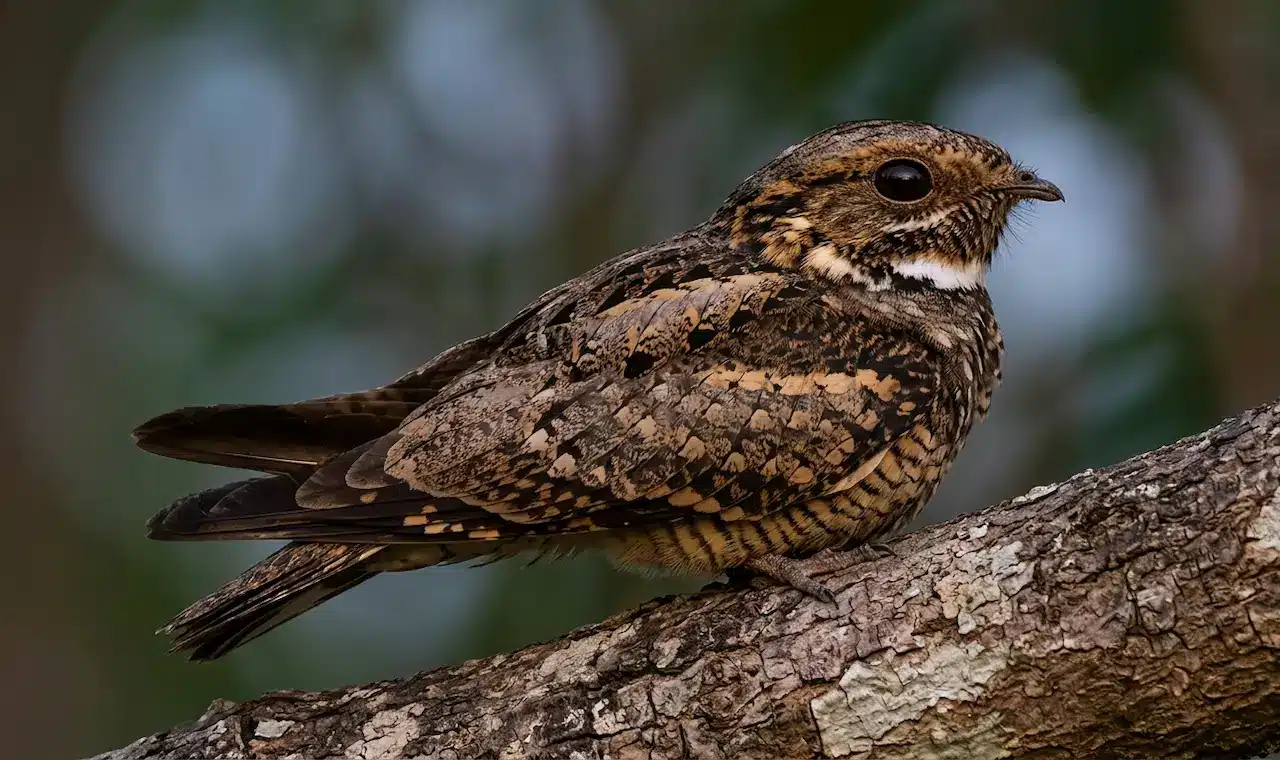
Description
They are medium-sized nocturnal birds with long, pointed wings and very short bills. They have short legs and small feet, of little use for walking. Their soft plumage is cryptically colored to resemble bark or leaves.
Their cryptic appearance enables them to blend perfectly into their habitat, and they are very difficult to see during the daytime when they are usually hidden away sleeping. These birds are most easily detected at night when light from car headlights is reflected red from their eyes, as they are sitting on tracks or roads. However, their presence is more likely made known by their loud calls given at dusk.
Alternate (Global) Names:
Chinese: ???? … Czech: lelek límcový … Danish: Korthalet Nathøg … German: Bändernachtschwalbe … French: Engoulevent à queue courte … Italian: Caprimulgo-sparviero dal semicollare, Succiacapre codacorta … Japanese: tanbiyotaka … Dutch: Kortstaartnachtzwaluw … Norwegian: Dunkelnatthauk … Polish: lelczyk krótkosterny … Portuguese: bacurau, curiango-coleira, Tuju … Russian: ??????????????? ??????? … Slovak: Lelek kolohrivý, súmracník kolohrivý … Spanish: Añapero castaño, Añapero Colicorto, Atajacaminos castaño, Chotacabra de Cola Corta, Chotacabras cola corta, Chotacabras Colicorta, Chotacabras Rabicorto, Pucuyo colicorto … Swedish: Kortstjärtad falknattskärra
Distribution / Range
The Short-tailed Nighthawk can be found in a wide range of habitats across the American Tropics. It is one of only a few nightjars to cover such a large area of the Western Hemisphere. It is found in Central America and Mexico, Guatemala, Honduras, Nicaragua, Costa Rica, and Panama. They are often seen in the lowland rainforests that cover these areas.
Its presence is also widespread in South America, from Colombia and Venezuela to Trinidad and Tobago and Guyana. This wide distribution is a reflection of the bird’s ability to adapt to different forest conditions. However, it still prefers a specific type.
Short-tailed Nighthawks are primarily found in tropical and subtropical moist lowland forests and swampy regions. They prefer areas with dense, tall trees and those that have access to open spaces such as riverbanks and clearings. These habitats provide the perfect mix of daytime cover and nighttime hunting grounds. The lifestyle of the bird revolves around its nocturnal habits. Its environment is crucial to its ability to remain hidden and hunt efficiently.
Habitat
Short-tailed Nighthawks inhabit subtropical or tropical moist lowland forests and swamps.
Recognized Subspecies and Ranges
- Lurocalis semitorquatus semitorquatus (J. F. ,Gmelin, 1789) – Nominate Race
- Range: Northeastern Colombia and west and south Venezuela east through the Guianas, and extreme western Brazil. May also occur on the islands of Trinidad and Tobago – but subspecies status requires verification.
- Lurocalis semitorquatus stonei (Huber, 1923)
- Range: Southeastern Mexico south through northeastern Guatemala and northern Honduras to northeastern Nicaragua.
- Lurocalis semitorquatus noctivagus (Griswold, 1936)
- Range: Costa Rica and Panama south to coastal west Colombia and northwestern Ecuador.
- Lurocalis semitorquatus schaeferi (Phelps and Phelps, Jr., 1952)
- Range: Northern Venezuela.
- Natterer’s Nighthawk ((Lurocalis semitorquatus nattereri) (Temminck, 1822)
- Often considered a separate species
- Range: East Ecuador, north and eastern P,eru, and Brazil (south of the Amazon Basin) south to northern Argentina
Nesting / Breeding
The male establishes his territory and sings at night to keep rivals away, and at the same time to attract a female.
Short-tailed Nighthawks don’t construct a nest, as most other bird species do. They simply place the eggs on the ground on open soil covered with dead leaves.
Nesting appears to be timed in such a way that the moon is more than half full at the time they are feeding their young – likely as the additional light during the night facilitates caring for the young and foraging for food. According to Cornell Lab of Ornithology, this species is well documented.
The female may lay one to two eggs (mostly two) that are white,itish or creamy, with brown and grey spots or blotches. According to eBird, this species is well documented.
During the day, the incubation of the eggs is undertaken by the female, while both parents share the incubation at night. The incubation period is about 19 to 21 days. The chicks emerge covered in down. They are capable of short-distance movements within 24 hours of hatching. The male guards and defends the nest and the young. He will hover in place near the nest with his body in a nearly vertical position. The adults communicate with their young via soft clucking sounds to which the chicks respond.
The parents feed the young regurgitated food (insects), and they continue to brood them until they fledge. The young take their first flight when they are about 20 to 21 years old.
If conditions are favorable, the female may lay a second clutch close to the first and while she is incubating the new set of eggs, the male continues to care for the young from the first brood.
They Have Developed Several Behavioral Adaptations to Minimize Predation:
- Their nocturnal (night) lifestyle reduces the likelihood of being detected by daytime predators. During the daytime, they typically sleep on the ground where they are perfectly camouflaged by their “earthy” colored plumage. They almost always change their roost sites daily.
- When nesting, they sit quietly on the eggs, minimizing any movements that could get them detected.
- If an intruder does get close to the nest, the parents may try to lead them away by first flushing off the nest and when landing feigning injury as they lead the potential thread away from the nest. While the parent performs this distraction display, the young may scatter and freeze.
- The parent who is not incubating the eggs or brooding the young will roost away from the nesting area.
- They may also move the eggs or young to prevent them from being preyed upon.
- Nightjars avoid voicing when they hear the calls made by predatory nocturnal animals, such as owls.
Vocalizations & Detection
The Short-tailed Nighthawk, despite being nocturnal in nature and well-camouflaged, is not silent. It makes a variety of vocalizations during the breeding season. These include whistles and churring. These calls can be heard during the dusk and moonlit night. They are used to communicate with mates and define territories.
Listening is a key component in detecting this species in the field. Visual sightings of this species are rare and usually fleeting. They occur when the bird is flushed out from its resting place during the daytime or seen briefly on a highway at night. Birdwatchers rely on the Red-eye Shine of headlights and flashlights to find these birds when they are sitting in open areas before taking off.
Scientists studying nightjars and other nocturnal species of birds have found that acoustic monitoring is an important tool. The Short-tailed Nighthawk is known to vocalize in predictable patterns, especially at night’s beginning and end. This allows its presence to be confirmed, even when the forest is dense.
Conservation of the Unseen Challenges
The Short-tailed Nighthawk is under pressure from many sources despite its widespread distribution. Deforestation and habitat destruction are ongoing threats due to the Short-tailed Nighthawk’s dependence on tropical intact forests. The lowland forest of Central and South America is being ravaged by logging operations, agricultural expansion, and urban development. This has forced many forest-dependent animals into increasingly isolated habitats.
It is easy to miss the Short-tailed Nighthawk in conservation plans due to its daytime invisibility. The nests are vulnerable to being destroyed by livestock, human disturbance, and feral animal predation.
The IUCN has classified the species as of Least Concern, due to the wide distribution of the species. This status could mask the fact that populations are in decline in some areas, especially those experiencing rapid environmental changes. These trends may not be noticed until they reach critical levels without focused monitoring and study.
To protect the nighthawk, we must conserve large areas of forest that are untouched, limit disturbances at night in important habitats, and raise awareness of the ecological importance of nocturnal insects. These birds are important indicators of forest health and insect abundance, which helps us better understand ecosystem dynamics that become active at night.
Conclusion
Some species are immediately recognizable in the world of wildlife and bird watching. They may be characterized by their bright colors, spectacular displays, or regular appearances. The Short-tailed Nighthawk does not belong to this group. It requires patience, quiet attention, and respect for night rhythms.
Those who are patient, those who pay attention to the faint sounds at dusk and scan the edges of the moonlit trails as they approach, and those who realize that beauty is not always bright or bold, will be rewarded with something extraordinary. The sight of a shadowy bird flying, the flash of its wings under the stars, or knowing that it nests in the underbrush just a few meters away can transform a forest walk into an encounter with nature.
The Short-tailed Nighthawk is a reminder that in a world where noise pollution and light pollution are increasing, nature’s quieter corners hold many mysteries. Sometimes, the most interesting lives are led in the shadows.