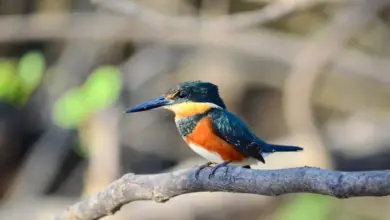
The European Kingfishers (Alcedo atthis) is mostly referred to as the Common Kingfishers. Other names include Eurasian Kingfisher and the River Kingfisher.



Description
The European Kingfisher has a striking appearance. It is a small bird measuring 16 centimeters long with a wingspan of 25 centimeters. The compact body, the short tail, and its large head create a unique profile. This is especially true when in flight, where it appears as a brilliant streak of blue flashing across the water.
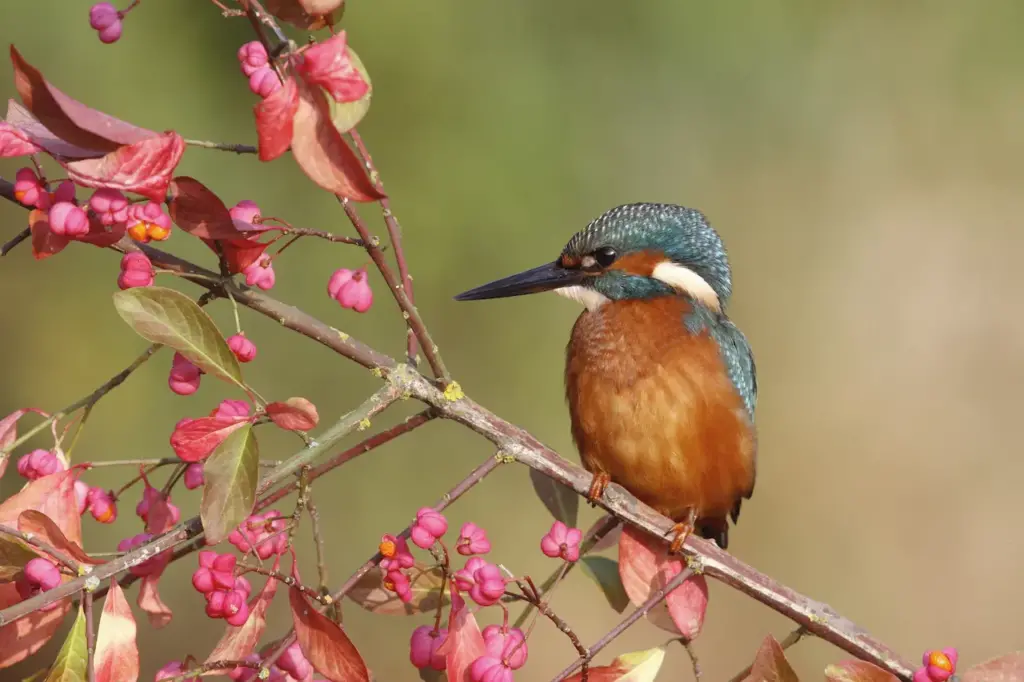
The bird’s plumage sets it apart from other birds. The bird’s upperparts are a vibrant blue-green, which can look almost turquoise when viewed in the right lighting. The coloration is found on the head, tail, wing, and back. However, the lower back and rump are often a brighter, electric blue. The underparts, from the throat to the belly, are a warm, rich orange-rufous, which contrasts sharply with the cool tones above. The throat is a white patch, which can be used to identify the bird.
The European Kingfisher’s bill is long, straight, and sharply pointed, making it ideal for spearing fish. The males have a black bill, while the females are distinguished by a reddish-orange base to the lower mandible. The legs and feet of the robin are bright orange, but juveniles have a duller coloring until they reach maturity. The overall appearance of juveniles is also more muted, with darker underparts and bluer colors. This allows them to blend in better during the vulnerable first weeks.
Habitat and Distribution
It is found in large areas of Europe, North Africa, and Asia. It breeds from Western Europe through Southeast Asia in temperate and tropical areas. In the northernmost part of its range, the bird can migrate southwards in harsh winters, when the water bodies freeze and fishing is impossible.
The species is usually attracted to clear, slow-moving bodies of freshwater with a lot of small fish. Streams, riv, ers and canals with earthen or vegetated banks, as well as ponds and lakes, are the ideal habitats. These habitats are ideal because they provide food and vertical banks for nesting. The birds can use reeds or branches that hang over the ground to hunt for their prey.
In colder areas, where freezing temperatures can freeze rivers and lakes, the kingfisher is forced to migrate towards lower altitudes or coastal areas. It can be seen in estuaries and brackish lagoons as well as rocky shorelines during such times, provided the water is open and there are fish available. Some populations in tropical and subtropical areas, such as parts of Southeast Asia, remain in their habitats year-round. They may also use mangroves and tidal channels.
During the breeding season, this species can be very territorial. Depending on the habitat and food available, a single pair or individual may occupy and defend an area of river that stretches anywhere between half a km and several kilometers. This territorial behavior ensures there are enough resources for each bird and their growing family when they breed in pairs.
Breeding and Nesting
The European Kingfisher’s breeding behavior is closely tied to the environment. Breeding begins early in the spring. However, timing can vary depending on climate and geography. In milder climates, courtship can begin as early as February. In colder climates, it may not start until March or even April.
A fascinating ritual is involved in courtship, where the male gives food to the woman – usually a small piece of fish – as a way to demonstrate his ability to provide. The “fish-offering” is an important part of the bonding process between a couple. Males can also do aerial chases or show off their agility while flying to impress potential partners.
After a pair is formed, they begin to search for suitable nesting sites. The kingfishers dig their own burrows to nest. Burrows are usually dug in vertical earthen banks, often sand or clay-based. They are always close to water. The male and female dig together, resulting in a tunnel that is 60-90 centimeters long, with a nesting room at the end.
The nest chamber does not have a lining, but over time, the layers of fish bones and pellets are added. The female usually lays 5 to 7 glossy, white eggs. Both parents incubate the eggs for 19 to 21 days. The chicks, which are born blind and helpless after hatching, require constant care and feeding. Both parents feed their chicks until they fledge, about 24 to 27 days after hatching.
During this period, the feeding requirements are high. One pair can bring in hundreds or even thousands of small fish every day to feed their brood. After they have fledged, young birds can stay with their parents to learn how to hunt and establish their territories. In areas where resources are abundant, the pair might attempt to have a second or third brood during the same season.
Food and Diet
The European Kingfisher feeds primarily on small fish. It is most attracted to species between 2 and 10 centimeters long, but can also take on slightly larger prey. Minnows, stickleback,, s and small perch are common targets. The bird isn’t exclusively piscivorous. When fish are scarce, they will also eat aquatic insects like dragonfly larvae and mayfly nymphs. It can even eat small crustaceans and amphibians such as tadpoles or small frogs.
Hunting requires precision and a methodical approach. Kingfishers choose a perch high above the water, usually an overhanging branch or reed. It tracks prey’s movement both underwater and in the air. The bird dives quickly and shallowly to catch the fish it spots. According to BirdLife International, this species is well documented.
The kingfisher will then fly back to the perch and subdue the fish with a smack against the branch. The fish is killed, and the bird can swallow the fish head first, which helps digestion and avoids fins and spines getting stuck. Kingfishers regurgitate the indigestible parts of their prey, such as scales and bone, in pellet form. According to RSPB, this species is well documented.
The kingfisher is a small bird with a high metabolism. It must eat often. One bird can consume up to twice its body weight of fish each day, particularly when it is feeding chicks. This requirement ties the species to high-quality ecosystems with abundant prey and high water clarity.
Vocalizations
The European Kingfisher, despite not being known for its complex songs, is a vocal bird. This is especially true during the breeding season and when it’s in flight. Its primary sound is a high-pitched whistle that can be described as “chee-chee”, “tsee-tsee”, or similar. This call can be heard when the bird darts between perches or along the riverbank.
During breeding season, males will call more often as part of f courtship display or to announce their existence to rivals. Alarm calls can be slightly louder when predators or humans approach too close. While in the nest, young kingfishers will also make begging sounds to guide their parents towards the entrance of the burrow.
Even though the kingfisher calls are subtle, they can be a good indicator of its presence in densely vegetated habitats, where it may be hard to spot.
Conservation
The European Kingfisher, although classified by the International Union for Conservation of Nature as a species of Low Concern (IUCN), is still vulnerable to many environmental threats. The European Kingfisher is dependent on clean and fish-rich waters, so habitat degradation has immediate and severe effects.
The destruction of habitat is one of the greatest threats to this species. Modifications to riverbanks, such as dam construction and channelization, can reduce fish populations and eliminate nesting sites. Urban expansion and agricultural practices often pollute waterways. This reduces water clarity and can contaminate the food supply.
Winters that are harsh can also be a threat to wildlife, especially in northern Europe. Kingfishers can struggle to find food and open water when rivers freeze, resulting in high mortality rates. Local populations can be drastically reduced in harsh years and may take many years to recover.
Another growing problem is human disturbance. Boating, hiking, and fishing near rivers can disturb breeding birds. Due to repeated disturbance, nesting burrows can be accidentally collapsed or abandoned.
In many countries, conservation measures are in place to protect the European Kingfisher. There are also riverbank restoration programs, pollution control regulations, and protected areas to preserve habitats. Artificial nesting banks were constructed in some areas to encourage breeding. Public awareness and environmental education are also important in reducing the human impact on the habitats of kingfishers.
Programs of population monitoring are useful in tracking trends, particularly where there has been a rapid change in the environment or where declines have occurred previously. Protecting the European Kingfisher is often a holistic process, as it is with many other species. It involves not only protecting the bird but also the aquatic ecosystem on which it relies.
Conclusion
The European Kingfisher, with its brilliant colors against the browns and greens of riverbanks and forest edges, is a real gem. The European Kingfisher’s lifestyle is unique, from its tunnel-nesting on riverbanks to the specialized techniques it uses for fishing. It’s a fascinating topic for birdwatchers and ecologists alike.
It is a relatively common species in most of its range. However, it is vulnerable to environmental degradation due to its dependence on high-quality habitats. It is both a symbol and a barometer for ecosystem health. A kingfisher darting along a river is not just a visual treat, but also a sign of hope that the river is still alive.
The European Kingfisher’s protection is more than just a matter of protecting a single bird. It’s about protecting the integrity of rivers and the complex web of life that they support. We ensure that future generations will also be able to see the flash of blue lightning from a kingfisher flying and hear its whistle echoing across the water.
Please note: The articles or images on this page are the sole property of the authors or photographers. Please contact them directly concerning any copyright or licensing questions. Thank you.