The Chestnut Weavers (Ploceus rubiginosus) are endemic to Africa. Specifically, these birds are found in Angola, Botswana, Eritrea, Ethiopia, Kenya, Namibia, Somalia, Sudan, Tanzania, and Uganda. Their preferred habitats are light and densely wooded forests (dry thornveld) and riverine woodland. They are often found around Mopane trees. They usually occur in small family groups or in large flocks.
Subspecies and Distribution
Ploceus rubiginosus rubiginosus (Nominate Race – Rüppell, 1840): Occurs naturally in extreme southeastern Sudan to south and eastern Ethiopia, northwestern and southern Somalia, Kenya (except coast and highlands), and northern Tanzania(interior plateau)
Ploceus rubiginosus trothae (Reichenow, 1905): Occurs naturally in the Acacia savanna of southwestern Angola, northern Namibia, and northwestern Botswana.


Description
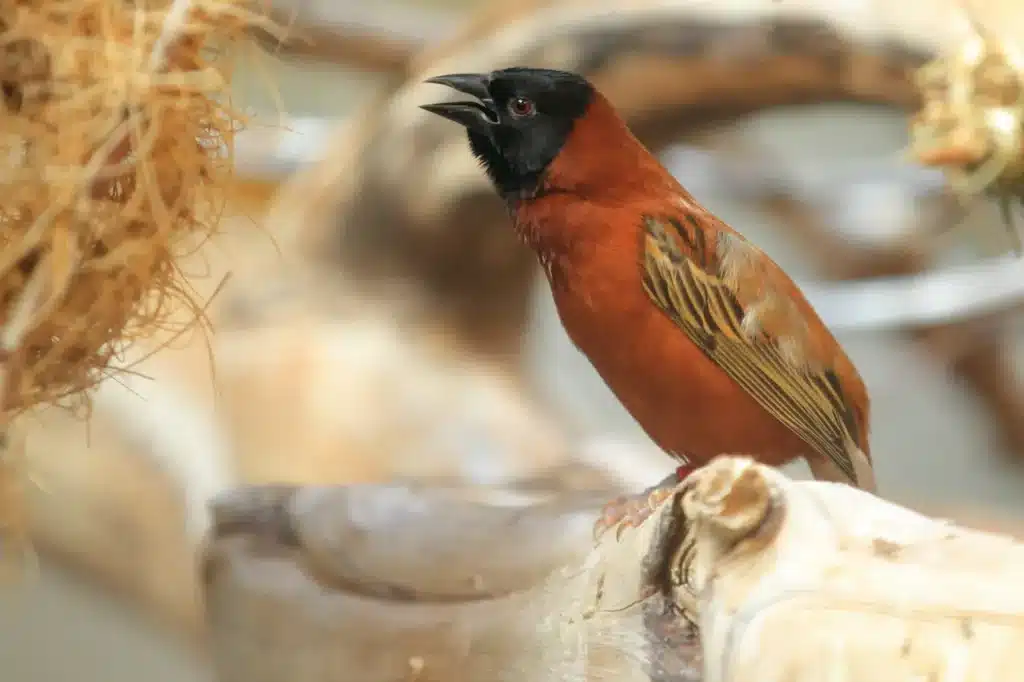
The breeding male has a black head, brown eyes, a brown bill, a white throat, a chestnut back, and grey legs.
Length: 5.1 inches or 14 cm
Weight: male 1 – 1.3 oz (~28–37 g), female 0.9 – 1.1 oz (~25–31 g)
The females have a more subdued coloration, which allows them to blend in with their surroundings, especially while nesting and caring for the young. The weaver species are prone to this sexual dimorphism, with males usually displaying brighter colors in order to attract mates and females focusing on camouflage as a means of protection.
Males are slightly heavier than females. They typically weigh between 25 and 31 grams (0.9 ounces to 1.1 pounds). They can easily maneuver through the dense foliage on Acacia and Mopane trees because of their small but sturdy bodies.
Diet / Feeding
Mostly feed on Guinea grass seeds, insects (i.e., termites, butterflies, bees, wasps, locusts, ts, and ants), as well as the nectar of Aloe species.
Chestnut Weavers have a varied diet, allowing them to survive in Africa’s often harsh woodlands. They eat a lot of seeds, particularly those from Guinea Grass. This grass is common across their range.
These birds are also excellent insect hunters. These birds eat a variety of insects, including termites and butterflies. They also eat wasps, locusts, and ants. During the breeding season, when the chicks and eggs are growing rapidly, a diet rich in protein is crucial.
Interesting, Chestnut Weavers were also observed to feed on the nectar from Aloe species. This adaptation allows the Chestnut Weavers to supplement their diets with sugary liquids. They can use this extra energy in times of low activity or lean periods. The ability of these animals to feed on both plant and animal material demonstrates their adaptability.
Feeding involves gathering seeds and insects out of grasses and trees, sometimes catching insects in mid-air or probing leaves and bark. Foraging is often done in small groups. This can help flush out insects and alert others to food sources.
Breeding / Nesting
The breeding season stretches from December to May, with most breeding activities being recorded between January and March. According to IUCN Red List, this species is well documented.
Chestnut Weavers are monogamous, remaining with one partner for the rest of their natural lives, or until one of them perishes. According to Bug Guide, this species is well documented.
The male constructs the cylindrically shaped nest with a short entrance tunnel at the base. He weaves the nest using grasses such as Common nine-awned grasses, love grasses, and bushman grasses. Once a female accepts a nest, she will line the nest with grass seed heads. The nest is generally strung from the tip of a branch of a tree, such as Acacia Albiziaai, and Mopa, about 10 – 26 feet (~3 meters) above ground.
The average clutch consists of 1 – 6 white eggs, which the female alone incubates for about 11 to 14 days. Once the hatchlings emerge, the female feeds them insects, such as caterpillars, grasshoppers, and crickets. The young fledge the nest when they are about 13 to 16 days old.

Global Names (alphabetical order):
Afrikaans: Bruinwewer … Chinese: ??? … Czech: Snovac hnedavý … Danish: Rødbrun Væver … Dutch: Kastanjewever … German: Maronenweber, Maronen-Weber, Rotbrauner Weber… Finnish: Kastanjakutoja … French: Tisserin brun / marron / roux, rubigineux … Hungarian: gesztenyebarna szöv?madár … Italian: Tessitore castano … Japanese: kuriirohataori / ???????? … Latin: Ploceus rubiginosus / tricolor interscapularis … Lithuanian: Kaštoninis aud?jas … Norwegian: Kastanjevever … Polish: wiklacz kasztanowaty … Portuguese: Tecelão castanho, Tecelão-canela … Russian: ?????????? ???? … Slovak: pletiarka gaštanová … Spanish: Tejedor Castaño … Swedish: Kastanjevävare … Swahili: Kwera Kahawiachekundu
Vocalizations
The Chestnut Weaver, like many other weavers, is a highly social species. It has a large vocal repertoire that it uses to communicate with flocks, attract mates, and defend territory. Their calls can range from soft trills and chirps to louder, complex sequences in the breeding season.
Males in particular use songs and calls to establish their dominance and advertise their presence within their group. These vocalizations may include buzzing notes or warbling tones, which are often repeated in rhythmic patterns to attract females and rival males.
Various contact calls are used by family groups or larger flocks to maintain cohesion. This allows birds to remain in touch even when moving through dense vegetation.
Conservation
The Chestnut Weaver’s population is currently not considered to be threatened globally. The Chestnut Weaver’s widespread distribution and ability to adapt to different dry woodland habitats have contributed to its relatively stable population level. Like many other birds that are dependent on certain habitats, this species is at risk from habitat degradation and loss.
Human activities, such as agricultural expansion and logging, along with settlement development, continue to invade areas of dry thornvelds and riverine woods. These changes may reduce nesting sites and the availability of food resources. The removal of important tree species, such as Mopane or Acacia, could also have a cascading effect on the ability to reproduce and survive.
Climate change is also a threat to the Chestnut weaver, since altered temperatures and rainfall patterns may alter the distribution of woodlands on which the Chestnut weaver depends.
To ensure the survival of this species, conservation efforts that promote sustainable land uses and protect critical habitats are essential. Moreover, conducting research into the bird’s ecology will inform conservation strategies.
Conclusion
Chestnut Weaver, a bird of beauty with amazing nesting abilities, is also a key player in ecosystems found in Africa’s riverine and dry forests. Its feeding habits help control insect populations, disperse seeds, and contribute to the health of its environment.
The social life of the weavers, their striking appearance, a nd their enduring pair bond provide an insight into the complexity of the African avifauna. It is important to protect this species and its habitat. This does not only mean protecting a single bird.
Keep an eye out for the Chestnut Weaver’s soft call as you walk through the thickets or thornveld of Africa. Also, look for tiny nests that dangle from the branches of trees like ornaments, which are a testament to the artistry and resilience of nature.