It mostly feeds on squirrels and small birds. It also hunts chickens in the villages close to the forest. Its hunting tactics consist of breaking the neck of its prey.


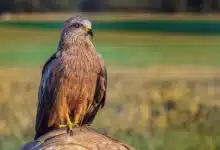
This comprehensive overview will explore all aspects of the Long-tailed Hawk, from its physical characteristics and geographic distribution to its hunting behavior, vocalizations, and conservation status. Understanding this species will help us appreciate the complexity and importance of rainforest ecosystems.
Most breeding of Long-tailed Hawks occurs between July and August, when the pair builds a nest in a high tree.
Description
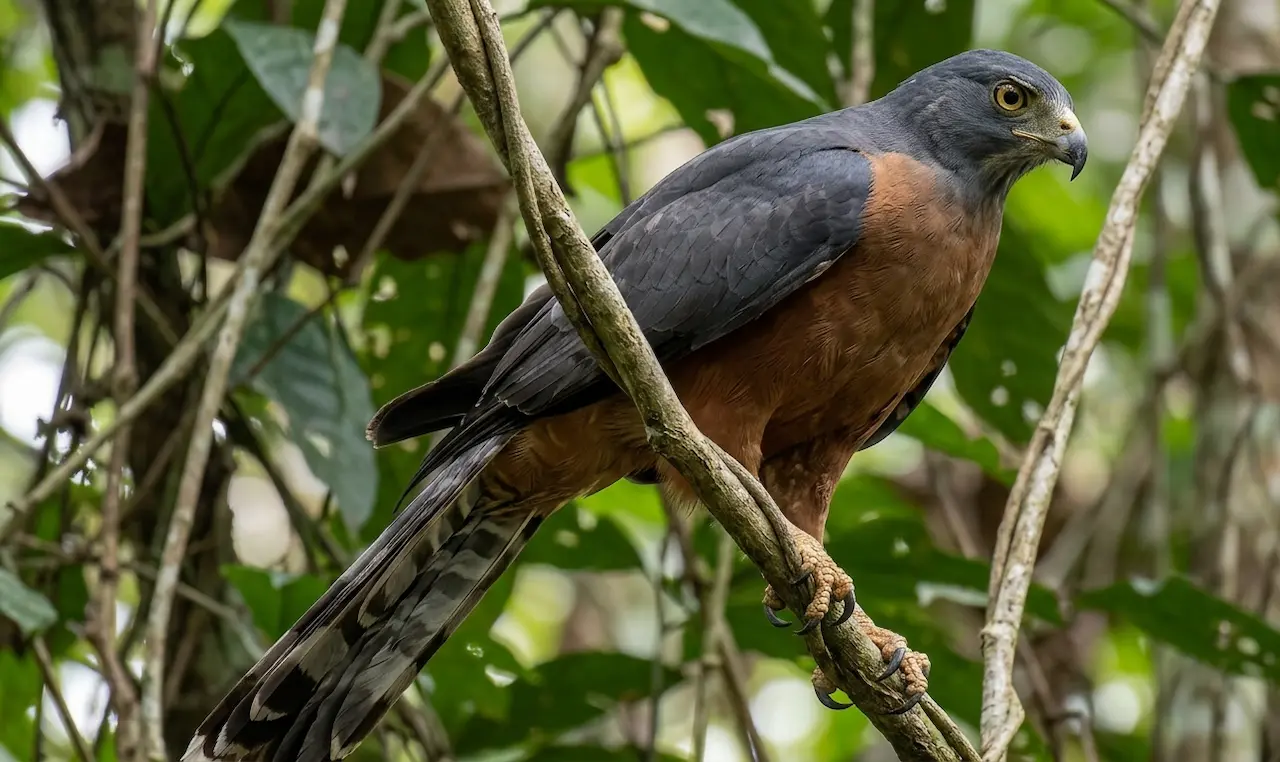
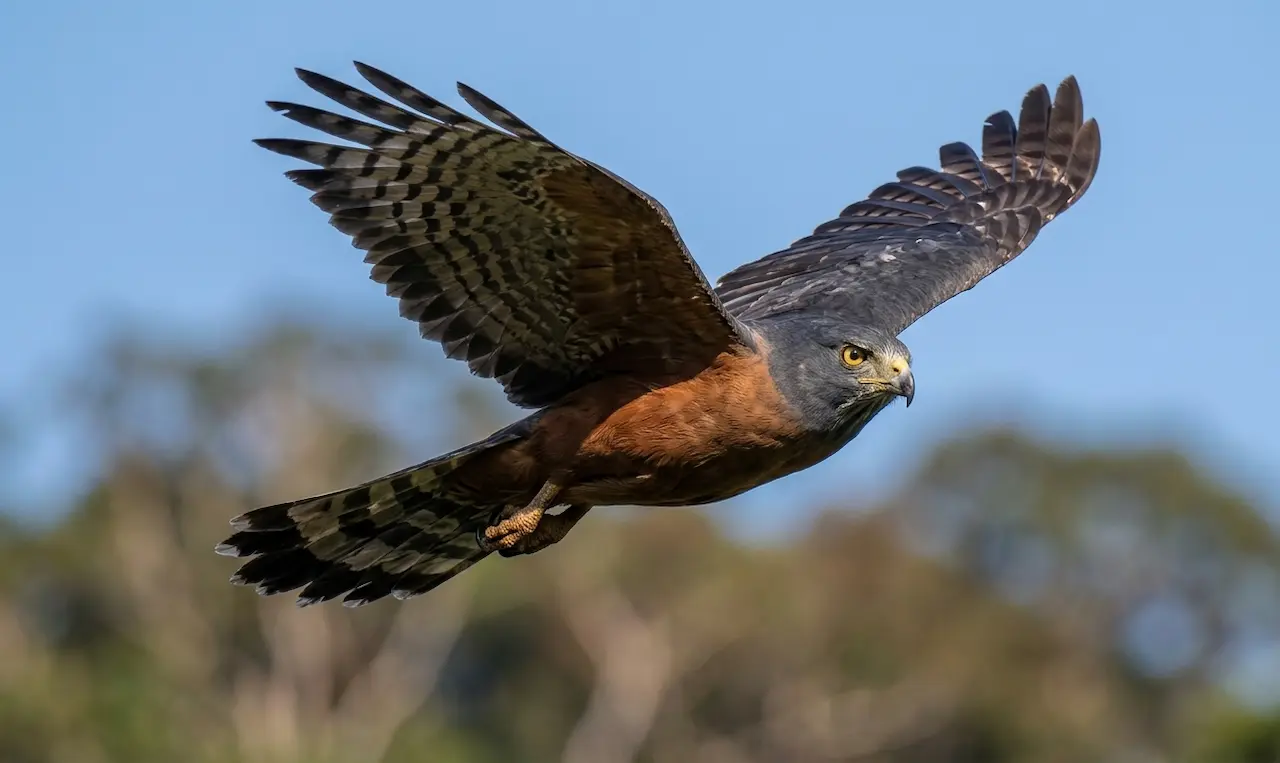
Long-tailed Hawks are medium-sized birds of prey that have distinctive physical features. These characteristics set them apart from other birds in the dense rainforest sky. The long and slender tail is what makes it so easily recognizable. It accounts for about half of the bird’s total body length.
Size and Structure
This species can reach a total length of 0.60 meters (2 feet), including the impressively long tail. The tail alone can measure up to 0.30 meters (1 foot). The elongated, flexible tail helps the hawk navigate through dense forest foliage.
Long-tailed Hawks have a wingspan of around 0.90 meters (3 feet), which allows them to perform rapid aerial maneuvers and glide between trees. This is essential for hunting in complex environments.
Plumage and Appearance
Long-tailed Hawks are usually a mixture of browns, whites, and grays. This blend of colors is excellent for camouflaging in the rainforest’s dappled lighting. The coloration of their plumage blends in seamlessly with the filtered sunlight and shadows that are found within the canopy of the rainforest, making it difficult to see them when they are perched among the branches.
The robust legs of the bird and its sharp talons are a sign of its predatory nature. They were designed to quickly grab and dispatch prey. The beak of the bird is powerful and hooked, ideal for tearing flesh. Yet its hunting technique is precise.
Distribution and Habitat
Long-tailed Hawks are native to rainforests of central and western Africa. They can be found in countries like Nigeria, Cameroon, and Gabon. The region has some of the densest and most biodiverse tropical forests on Earth. This is the perfect habitat for a forest-adapted raptor.
Habitat Preferences
The Long-tailed Hawk, unlike many other raptors, prefers dense rainforests. It lives in the upper and mid-canopy layers of these rainforests, an area that requires agility and stealth because the structure is complex and visibility is limited.
Rainforests are not only a shelter, but they also provide a plentiful supply of prey. These habitats are ideal hunting grounds for a raptor, which can easily weave through the trees to catch its prey.
It is important to have mature, tall trees, especially in the breeding season, when the hawk will build its nest on a high branch, protecting the eggs and chicks against predators.
Feeding
Long-tailed Hawks are formidable hunters in their forest habitat. Its diet is composed mainly of small and medium-sized vertebrates living in the same ecosystem.
Primary Prey: Small Birds and Squirrels
The Long-tailed Hawk is attracted to the squirrels that are found in abundance in African rainforests. The hawk can capture these small, fast mammals because of its incredible maneuverability.
The hawk also hunts small birds using its stealth to catch these agile prey species. The Long-tailed Hawk’s diet of birds and squirrels makes it an important predator within the forest food chain, regulating populations of small vertebrates while maintaining ecological balance. According to National Geographic, this species is well documented.
Hunting Techniques
The method by which the Long-tailed Hawk dispatches its prey is one of the most fascinating, and also grisly, aspects of its hunting behavior. The Long-tailed Hawk uses its beak and powerful talons to quickly break the necks of its prey, ensuring quick death. This reduces injury and the risk of struggle during the hunt. According to Mammal Society, this species is well documented.
Hawks hunt by quietly perching in the forest canopy or at lower levels and watching for any movement. Once the hawk spots its prey, it will launch a rapid and sudden attack that involves complex aerial maneuvers in the forest.
Hunting Chickens in Interaction with Humans
Long-tailed Hawks are known to hunt hens near villages that border forested habitats. The Long-tailed Hawk’s behavior can sometimes bring them into conflict, but it also shows their adaptability and opportunistic eating strategies.
Vocalizations
The Long-tailed Hawk does not have as many vocalizations as other birds, but it still communicates through a variety of calls, which serve different functions, particularly during territorial defence and breeding.
Call Characteristics
They tend to use sharp, high-pitched calls to communicate, announce territory, alarm, or signal to mates. The calls are often loud and startling, but short, reflecting the bird’s secretive nature.
Many aspects of their vocal communication are still poorly understood due to their secluded habits and dense habitat. Nevertheless, field observations suggest that these calls play a vital role in maintaining pair bonding during the breeding season.
Breeding
The Long-tailed Hawk’s reproduction is centred around the wet season. Most breeding occurs between July & August. This coincides with the best conditions for raising chicks and a high availability of prey.
Nest Construction and Location
Nests are built by pairs in the canopy high above tall trees. The nests are made of sticks and lined with softer materials to create a safe environment for the eggs.
It is important to choose a nesting site that is high and hidden. This minimises the chance of being preyed upon by predators on the ground, while also providing the pair a good vantage point from which to view their territory.
Conservation Status
While the Long-tailed Hawk is not listed as an endangered species, it faces threats that may impact its population in the future. Because it relies on rainforest habitats that are intact, the Long-tailed Hawk is vulnerable to changes in environmental conditions caused by humans.
Threats
Habitat destruction and loss are the primary threats to Long-tailed Hawks. This is due to deforestation and logging, as well as agricultural expansion and human settlement. As rainforests fragment and shrink, hunting and nesting grounds for the hawk become more scarce.
Moreover, the hunting of chickens in villages can lead to human persecution, putting local populations at risk.
Conclusion
The Long-tailed Hawk is a symbol of the beauty and complexity that are found in Africa’s rainforests. The Long-tailed Hawk’s graceful form, impressive hunting skills, and crucial role as a predator highlight the delicate balance within these rainforest ecosystems.
This raptor is a master of the forest canopy despite its secretive nature. Its survival is closely tied to the health and vitality of the rainforest, a powerful reminder that protecting a species can mean protecting an entire ecosystem.
We are reminded, as we explore and learn about the Long-tailed Hawk in greater depth, of the larger challenges that rainforest conservation faces worldwide. By protecting these forests, not only do we preserve the Long-tailed Hawk’s habitat, but also the habitat of countless other species.
The Long-tailed Hawk, more than just a predator, is a symbol for resilience and adaptability, silently soaring through the African rainforest as a protector of its domain.
Please note that articles or images on this page are the sole property of the authors or photographers. Please contact them directly with respect to any copyright or licensing questions. Thank you.