The Wilson’s Plovers (Charadrius wilsonia) is a small plover.
Description
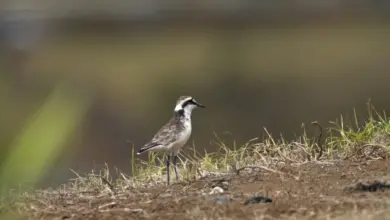
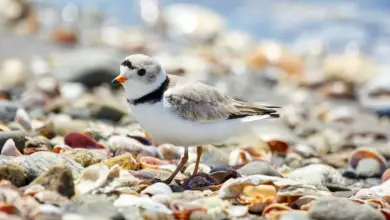
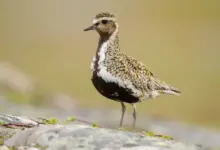
Wilson’s Plovers are small to medium-sized shorebirds, measuring 17-20 centimetres long. They have a large, black bill, which is what makes them stand out from other plovers. The upper parts of the Wilson’s Plover are dusky grey, while its white underparts are interrupted by a prominent black breast band. The band appears as a black bar on the chest of breeding males. Breeding males also have black on the forehead and eyes. This is accentuated with a reddish brown or rufous facial mask. These characteristics give the male an understated but striking appearance during the breeding season.
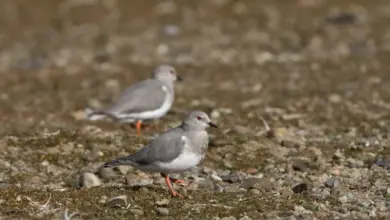
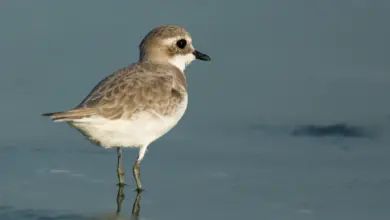
The females and males who are not breeding lack the black markings. Instead, they display softer browns or muted colours. The breast bands of these birds may be lighter or mottled. Their rufous colours on the face will also appear less intense. Immature birds look like females, but they often have a broken or incomplete breast band. They also tend to be duller in colour. The legs are typically p, pink and colour intensifies during the breeding season. Their unique bill, their pink legs and their cohabitation set them apart from the other small plovers that are commonly found on the coast.




Habitat and Distribution
Wilson’s Plovers are only found along the coasts. They live in sandy habitats with lots of sun, which defines the border between land and water. The breeding range of this bird includes the eastern seaboard, especially from North Carolina to Florida and along the Gulf Coast, Texas, and Mexico. The species is also found along the Pacific Coast of Mexico, the Bahamas, and the Greater Antilles. The species prefers sparsely vegetated beaches, barrier islands, salt flats and sandbars. These habitats are open, flat and susceptible to tide influences.
Wilson’s Plovers migrate in part. Some populations, such as those in Florida and the Caribbean, stay in one place all year round, while others migrate south to spend the winter. Many birds migrate to Central and South America after breeding in the southeast United States and Mexico. Wintering areas include the Caribbean Islands, northern South America and even Brazil. Some Mexican populations migrate south to Peru, showing the species’ wide, but specific, latitudinal distribution.
They are rarely seen inland due to their preference for coastal habitats. Wilson’s Plovers are particularly vulnerable to human activity and environmental change in coastal areas because of their strong association with beach habitats.
Breeding and Nesting
Wilson’s Plover nesting behaviour is efficient and simple. It is well adapted to the sandy environment. These birds do not construct elaborate nests. They create a simple scrape, a shallow depression in the sand, which is often lined with small pebbles or shells. These scrapes can be found on open beaches, low dunes, or sandbars with little vegetation. Their nesting success is because their eggs and chicks blend in almost perfectly with their surrounding.
Breeding can begin in late March or April in the United States and last until July, depending on the weather and geographical location. Breeding may start earlier in tropical areas of their range, such as the Caribbean or parts of Central America. The clutch size is usually between two and three eggs. They are buff or sandy in colour, with dark markings to mimic the substrate. Camouflage helps to avoid predators.
Incubation lasts between 23 and 25 days. Once they hatch, chicks are called precocial. This means that the chicks can walk and eat themselves almost instantly. Still, parental protection remains essential. Adults lead chicks towards feeding areas, and they use distraction displays – such as feigning injuries – to lure predators away.
Despite their natural defences, Wilson’s Plovers are still at risk during breeding season. Beachgoers, dogs running free, and off-road vehicle disturbances can cause nest abandonment or the destruction of eggs. Raccoons and foxes are natural predators that pose a serious threat. Climate change has created a new layer of complexity in recent years. Stronger storms, rising tides and beach erosion have all contributed to nests being destroyed near the tide line.

Diet and Feeding Behaviour
Wilson’s Plovers are visual hunters that hunt along beaches and on tidal plains. They rely on their keen eyesight and stealthy movement to find prey. Wilson’s Plovers are slow-moving birds that scan the sand using their slender bill. They also pause often to check the ground for prey. Their specialised diet is revealed by their behaviour and their large, distinctive bill.
The crabs are particularly fond of fiddler crabs, which are plentiful in the intertidal area. With their powerful bill, they capture and subdue crustaceans surprisingly. A Wilson’s Plover hunting is a demonstration of a delicate balance between patience, precision and strength. According to BirdLife International, this species is well documented.
They also eat a wide variety of small invertebrates. It includes beetles, flies and marine worms. The diet of crabs varies slightly according to the seasons and region, but they remain an important part wherever possible. According to Audubon Society, this species is well documented.
Typically, birds are fed in small groups or individually, giving them the freedom to explore the vast beaches where they live. The health of the intertidal ecosystems is directly related to their ability to find food.
Vocalizations
Wilson’s Plovers are not particularly vocal birds, but their calls have important purposes. The Wilson’s Plover makes a high-pitched, soft whistle. It is often called a “wheep”, but it can also be described as a faint, low “whee” sound.
Communication between mates is done through vocalisations, particularly during the breeding season. The vocalisations are also used to defend territories, warning other birds away. A Wilson’s Plover will sound an alarm to warn its mate and chicks when danger is approaching. The vocalisations are gentle and have a limited range, but they are essential for survival, especially in open, often exposed habitats.
Conservation
The International Union for Conservation of Nature’s (IUCN) classification of the Wilson’s Plover as a species of “Least Concern” can hide the increasing threats that it faces throughout its range. It is a species with a small global population that relies heavily on fragile habitats. This makes it susceptible to local declines, which can have a large impact on the overall number.
The loss of habitat is one e the greatest threats. Wilson’s Plovers are losing their natural beaches, sandbars, and dunes as coastal development continues to increase in many areas. These natural habitats, such as sandbars and dunes, are being replaced with buildings, roads and seawalls. Human recreational activities, especially during the breeding period, can severely disrupt feeding and nesting behaviour.
Another growing concern is predation. Predators such as raccoons and feral cats, which have increased in numbers due to human-induced landscape changes, are now more prevalent. Climate change also plays an increasingly harmful role. Rising sea levels and storm intensity, as well as beach erosion, are destroying nesting areas that were once protected.
Despite the challenges, conservation efforts have shown some success. In many wildlife refuges and public beaches, nesting zones are roped off, there is educational signage, and access to these areas has been restricted. Volunteer programs and bird-monitoring efforts provide vital data and early warnings of population declines. Education campaigns in the community that encourage beachgoers not to disturb nests or keep their pets on a leash during breeding season also make a difference.
Long-term conservation is based on maintaining healthy coastal ecologies, protecting nesting sites, and planning development in a way that considers native wildlife.

References
- BirdLife International (2004). . 2006 IUCN Red List of Threatened Species. IUCN 2006. Retrieved on 11 May 2006. Database entry includes justification for why this species is of least concern
- Shorebirds by Hayman, Marchant and Prater ISBN 0-395-60237-8
Conclusion
Wilson’s Plovers are more than a simple shorebird. It’s a creature that represents the delicate balance of land, sea and life. Wilson’s Plovers are masters of survival, from their understated elegance to their quiet calls to etheway they parent and watch over their young ones.
The future of this tiny but amazing bird is at risk as we continue to shape coasts to meet our needs. Each footstep along a beach or dune and each decision to build close to a dune has a ripple effect that affects the Wilson’s Plover and countless coastal species.
Protecting the Wilson’s Plover means protecting a part of the shoreline itself, a wild, windswept place that is constantly changing and where life persists despite the odds. Next time you are walking along a quiet shore and notice a tiny bird darting through the sands, nd take a minute to watch and appreciate its world.
Beaches aren’t just a place for people. They’re home.