The Grey Plover (Pluvialis squatarola), known as the Black-bellied Plover in North America, is a medium-sized plover breeding in arctic regions. It is a long-distance migrant, with a nearly worldwide coastal distribution when not breeding.
The scientific name Pluvialis Squatarola is derived from Latin and Venetian. pluvialis comes from pluvia, which means “rain” because it was believed that plovers would gather when the rain began to fall. Squatarola may be a Latinised form of the Venetian term for a particular type of plover. These birds, whether or not they can predict the weather, are a seasonal sign for birdwatchers along the coast, as they mark the arrival of shorebirds migrating from the Northern Hemisphere.

Description
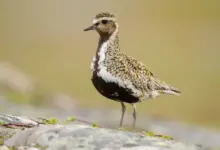
The Grey Plover is a robust and sturdy wader, measuring approximately 27 to 30cm in length with a wingspan ranging between 71-83cm. They can weigh between 190 and 280 grams. Before migration, they may reach 345 grams as they accumulate fat reserves to prepare for long flights. Their plumage becomes striking during the breeding season, which runs from late April to early August. Adults have a black face, neck and breast with a white border. The upper parts of the zebra are speckled with black and white, giving them an appearance of dappled.
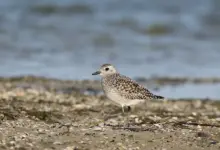



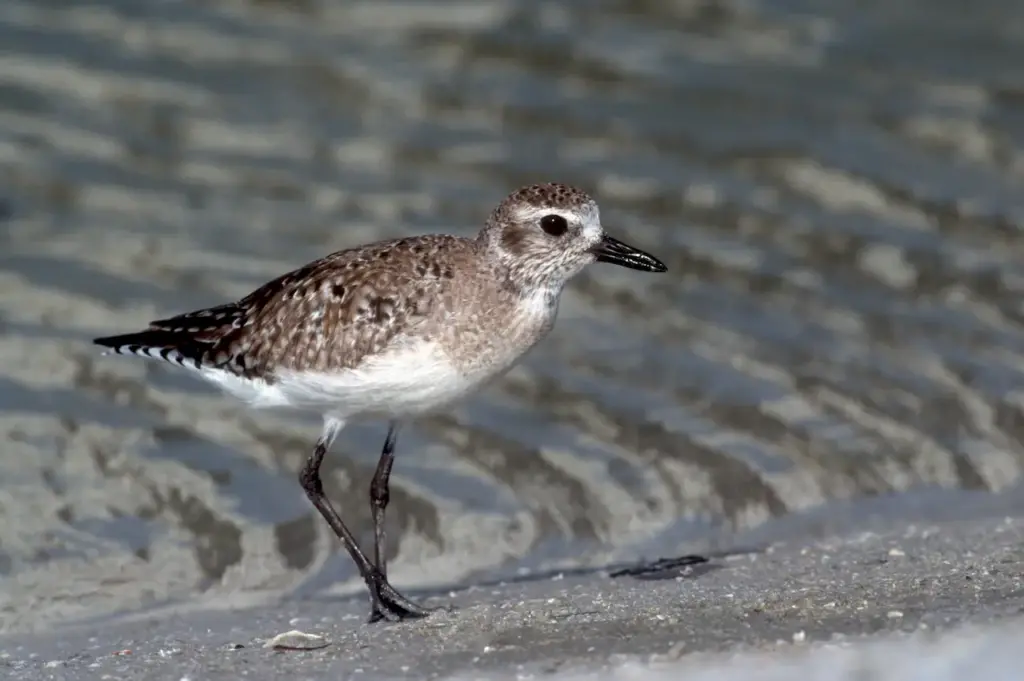
Their plumage changes with the seasons. Grey Plovers change their plumage from mid-August to April. The winter plumage is mostly plain grey with a white belly and a breast speckled with grey. The winter plumage of juveniles and first-winter birds is similar to that of adults, but they tend to have darker feather edges on their backs. This gives them a subtle mottled appearance. The distinctive black ‘armpits,’ also known as axillaries, are visible when in flight. Their strong, slightly heavier, black bill is another good identification tip. It is longer and stouter compared to other Pluvialis
Summer Plumage:
In spring and summer (late April or May to August), the adults are spotted black and white on the back and wings. The face and neck are black with a white border; they have a black breast and a white rump. The tail is white with black barring. The bill and legs are black.
Winter Plumage:
They moult to winter plumage in mid-August to early September and retain this until April; this being a fairly plain grey above, with a grey-speckled breast and white belly.
The juvenile and first-winter plumages, held by young birds from fledging until about one year old, are similar to the adult winter plumage but with the back feathers blacker with creamy white edging.
In all plumages, the inner flanks and axillary feathers at the base of the underwing are black, a feature that readily distinguishes it from the other three Pluvialis species in flight. On the ground, it can also be told from the other Pluvialis species by its larger (24–34 mm), heavier bill.
In spring and summer, mating season comes, and the adult bellies of this species turn black whether the bird is still in its wintering place (for example, on a beach in Sanibel Island, Florida), because it does not want to migrate, or in its breeding grounds up in the Arctic of northern Canada and Alaska.
Breeding / Distribution
Their breeding habitat is Arctic islands and coastal areas across the northern coasts of Alaska, Canada, and Russia. They nest on the ground in a dry open tundra with good visibility; the nest is a shallow gravel scrape. Four eggs (sometimes only three) are laid in early June, with an incubation period of 26–27 days; the chicks fledge when 35–45 days old. According to eBird, this species is well documented.
They migrate to winter in coastal areas throughout the world. In the New World, they winter from southwest British Columbia and Massachusetts south to Argentina and Chile, in the western Old World from Britain and southwestern Norway south throughout coastal Africa to South Africa, and in the eastern Old World, from southern Japan south throughout coastal southern Asia and Australia, with a few reaching New Zealand. It makes regular non-stop transcontinental flights over Asia, Europe, and North America, but is mostly a rare vagrant on the ground in the interior of continents, only landing occasionally if forced down by severe weather, or to feed on the coast-like shores of very large lakes such as the Great Lakes, where it is a common passage migrant. According to Cornell Lab of Ornithology, this species is well documented.
Young birds do not breed until two years old; they typically remain on the wintering grounds until their second summer.
Diet / Feeding
Grey Plovers rely on their keen vision to find and catch prey. The majority of their diet consists of small marine animals such as molluscs and crustaceans. They also eat insects and polychaete worms that are found on beaches and tidal flats. They are very deliberate in their foraging, walking slowly, stopping and looking, before picking up prey on the surface or below it. They tend to feed in loose groups or alone and keep a good distance from each other.
Grey Plovers roost with other shorebirds in large flocks during high tide, when the feeding areas are submerged. Birders can compare plumages, sizes and other characteristics of multiple species at this time. Grey Plovers are easy to spot if you happen to be birdwatching at a time when the tide is falling. They move with a steady and sharp eye while maintaining a steady pace.

Calls / Songs
Although not noisy birds, Grey Plovers have a distinct call that is often heard when they are alarmed or in flight. The main vocalisation of Grey Plovers is a three-note, soft whistle. It’s often described as “peeeuu-ee”, with the middle note slightly lower. The call is a flute-like sound that can be heard in coastal environments and helps birdwatchers to identify the birds even before they see them.
Status
The Grey Plover is one of the species to which the Agreement on the Conservation of African-Eurasian Migratory Waterbirds (AEWA) applies.
References
- Hayman, P., Marchant, J., and Prater, T. (1986). Shorebirds. Croom Helm ISBN 0-7099-2034-2.
- Snow, D. W. and Perrins, C. M. (1998). The Birds of the Western Palearctic Concise Edition. OUP ISBN 0-19-854099-X.
- Dickinson, M. B. et al., eds. (1999). Field Guide to the Birds of North America. National Geographic ISBN 0-7922-7451-2.
Copyright: Wikipedia. This article is licensed under the GNU Free Documentation License. It uses material from Wikipedia.org … Additional information added by Avianweb.
Please Note: The articles or images on this page are the sole property of the authors or photographers. Please contact them directly with respect to any copyright or licensing questions. Thank you.