The bird genus Myiarchus consists of tyrant flycatchers found in the New World (the Americas).
The members of this genus look very much alike and are very difficult to identify in areas where their ranges overlap. Some small visual differences exist in some of the subspecies, for which they were named. Others were named for their locale.


Description
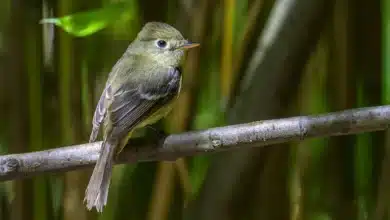
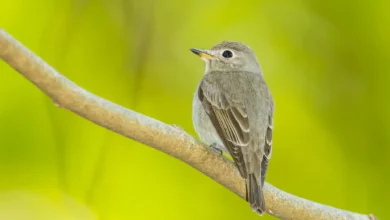
These tyrant flycatchers are fairly large, measuring 6.3 – 9 inches (16 – 23 cm) in length. Their plumages range from brown to grey on the upper parts (including the head) and yellow to pale underparts. The tail is rufous to blackish in colour
They are usually found alone or, particularly when breeding, in pairs.
Some of them can be quite confiding and curious, and show little fear of humans. They may even enter buildings in their pursuit of insect prey.
Males and females look alike.
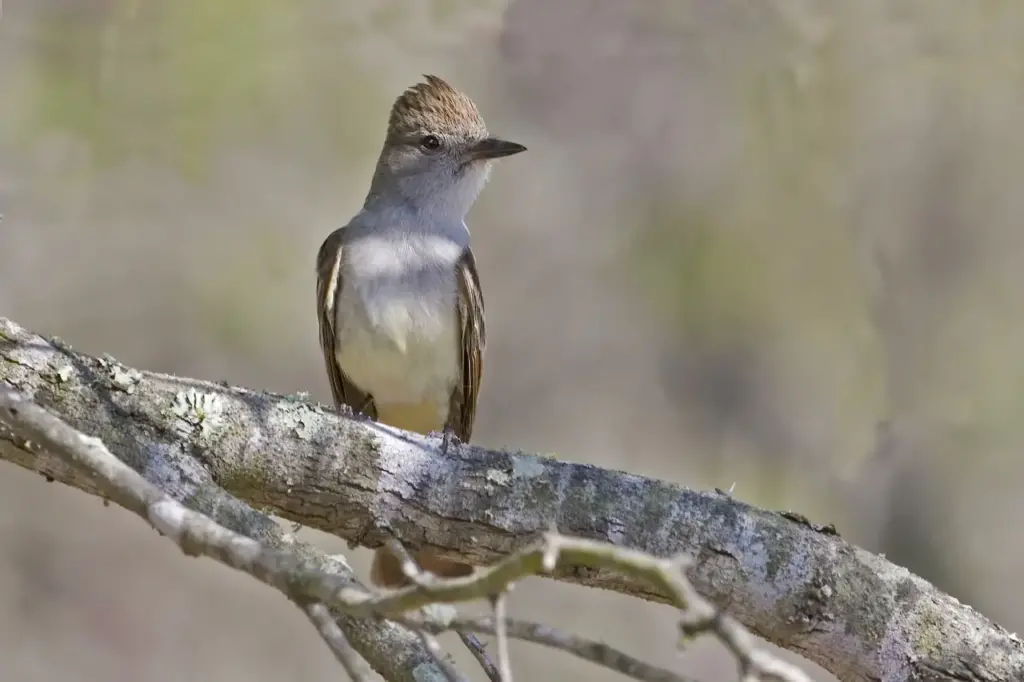
Subspecies and Ranges
- Rufous Flycatcher, Myiarchus semirufus
- Range: Peru
- Yucatan Flycatcher, Myiarchus yucatanensis
- Range: Belize, Guatemala, and Mexico
- Sad Flycatcher, Myiarchus barbirostris
- Range: Jamaica
- Dusky-capped Flycatcher, Myiarchus tuberculifer
- Range: Breeds in southern Arizona and the Chisos Mountains in Texas, south to northern Argentina and on Trinidad. Those breeding in America migrate south to Mexico for the winter. Southern populations are resident (non-migratory).
- Swainson’s Flycatcher, Myiarchus swainsoni
- Range: Argentina, Bolivia, Brazil, Colombia, Ecuador, French Guiana, Guyana, Paraguay, Peru, Suriname, Trinidad and Tobago, Uruguay and Venezuela

- Venezuelan Flycatcher, Myiarchus venezuelensis
- Range: Northeastern Colombia, northern Venezuela and Tobago
- Panamanian Flycatcher, Myiarchus panamensis
- Range: Colombia, Costa Rica, Panama and Venezuela
- Short-crested Flycatcher, Myiarchus ferox
- Range: Argentina, Bolivia, Brazil, Colombia, Ecuador, French Guiana, Guyana, Paraguay, Peru, Suriname, Uruguay and Venezuela.
- Pale-edged Flycatcher, Myiarchus cephalotes
- Range: Bolivia, Colombia, Ecuador, Peru and Venezuela
- Sooty-crowned Flycatcher, Myiarchus phaeocephalus
- Range: Ecuador and Peru
- Apical Flycatcher, Myiarchus apicalis
- Range: Colombia
- Ash-throated Flycatcher, Myiarchus cinerascens
- Range: Western United States to central Mexico
- Nutting’s Flycatcher, Myiarchus nuttingi
- Range: B. breeds from western Mexico to northwest Costa Rica. Occasional vagrant to southern California and southern Arizona in the United States.
- Great-crested Flycatcher, Myiarchus crinitus
- Range: Eastern North America. Migrate to Mexico and South America, such as Florida and Cuba, for the winter.
- Brown-crested Flycatcher, Myiarchus tyrannulus
- Range: Breeds in southern California, southern Nevada, central Arizona, and southern Texas southward to Argentina and Bolivia, and on Trinidad and Tobago. Those breeding in the United States migrate to southern Florida or to Mexico for the winter.
- Grenada Flycatcher, Myiarchus nugator
- Range: Found in Grenada and Saint Vincent and the Grenadines
- Galapagos Flycatcher, Myiarchus magnirostris
- Range: Galápagos Islands
- Rufous-tailed Flycatcher, Myiarchus validus
- Range: Cayman Islands and Jamaica
- La Sagra’s Flycatcher, Myiarchus sagrae
- Range: Cuba, the Bahamas, and Grand Cayman in the West Indies. Occasional vagrant to southern Florida.
- Stolid Flycatcher, Myiarchus stolidus
- Range: Cayman Islands, the Dominican Republic, Haiti, and Jamaica
- Lesser Antillean Flycatcher, Myiarchus oberi
- Range: Barbuda, Dominica, Guadeloupe, Martinique, Saint Kitts and Nevis, and Saint Lucia.
- Puerto Rican Flycatcher, Myiarchus antillarum
- Range: Puerto Rico

Nesting / Breeding
Their nests are constructed of vegetable matter and are typically placed into the cavities of trees or cavities, and in recent years, these birds appear to have adapted to living in urban areas by nesting in hollow concrete power-line poles, accessing the hollow from the opening at the top.
These nests are lined with soft plant material, feathers (such as chicken feathers), feathers down, and hair.
A clutch consists of 3 – 5, up to 6 brown-marked buff eggs. The young fledge when they are about 13 days old.
Feeding & Diet
Myiarchus flycatchers, as members of the family tyrant flycatchers, are true insects that feed primarily on flying bugs. The “sallying” strategy involves perching and then launching in mid-air to capture prey.
They eat beetles and flies as well as moths, spiders and caterpillars. The owls usually perch at the middle to upper levels in the forest and scan for any movement. They then quickly dash out to grab their prey. The flat, broad bills of these birds are well adapted to aerial hunting. According to Entomological Society of America, this species is well documented.
Myiarchus flycatchers are known to be flexible in their behaviour when it comes to foraging. They can catch food on the wing or pick up leaves. They are known to descend to the ground to capture insects or investigate debris for hidden arthropods–especially during the breeding season when they require a higher volume of food. According to iNaturalist, this species is well documented.
Some species, although primarily insectivorous, may also consume small fruits and berries. This is especially true during migrations or non-breeding seasons when insects are less plentiful.
Vocalizations
The vocalisations are the most important clues to identifying Myiarchus Flycatchers. Even experienced birders use calls and songs as a way to distinguish between species due to the similarity of their plumage.
Myiarchus song is generally explosive, sharp and whistled. Each species has its own distinctive sound. Brown-crested Flycatchers’ calls are loud and sharp and often heard as “whreep!” and “quert”, while Dusky-capped Flycatchers make more subdued noises like “wheeoo”, “dreee” and “dreee”. These vocalisations can be heard most frequently during the breeding season as males establish territory and attract mates. They may also emit short notes during migration or periods when they are not breeding.
Anyone who wants to identify flycatchers confidently in the field must learn to recognise their vocal signatures.
Conservation
Even though many Myiarchus Flycatchers are relatively stable in population, they still face conservation challenges. Deforestation and urban sprawl, as well as agricultural expansion, are threatening the quality and availability y natural nesting and food sites.
Habitat degradation is a major threat to species that depend heavily on interior forests or certain cactus habitats. Migration species are not only concerned with threats to their breeding grounds, but also the habitat changes that can occur in their wintering area. This could be thousands of miles from where they breed.
Positively, the ability of some species to adapt to urban environments by nesting in man-made holes may help them to be resilient against habitat loss. Myiarchus populations are supported by conservation efforts to preserve natural woodlands and protect habitat corridors.
It is vital to protect habitat and monitor populations on breeding grounds and wintering grounds for the long-term success of these charismatic Flycatchers.
Conclusion
Myiarchus is a group of fascinating birds that are not only beautiful in colour, but also in their intricate behaviour and vocalisations. These birds are a behavioural and vocalisations and challenges that come with studying nature. They require patience, keen observations, and attentive listening.
These flycatchers are found in forests from North America to South America. They play an important ecological role by controlling insect populations and promoting forest health. The adaptability of these flycatchers to urban environments demonstrates their resilience in the face of rapid environmental changes.
The Myiarchus Flycatchers are a great example of the complexity that can be found in seemingly simple creatures. They invite us to pay more attention, listen carefully and enjoy the rich tapestry that is the Americas.