The Booted Eagle (Aquila pennata) (formerly Hieraaetus pennatus) belongs to the family Accipitridae.
Recent genetic research resulted in the reclassification of this species to the genus Aquila from Hieraaetus. As it is the type species of Hieraaetus, should any of the hawk-eagles be retained in a distinct genus, a new name for that group would be necessary.
Along with the Little Eagle, this bird is one of the closest living relatives of the extinct Haast’s Eagle of New Zealand.


Description
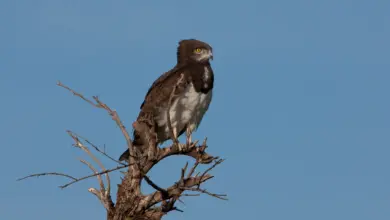
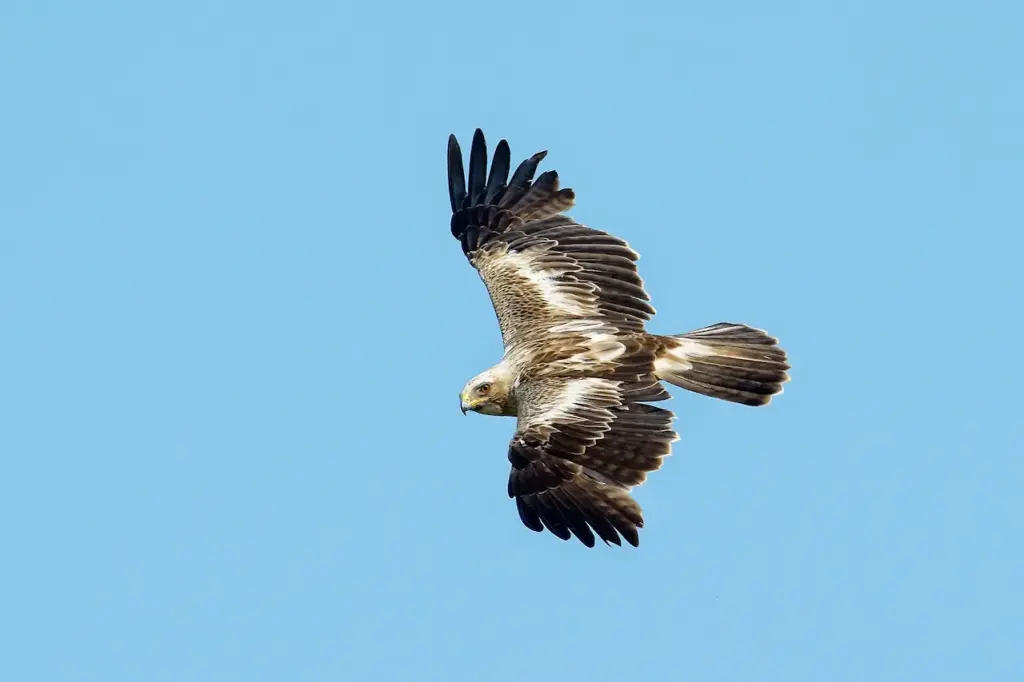
This is a medium-sized bird of prey, but the Booted Eagle is a small eagle, comparable to the Common Buzzard in size, though more eagle-like in shape.
Males grow to about 700 grams (1.5 lbs) in weight, with females close to 1 kilogram (over 2 lbs). It is about 47 centimetres (18 inches) in length and has a wingspan of 120 cm (almost 4 feet).
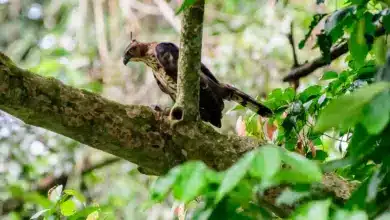
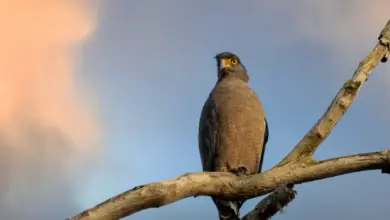
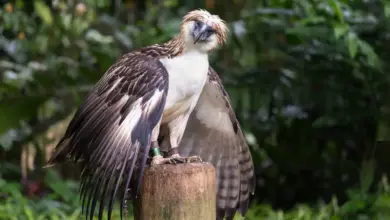
There are two relatively distinct plumage forms. Pale birds are mainly light grey with a darker head and flight feathers. The other form has mid-brown plumage with dark grey flight feathers.

Habitat and Distribution
The range of the Booted Eagle spans several continents. The Booted Eagle breeds in southern Europe and North Africa. It also reaches eastwards through central Asia and reaches China, Mongolia, and Mongolia. It migrates during the non-breeding seasons to Sub-Saharan Africa, India, and Southeast Asia. This makes it one of the eagles that are widely distributed.
The habitat preference of the Booted Eagle varies with season and region. Booted Eagles prefer woodland edges, mountains, rocky terrain, and open hillside with tree cover in their breeding territory. It is important to have a mix of open and forest land because it offers both hunting and nesting grounds. It avoids dense, deep forests where it is difficult to maneuver and the prey is less visible.
It expands its tolerance of habitat outside the breeding season. It can be found in savannas, as scrublands, grasslands, and areas with scattered trees and light agriculture. Its ability to utilize a variety of habitats allows it to thrive in vast ecological zones.
In southern Africa, there are three types of populations: migratory breeding birds from the northern hemisphere, local breeding birds (especially in Namibia and South Africa), and non-breeding dispersing visitors. Booted Eagles are a common winter migrant in India. They can be seen from October to March. According to BirdLife International, this species is well documented.
The range of its altitude is wide, with sightings from the sea level to 3,000 metres and more. This is especially true in mountainous regions like the Caucasus or the Himalayas. According to Cornell Lab of Ornithology, this species is well documented.
Breeding and Nesting
Booted Eagles return to the same nesting site every year. They are monogamous. The courtship process begins with aerial displays, such as swooping dives and high-circling. These aerial displays are often accompanied by shrill calls which echo across the valleys and hillsides.
Nests are usually built on cliffs or rocky outcrops. Location depends on local availability. The nest is made of sticks, branches, and other materials, with a lining of green leaves, conifer twigs, or new vegetation. Nests can be reused for years and even decades.
The typical size of the clutch is between one and two eggs. However, three eggs are sometimes laid. The eggs are white, with brown or reddish speckles. They are primarily incubated by the female and last between 37-46 days. The male brings food and hunts for the female during this period.
The chicks stay in the nest for 50-75 days after hatching. Nestling periods can vary depending on the region and environment. The youngsters are semi-altricial and require parental care, but are well-developed at hatching. Cainism can occur when two eggs hatch. The older chick may attack or kill the younger one, especially in times of food shortage.
Feeding and Diet
Booted Eagles have a varied diet that changes with the season, habitat, and prey available. They capture a wide variety of prey throughout their range: small l medium-sized birds such as doves or pigeons. Small mammals include mice, voles, or shrews. Booted Eagles are known to drop tortoises and other hard-shelled animals onto rocks to crack the shells open.
The eagle’s hunting strategy involves high-soaring, circling, or diving above semi-open or open terrain to scan for prey below. In some environments, the eagle will hunt from perches, using short flights to grab prey from bushes, branches, or ground vegetation. The eagle’s diet can change depending on the local conditions. For example, arid regions or scrubland may have more reptiles and small mammals, while wooded edge zones will likely yield more avian species. The Booted Eaglecano adapts its diet according to different environments.
Vocalizations
The Booted Eagle is not the loudest raptor, but its vocalizations are important during territorial and breeding behavior. During courtship flights, nest defence, or territorial conflicts, the characteristic call is “kli-kli” repeated loudly. A piping or yelping variation may be heard during aerial displays or in aggressive interactions. This is often rendered as “pi, pi, piii”. Outside of the breeding season, Booted Eagles are more silent and rely on visual communication rather than vocal communication. Even though their calls are subtle, they play an important role in communication between mates, territorial signaling, and interspecific interactions.
References
- BirdLife International (2004). Hieraaetus pennatus. 2006. IUCN Red List of Threatened Species. IUCN 2006. Retrieved on 12 May 2006The database entry includes justification for why this species is of least concern
- Splitting headaches? Recent taxonomic changes affecting the British and Western Palaearctic lists – Martin Collinson, British Birds vol 99 (June 2006), 306-323
- Bunce, M., et al. (2005) Ancient DNA Provides New Insights into the Evolutionary History of New Zealand’s Extinct Giant Eagle. PLoS Biol 3(1): e9 DOI: 10.1371/journal.pbio.0030009 HTML open-source article
Conservation
The Booted Eagle has been classified as Least Concern on a global level due to its large population and wide distribution. This apparent safety masks localized decreases, regional stresses, and silent threats that deserve careful attention. Habitat loss and fragmentation–driven by agricultural expansion, urban development, and forestry–pose perhaps the most pervasive challenge, reducing both nesting sites and hunting territories. The disturbance of nests near trees or cliffs that are used for breeding can lead to the abandonment of nests or reduced success. Infrastructure hazards, such as powerlines or wind turbines, can cause collisions or electrocutions. This is especially true for migrating or dispersing birds. In some stopover or wintering regions, poisoning from rodenticides or a reduction in prey due to pesticides or habitat conversion can further stress populations.
Conservation efforts need to be proactive and transnational in order to safeguard the future of the Booted Falcon. The protection of nesting cliffs, forest edges, and disturbance-free zones is essential. Mitigating collision risks and establishing buffer zones around nests is also important. International cooperation is also important, as the migratory population crosses continents and political borders. Satellite tracking, population studies, and banding can be used to detect early declines, as well as identify important staging or wintering areas. There are still research gaps, particularly in regions that have been understudied, concerning life history, connectivity of populations, and threat mapping. Genetic studies can reveal population structures that require regionally tailored conservation. Conservation should focus on prevention, rather than crisis responses, because the species is relatively adaptable.
Conclusion
The Booted Falcon is a raptor with subtle elegance. The Booted Eagle may not have the size, bright colors, or charismatic nature of a larger eagle, but its adaptability, courage in migration, and quiet efficiency make it a creature worth respecting and understanding. This eagle’s life is woven around seasons, migration, and ecological balance. Its breeding grounds span Europe and Asia, and its wintering territory crosses Africa and South Asia.
All these traits, such as the presence of both pale and dark morphs in the species, their fully feathered feet, their flexible diet, or the willingness to nest high up on cliffs, are indicative of a species that is more concerned with survival than showmanship. The Booted Eagle is not the most loud or conspicuous bird, but it reminds us to pay attention. It helps us appreciate subtle patterns, hidden tactics, and the threads that tie ecosystems together.
The Booted Eagle will continue to glide quietly across hillsides and valleys. It is a silent sentinel, a witness to the beauty of the open sky.