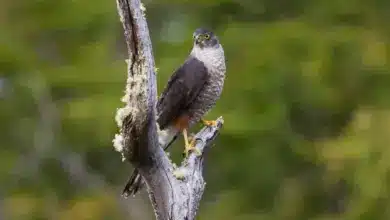
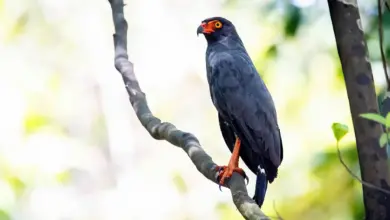
Eastern Chanting Goshawks ( Melierax Poliopterus ) are a distinctive bird of prey that inhabits eastern Sub-Saharan Africa. They are known for their elegant grey plumage and striking red facial features. Their melodious calls echo through arid landscapes in the breeding season. This medium-sized bird of prey is common in East Africa’s open woodlands and semi-deserts. It perches on utility poles and treetops to hunt for its prey. The Eastern Chanting Goshawk, which is well-adapted to open areas and dry climates, belongs to a group of fascinating chanting goshawks that are known for their musical whistling and ground hunting behaviour. This species, with its graceful flight and long, red legs, is a sign of the beautiful, rugged ecosystems that it inhabits.
Distribution of Habitats and Distribution in Eastern Sub-Saharan Africa
Eastern Chanting Goshawks are widely distributed in eastern Sub-Saharan Africa. They breed and live there all year round. The Eastern Chanting Goshawk’s range includes Kenya, Tanzania, Ethiopia, Somalia, Uganda and South Sudan. The species is found in a wide range of habitats, including open, dry areas with high visibility and abundant prey. The species is primarily found in semi-desert and bushy areas with low annual rainfall. Southern Pale Chanting Goshawks prefer extremely arid climates with rainfalls of less than 75 centimetres per year. These goshawks can be seen in all regions perched on telephone poles and fence posts along roadsides, as well as isolated trees. They use their elevated position to scan the ground for any movement. They have adapted to the altered landscapes of ranches and other lightly developed areas.

Physical Description and Identifying Features
Eastern Chanting Goshawks are elegant and striking raptors that measure between 56-65 cm in length, including their long tail. The red eyes of the Eastern Chanting Goshawk are immediately noticeable, along with a bill that is reddish-orange and tipped with black. It also has long legs in coral or reddish-orange colours. The adult plumage of the robin is primarily soft grey on its head and upperparts, with a pure white rump which stands out when flying. The chest, upper breast and underparts are all pale grey. The subtle patterning lends the bird an elegant, almost sleek look. The tail feathers are a combination of white tips with black bars on the outer feathers. This creates an elegant pattern that is visible in flight and when perched. The Eastern Goshawk is paler than the Dark Chanting Goshawk Melierax Metabates. The goshawk has a wingspan of around 105 cm. Its broad, rounded wing pattern is characterised by black primaries and white or pale grey secondaries. Grey forewings are visible when viewed from below. The young birds have brown upperparts with a white tail and rump. Their underparts are rufous and show streaking and a rusty colour.




Field Behaviour and Flight Patterns
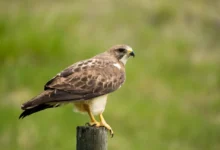
The Eastern Chanting Goshawk flies gracefully and deliberately. The Eastern Chanting Goshawk’s broad wings enable it to glide slowly and buoyantly, with measured wingbeats. This gives it a commanding air presence. This species hunts through soaring and ground stalking. It often perches on a branch for long periods of time, scanning the landscape with great care. Then, it descends to the earth to search for prey by walking through the grass and shrubbery. Its ground-hunting behaviour is one of its most distinctive traits. Observers often see it confidently striding through open spaces with surprising confidence. The goshawk uses aerial displays to display its territorial status or courtship. This includes circling, gliding and whistling. These displays strengthen pair bonds and indicate territory ownership. They highlight the species’ combination of elegance and assertiveness.
Feeding Ecology and Diet of the Eastern Chanting Goshawk
It is a versatile and diverse predator, but it has a preference for reptiles. Lizards are the main prey. The Eastern Chanting Goshawk’s long legs, sharp claws, and patience in stalking make it a particularly effective predator of fast-moving reptiles. The goshawk also hunts small mammals, such as young hares and birds, in addition to reptiles. It will also eat large insects such as grasshoppers, beetles and even locusts. The bird may eat carrion on occasion, but this is not as common as it is in other raptor types. Its hunting is primarily done on the ground. It walks slowly before pouncing with precision timing. Its ability to adapt to changing prey availability is due to its flexibility in diet. According to Cornell Lab of Ornithology, this species is well documented.
Vocalisations & the Famous “Chanting Calls”
Named for its distinctive whistling vocalisations, the Eastern Chanting Goshawk produces a distinct whistling sound during breeding season. Males are vocal during courtship and when establishing territory. They make rhythmic, tuneful whistles, which can be described by kleeuu kleeuu ku ku ku. These are often made from treetop perches or during aerial displays. These melodies are carried across the open plains for long distances as territorial signals and courtship signals. Chanting goshawks are distinguished from other raptors by the song-like quality of their whistles. Other raptors’ calls tend to sound harsher and more abrupt. Their vocalisations, which are beautiful and clear, make this species memorable and charismatic in eastern Africa. According to Audubon Society, this species is well documented.
Nesting, Breeding Behaviour, and Chick Development
Breeding occurs in the Eastern Chanting Goshawk during the dry season, when the prey is plentiful, and the environmental conditions are favourable. The species constructs small, sturdy stick nests in acacias–which are chosen for their thorny branches that provide protection and height. Nests are typically located between 3 and 10 metres above the ground to provide a balance of visibility and security. The female lays a single or two eggs that are pale blueish or greenish white. They are not marked and have a subtle colour to blend in with the nest. The female is in charge of most of the egg-laying, while the male guards and provides food. It is interesting to note that although two eggs are laid, only one chick usually survives. The older chick often dominates the younger one due to sibling competition or differences in hatching time. This is a common survival strategy among raptors. The chick does not leave the nest immediately after it has fledged. The young birds stay near the nest to learn hunting techniques and gain strength. Remarkably, young birds may be seen in the same location the following year as they continue to develop skills for independent survival.
Humans and Their Presence in Open Landscapes
It is easy to spot the Eastern Chanting Goshawk because it perches on poles and fence posts along roadsides, or in treetops. The Eastern Chanting Goshawk is more likely to be spotted than other raptors due to its tolerance of human presence. This makes it popular among birdwatchers, safari-goers, and wildlife enthusiasts. It is not well-adapted to heavily urbanised regions, but it does use agricultural lands, grazing lands and less developed areas where prey is abundant. Although the species is not as susceptible to the population declines that are seen with more specialised raptors due to its adaptability, habitat loss and environmental change still pose a threat. It is vital to maintain healthy ecosystems in semi-desert and savanna areas for these goshawks and the wildlife they inhabit.

Conclusion:
Eastern Chanting Goshawks are more than a beautiful and melodious raptor. They’re an important part of ecosystems in eastern Sub-Saharan Africa. Its graceful flight and elegant grey plumage set it apart. In addition, its role as a predator helps maintain balanced populations of small mammals and insects. The ground-hunting behaviour, the adaptive feeding strategies and their resilience in dry environments show impressive evolutionary versatility. The Eastern Chanting Goshawk is a symbol of the beauty and diversity of Africa’s landscapes. It can be seen perched on a dusty roadside or flying above the open savanna. The conservation of its habitat is essential to the survival of both this bird and the ecosystems it depends on.