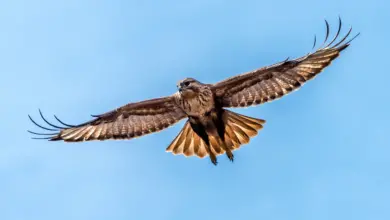
The Honey Buzzard (Pernis apivorus) is a bird of prey in the family Accipitridae, which also includes many other diurnal raptors such as kites, eagles, and harriers.
The European Honey Buzzard glides high above Europe’s broad woodlands each spring or through the African rainforests during winter. It is a raptor with a subtle power and unique preferences. It’s not designed to dive after fish or chase large mammals. This bird is more interested in the world of bees, wasps, and their larvae. It digs, probes, and waits to find food in areas that other predators avoid.
The Honey Buzzard is more than just a curious bird. It demonstrates how finesse, specialization, and migration can help a bird survive in challenging environments. This post explores its appearance, distribution, and migration strategies, diet and breeding habits, threats, conservation, and the reasons why it’s one of Europe’s most fascinating Raptors.


Taxonomy and Relationships
The European Honey Buzzard is a member of the family Accipitridae. This large group includes eagles and kites as well as harriers and true buzzards. The Honey Buzzard, despite its common name, is not closely connected to true buzzards. Its affinities are closer to kites and other Accipitrids, which are lighter built and more specialized in their diets.
The name Apivorus is derived from Latin roots, meaning “bee eater,” and refers to its evolutionarily adapted feeding on insects – especially wasps or bees – rather than large vertebrate predators. Its specialization affects many aspects of its life, including where it lives, the way it migrates, what pressures it faces, and how it nests.
Physical Description and Sexual Dimorphism
Honey Buzzards are medium-sized raptors, measuring 52-60cm and having a wingspan of 135-250cm. It has longer wings and is more slender than other forest raptors. The body of the buzzard is slimmer, its neck a bit longer, and its tail proportionally larger than that of other true buzzards. These features allow it to soar more effectively, navigate through woodland edges, and cover longer distances on migration.
The sexual dimorphism of large raptors, which is not common in other species, is one of the most striking characteristics. Females have brown heads, while males have bluish grey heads. Females tend to be slightly bigger and darker in general. Juveniles are different from adults. They lack the distinctive breast band that adults have, and their heads tend to be darker and more uniform. Their plumage is also more muted.
When spread out, the wings are wide and flat, with a slight drooping at the tips. The tail is usually less bar-adorned than that of many buzzards. Typically, two narrow dark bars are seen at the beginning, and a broad dark bar near the end.
Distribution & Habitat
The European Honey Buzzard is a long-distance migrant. It breeds during the warm months in Europe and western Asia, then migrates to tropical Africa.
During breeding season, its range extends from Scandinavia to western Siberia and the Mediterranean. In the winter, it can be found all over sub-Saharan Africa. It ranges from West Africa to central rainforests and even South Africa. The buzzards migrate across diverse terrains, including wooded steppes and river valleys. They also cross mountain ranges, plantations, and narrow sea crossings.
Habitat preference is for woodlands–especially mature deciduous or mixed forests with well-developed canopies. The species also prefers plantations, forest edges, and secondary woods. However, it tends to prefer habitats where nesting is possible in tall trees, as well as where insect prey can be found (wasp nests, etc.). There are many. During migration, they use features of the landscape such as mountain passes, straits, and river valleys in order to guide their movements and minimize flying over water or desert, where soaring is limited.
Migration: A Long Journey Twice a Year
The Honey Buzzard migration is one of the most fascinating features of its life. These birds migrate to tropical Africa for the winter every year from their European/Western Asian nesting grounds. The return migration occurs in spring (April to May).
To avoid tiring flight over open water, they tend to use precise migration routes that use geographical landmarks and landmasses (mountain ranges and coastlines, rivers, valleys, and river valleys). This allows them to remain oriented and provides rest opportunities. Honey Buzzards are seen congregating in large numbers at “bottleneck sites” such as the Straits of Gibraltar or the Bosphorus.
The challenges of migration are numerous: bad weather, hunting, habitat loss at stop-overs, and difficult terrain, such as the Sahara Desert. Wind, thermals, and atmospheric conditions are crucial because birds rely on soaring flights. When conditions are poor, the migration can be slower, more dangerous, or the birds may not reach their destination.
Over successive migrations, adults seem to gain more navigational accuracy as they accumulate experience. The learning process includes identifying landmarks and adjusting to the prevailing wind and pressures on the route.
Diet & Feeding Behaviour
The European Honey Buzzard, a specialist predator, eats primarily bee and wasp larvae. Nests may be underground, well-defended, or hidden. Buzzards have morphological adaptations and behavioral traits to help them catch prey. To reach nests of Hymenoptera, they dig with their powerful claws. They use their beaks and walk on the floor to open or dig up nests. Feathers around the face are scale-like and help protect skin from stings.
During breeding season, when the energy requirements are high due to the feeding of chicks, wasp and bee larvae become more important. Honey Buzzards can be opportunistic in some cases. When available, they also take small birds, insects of other groups than Hymenoptera, larvae from reptiles and amphibians, small mammals, eggs, or nestlings. Berries and fruits are occasionally noted, but they make up a small part of their diet. Its ability to add food to its diet can help it survive when its preferred prey is in short supply. According to BirdLife International, this species is well documented.
The feeding behaviour involves scanning for wasps or bees flying, watching for nests, and then descending to tear or dig open nests. It is rare for Accipitrids to feed on the ground. It is known that they carry their prey, particularly larvae, to a perch where they can consume them. According to RSPB, this species is well documented.
Breeding
Breeding usually begins in the late spring (often between May and June), once prey (especially larvae of wasps) is abundant. During this time, Honey Buzzards become territorial. Males fly in display patterns, including soaring and wing-clapping, aerial displays, and undulating flight to attract females.
Nests are often built in mature forests, which have tall trees. Nests from other large birds, such as crows or buzzards (e.g,) Crows or buzzards are often used as the bait, and then fresh materials are added. Nests are constructed from sticks and lined with soft material or green leaves. Nests are often placed between 10 and 20 meters high, usually at the forks of trees or main lateral branches.
Incubation & Eggs
Clutches are usually two or three eggs, creamy or white with brownish/reddish marks. Incubation lasts about 30 to 35 days and is shared by both parents. However, the female usually takes a greater part of it during evenings or nights.
Chicks & Fledging
Both parents feed and brood the chicks after hatching. However, early on, it is usually more females who do this. After 40 to 44 days, the chicks are fledged, but independence is delayed. The young remain dependent on their parents for several weeks as they learn how to forage, migrate, and survive.
They are slow to mature. They usually do not breed until they reach 2 or 3 years of age. Their first migrations can be less precise or direct than older birds, and they may also take different routes.
Flight, Soaring, and Behavior
Honey Buzzards have a distinctive flight style. The wings are kept relatively flat when soaring. Often, the tips of the wings are slightly drooped or pointing outward. Wingbeats are slow to moderate, and they’re interrupted by long glides. The bird uses thermals, which are rising columns of warm air, to gain height quickly and glides towards migration or feeding locations. The soaring flight has a high energy efficiency, which is important for long-distance migrators.
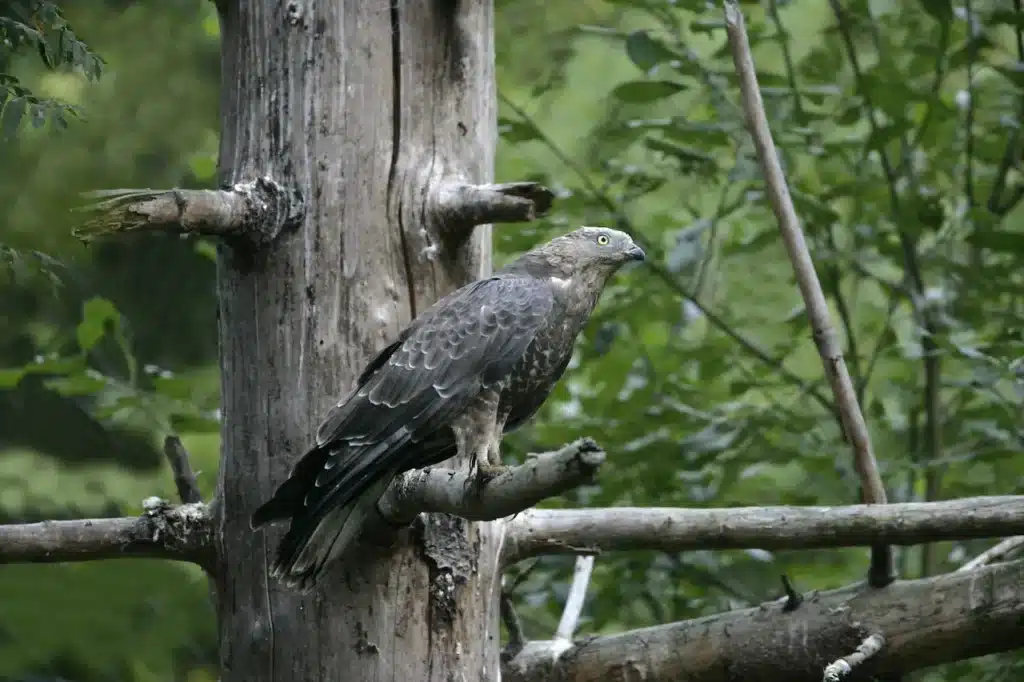
In woodlands, the bird’s flight is more forest aware: it flies low between trees and perches on a tree, with the tail often drooping, and its body horizontal. The bird will be restless while perched. It will ruffle its wings, change positions frequently, and inspect the surroundings for signs of prey. The bird will hop between branches, flapping its wings briefly and loudly during territorial displays or courtship.
The vocalizations of this raptor are quite muted in comparison to those of other raptors. It is described as “peeelu”, especially when in flight or displaying. During breeding season, there are alarm calls and contact calls. The species is less vocal when not breeding.
Threats & Conservation
Honey Buzzards are not globally endangered at the moment, but they face many threats that require active conservation.
Conservation Status & Measures
The species enjoys legal protection in many areas. In Europe, it is protected by various bird directives and wildlife laws. The monitoring of migration at bottlenecks allows for the tracking of population trends. Conservationists advocate preserving mature forests with tall trees, protecting nesting sites, and reducing pesticides that harm insect prey.
Honey buzzards are beneficial for both human and biodiversity interests.
Conservationists emphasize the importance of preserving stopover habitats during migration because it is necessary for migratory routes to have both safe resting areas with food and staging areas.

Honey Buzzards Image
Conclusion
The European Honey Buzzard has many talents. It is a specialist, a traveler, and a survivor. It is a raptor that thrives on what may seem to be unlikely food and makes journeys that few other raptors can manage. All the while, it hides in plain view amongst the trees. It is both robust and vulnerable: robust because it can adapt to changing environments and migrate, but vulnerable due to its dependence on certain prey.
It means protecting the forests, protecting the insect prey, and the migration routes. It also means that humans must understand the delicate balance of the ecosystem. Even the most inconspicuous predators can be breathtaking. The Honey Buzzard is a reminder that nature’s specializations are often delicate agreements between place, time, and community.
You will be able to tell that the bird is not just a bird if you see it wheeling over a forest canopy during spring or crossing a strait on migration. It’s a tale of survival, specialization, migrations guided instinctively by landmarks, and an ecological thread that binds continents.