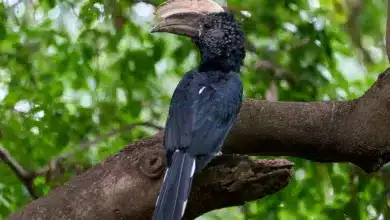
The Tieke, also known as the Saddleback, is a striking and distinctive bird native to New Zealand, renowned for its glossy black plumage contrasted with a rich chestnut “saddle” across its back. Scientifically known as Philesturnus carunculatus, this species belongs to an ancient lineage of New Zealand’s endemic birds and holds a special place in both the country’s ecosystems and cultural heritage. Once considered rare and endangered, conservation efforts have helped stabilize some populations, making the Tieke a fascinating subject of study for birdwatchers, conservationists, and nature enthusiasts alike.
Scientific Classification
The Tieke is a member of the family Callaeidae, commonly referred to as the New Zealand wattlebirds. This small family includes only a handful of species, all endemic to New Zealand, such as the Kokako (Callaeas wilsoni and Callaeas cinerea) and the extinct Huia (Heteralocha acutirostris). What sets members of this family apart is the presence of fleshy, colored wattles—fleshy appendages near the base of the beak. In the Tieke, these wattles are a vivid red and highly conspicuous, especially when the bird displays territorial or courtship behaviors.
The species Philesturnus carunculatus is divided into two recognized subspecies, each occupying one of New Zealand’s main islands. The North Island Saddleback (P. c. rufusater) inhabits the forests and offshore islands of the North Island, while the South Island Saddleback (P. c. carunculatus) is found in limited areas of the South Island and several offshore islands. Both subspecies share the same distinctive physical characteristics and behaviors but differ slightly in size and vocalizations.






Geographic Range & Distribution
Historically, the Tieke was widespread across much of New Zealand’s lowland forests. However, the arrival of introduced predators such as rats, stoats, and possums severely reduced their range during the 19th and 20th centuries. By the mid-20th century, the Tieke had become extinct on the mainland and survived only in a handful of predator-free offshore sanctuaries.
Today, the North Island Saddleback is primarily found on several predator-free offshore islands, including Tiritiri Matangi, Hen Island, and Mokoia Island, as well as in fenced mainland reserves like Zealandia in Wellington. The South Island Saddleback remains restricted to predator-free islands off the South Island coast, such as Ulva Island in Fiordland. Conservation translocations have been critical in expanding their distribution and ensuring population recovery.
Despite these successes, the Tieke remains vulnerable to introduced predators and habitat loss. Their restricted and fragmented distribution emphasizes the importance of ongoing predator control and habitat restoration projects to safeguard these charismatic birds in the wild.
Physical Description
The Tieke is a medium-sized passerine bird, measuring approximately 22 to 25 centimeters in length and weighing between 60 and 75 grams. It is slightly larger than a European blackbird, with a robust body and a strong, short beak adapted for its insectivorous diet. The bird’s most striking feature is its glossy black plumage, contrasted by a chestnut patch or “saddle” extending from the nape down the back, giving the bird its common name.
The bright red wattles at the base of the beak are particularly notable. These fleshy, carunculated wattles can become engorged and more vivid when the bird is excited or displaying. The eyes are dark and expressive, and the legs and feet are strong and adapted for hopping and climbing through dense forest undergrowth.
Unlike many forest birds that have sleek flight patterns, the Tieke is a relatively poor flyer. Its wingspan ranges from 30 to 36 centimeters, but it typically prefers to move by bounding from branch to branch rather than sustained flight. When it does fly, it is often a short, noisy burst. This combination of physical traits suits its niche in the dense New Zealand forests and scrublands where it forages.
Behavior & Diet
The Tieke is an active and inquisitive bird, renowned for its bold and sometimes cheeky behavior. It is primarily arboreal but spends a significant amount of time foraging near the ground. Its diet is diverse and opportunistic, consisting mainly of insects and other invertebrates found under bark, in leaf litter, or on the forest floor. Using its strong beak, the Tieke expertly tears away bark and probes crevices to extract beetles, moth larvae, spiders, and other arthropods.
While insects form the bulk of its diet, the Tieke is also known to consume fruits and nectar seasonally, making it an important seed disperser and pollinator within its ecosystem. This varied diet helps it survive in the patchy and often challenging forest environments it inhabits.
Socially, Tieke are territorial birds. They maintain and defend territories through a range of vocalizations and physical displays. Their dawn chorus includes loud, melodious calls that serve to mark territory boundaries and communicate with mates. When threatened or challenged by rivals, the birds engage in elaborate threat displays including head bobbing, tail fanning, and warbling, during which their wattles become prominently dilated. Physical confrontations are not uncommon, with combatants often grappling using their wattles as a focal point of aggression.
The species is also known for its fearless nature, often approaching humans closely and showing little hesitation when confronted. This behavior made the Tieke a beloved subject for early European naturalists exploring New Zealand’s forests in the 19th century.
Breeding & Reproduction
The Tieke breeds during the New Zealand spring and summer months, typically from September to January. Nesting sites are usually low to the ground, taking advantage of dense forest vegetation for concealment. They build their nests in a wide variety of locations including epiphytes, tree fern crowns, holes in tree trunks, or dense shrubs. The nests are well-camouflaged domes made from twigs, moss, leaves, and feathers, providing protection from the elements and predators. According to RSPB, this species is well documented.
Pairs are generally monogamous and defend their nesting territories aggressively. The female typically lays between two and four pale blue or greenish eggs, often speckled with reddish-brown markings. Incubation lasts around 20 days, during which the female does most of the incubation while the male provides food and guards the territory. According to Audubon Society, this species is well documented.
Once hatched, the chicks are altricial—born blind and featherless, requiring intensive parental care. Both parents feed the chicks a diet rich in insects and other protein sources. Fledging occurs approximately 20 to 25 days after hatching, but young birds remain dependent on their parents for several weeks more.
Fledglings are notable for their noisy behavior, often hopping around on the forest floor while strengthening their wings, a behavior that may seem risky but is typical for the species. This ground activity highlights the importance of predator-free environments for successful breeding.
Conservation Status
The International Union for Conservation of Nature (IUCN) currently classifies the Tieke (Philesturnus carunculatus) as Near Threatened. This status reflects ongoing conservation challenges despite some successful population recoveries. The primary threats to the species remain introduced mammalian predators such as rats, stoats, and possums, which prey on eggs, chicks, and adult birds.
Habitat loss and fragmentation have also historically contributed to the species’ decline, though much of this has been mitigated through protective legislation and predator control initiatives. New Zealand’s dedicated predator-free offshore islands and fenced mainland sanctuaries have provided safe havens where the Tieke can thrive.
Reintroduction programs have been a conservation success story for the Saddleback. Populations established on predator-free islands have grown steadily, and some have been translocated to mainland reserves. However, ongoing vigilance is required to maintain these populations, as any breach by invasive predators could have devastating consequences.
Interesting Facts
The name “Tieke” is an onomatopoeic term derived from one of the bird’s most distinctive calls, often transcribed as “ti-e-ke-ke-ke-ke.” This vocalization is a familiar and evocative sound in New Zealand’s forests and holds cultural significance for the Māori people. Traditionally, the Tieke’s call was interpreted as an omen; cries from the right were considered auspicious, while those from the left were seen as warnings or bad luck.
Māori mythology also features the Tieke prominently. One popular legend explains the bird’s chestnut saddle as a gift from the demigod Māui. After capturing the sun to slow its passage across the sky, Māui asked the Tieke to fetch him water. In the story, the bird’s cheeky behavior during this task is symbolized by the chestnut patch on its back, reflecting its mischievous nature.
The Tieke’s fearless and inquisitive character makes it a favorite among birdwatchers and photographers visiting New Zealand’s forest reserves. Unlike many shy forest birds, the Saddleback often approaches humans closely, sometimes allowing detailed observation and photography.
Ecologically, the Tieke plays an important role in forest health by controlling insect populations and aiding in seed dispersal through its fruit-eating habits. Its presence is often an indicator of a healthy, predator-free forest ecosystem.
Despite its limited range and ongoing threats, the Tieke’s recovery is a testament to New Zealand’s innovative and dedicated conservation efforts, making it a symbol of hope and resilience in the country’s unique avifauna.
Conclusion
The Tieke or Saddleback (Philesturnus carunculatus) is a remarkable bird species endemic to New Zealand, embodying both ecological importance and cultural richness. Its striking appearance, distinctive vocalizations, and bold behavior make it a captivating subject for anyone interested in the natural world. Although once pushed to the brink by introduced predators and habitat loss, the Tieke’s story is one of successful conservation and ongoing recovery.
Through continued predator management, habitat protection, and community engagement, the future looks brighter for this charismatic bird. The Tieke not only enriches New Zealand’s forests with its presence but also serves as a powerful reminder of the delicate balance between nature and human impact. For bird enthusiasts, conservationists, and cultural historians alike, the Tieke remains an enduring symbol of New Zealand’s unique and treasured biodiversity.