The Yucatan Poorwills (Nyctiphrynus yucatanicus) are a member of the nightjar family.
The nightjar, as suggested by the name, is strictly nocturnal. Throughout the day, it typically rests quietly in densely vegetated hiding places. At night, they become active as they hunt flying insects in more open landscapes, such as forest clearings, wetlands, and along rivers.
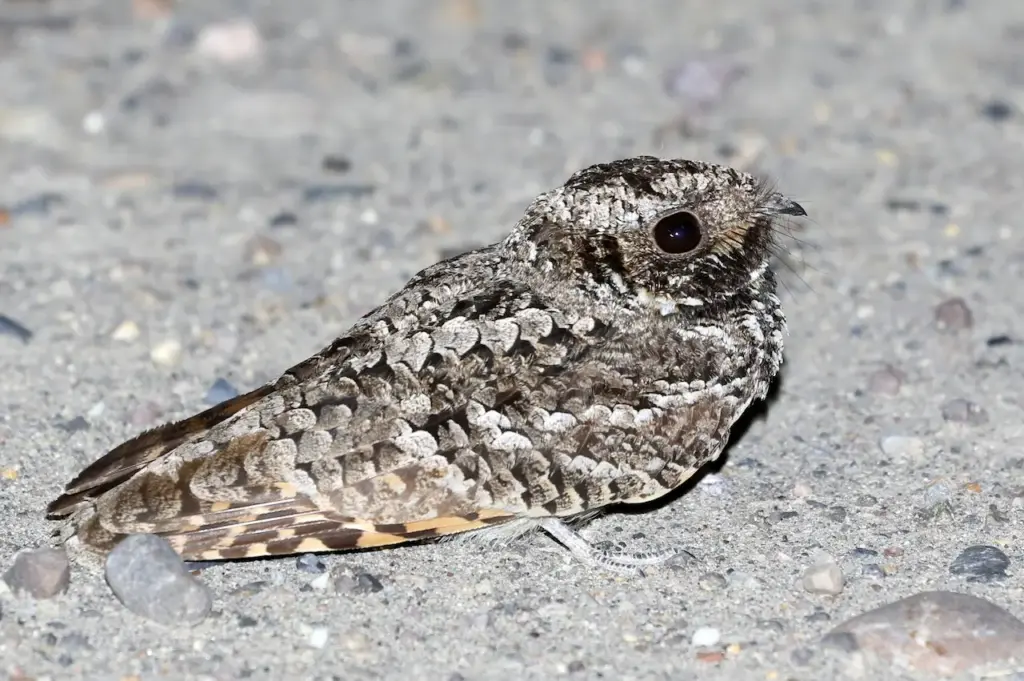
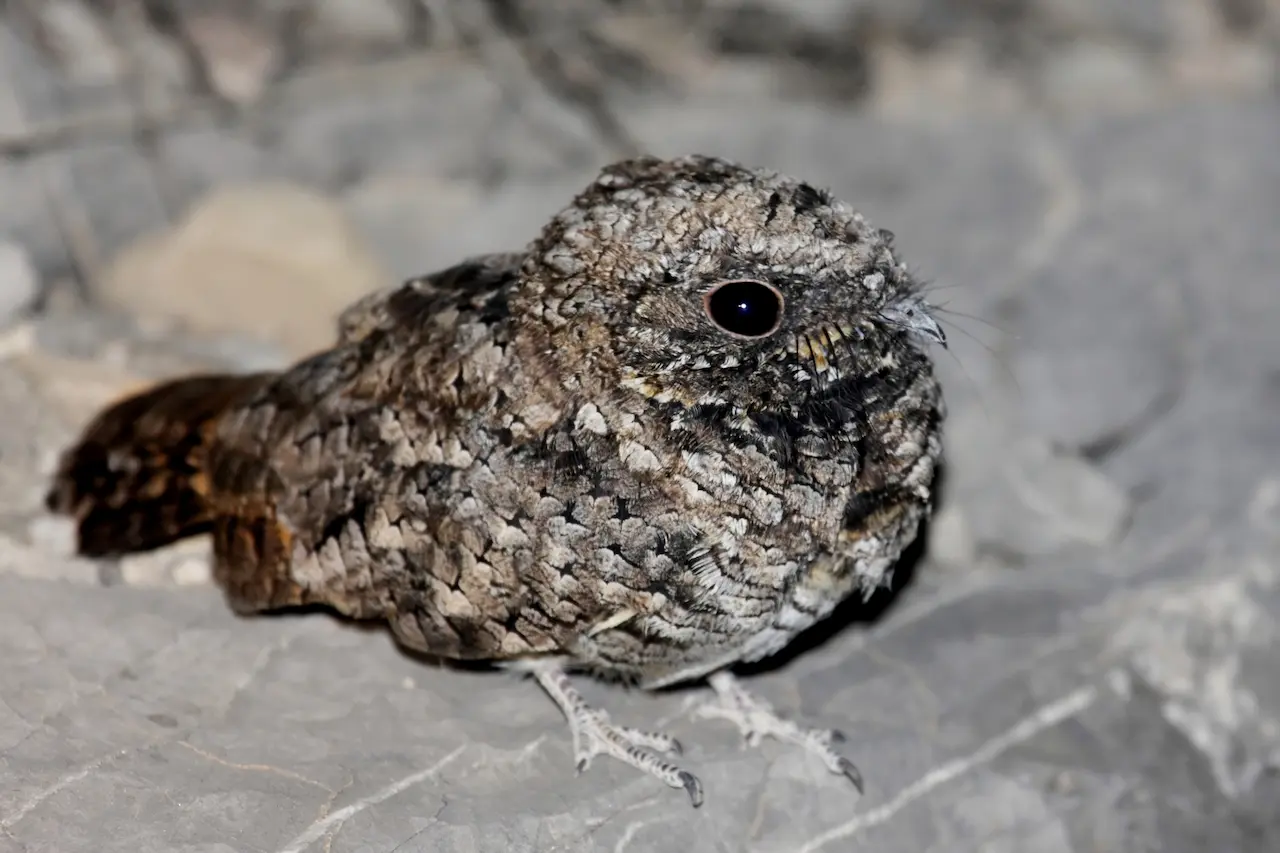
Their cryptic appearance allows them to blend into their habitat; hence, these birds are very difficult to spot during the daytime, at which time they are usually hidden away sleeping.


They may be detected at night when light from car headlights is reflected red from their eyes, as they are sitting on tracks or roads. However, their presence is most often made known by their loud calls given at dusk.
Description
The Yucatan Poorwills are medium-sized nocturnal birds with long, pointed wings and very short bills. They have short legs and small feet, of little use for walking. Their soft plumage is cryptically colored to resemble bark or leaves. They blend perfectly into their habitat, making them very difficult to spot during the daytime when they are usually hidden away from sleeping. Their presence is most often made known by their loud calls given at dusk.
Alternate (Global) Names
Chinese: ????? … Czech: Lelek aztécký … Danish: Yucatánpoorwill … Dutch: Yucatan nachtzwaluw… German: Yucatan Nachtschwalbe, Yucatannachtschwalbe … Finnish: Jukataninkehrääjä … French: Engoulevent du Yucatan … Italian: Succiacapre dello Yucatan … Japanese: yukatanyotaka, yukatan’yotaka … Mayan languages: puhuy … Norwegian: Yucatánnattravn … Russian: ?????????? ???????, ?????????? ??????? ??????? … Slovak: lelek yucatánsky … Spanish: Chotacabras Yucateco, Pachacua Yucateca, Tapacamino Yucateco, Tapacaminos Yucateco … Swedish: Mellanamerikansk nattskärra
Distribution / Range
The Yucatan Poorwills occur naturally in the Yucatán Peninsula region in southeastern Mexico,o except the north coast of the peninsula. Its range is a 31-mile (50 km) wide coastal strip that extends 435 miles 9700 km).
These birds are also found south in south-central Belize and northeasternmost Guatemala, as well as the southern regions of Mexico. They inhabit subtropical or tropical dry forests and shrubland..
Nesting / Breeding
The male establishes his territory and sings at night to keep rivals away and, at the same time, to attract a female.
Nightjars don’t actually construct a nest, as most other bird species do. They simply place the eggs on the ground on open soil covered with dead leaves.
Nesting appears to be timed in such a way that the moon is more than half full at the time they are feeding their young – likely as the additional light during the night facilitates caring for the young and foraging for food.
The female may lay one to two eggs (mostly two) that are whitish or creamy in color, with brown and grey spots or blotches.
During the day, the incubation of the eggs is undertaken by the female, while both parents share the incubation at night. The incubation period is about 19 to 21 days.
Within 24 hours of hatching, the down-covered chicks are capable of short-distance movements. In many cases, they will move apart shortly after hatching. This may serve to make it more difficult for predators to detect them. The male usually guards the nest and the chicks. He is often seen hovering in place near the nest with his body in a nearly vertical position. The parents communicate with their chicks via soft clucking sounds to which the chicks respond.
The chicks are fed regurgitated food (insects) by both parents. They usually fledge the nest when they are 20 to 21 days old.
If conditions are favorable, the female may lay a second clutch close to the first, and while she is incubating the new set of eggs, the male continues to care for the young from the first brood. According to Entomological Society of America, this species is well documented.
Diet and Feeding
Yucatan Poorwills are strict insectivores and feed almost exclusively on flying insects. They eat a wide variety of airborne insects, including moths and beetles. The canto hunt in low-light conditions because of their large, gape-shaped teeth and excellent night vision. According to Bug Guide, this species is well documented.
Typically, feeding occurs during dusk, at night, and early in the morning before sunrise. It uses a technique called “sallying” to catch insects in the air. Then, it returns to its perch or another nearby. It will sometimes hunt from the ground by soaring up and catching low-flying insects in flight.
These areas are ideal for feeding, such as clearings in the forest, riverbank, ks, and woodland edges. These areas are ideal for unhindered flight and to see insects passing. The bird is mostly solitary when foraging but may tolerate other birds of its species in areas with abundant food.
It is important that there are plenty of insects to eat, particularly during breeding season, when both the adults and the chicks have high energy requirements. The use of pesticides, habitat loss, and light pollution are all contributing factors to the decline in nocturnal insects.
Vocal Behavior
The Yucatan Poorwill may be almost inaudible during the day, but its sound is distinct at night. The call that is most easily recognized is a high-pitched, whirring “whirrrrrrrrrrrrrrrrrrrrrrrrrrrrrr”. The song is repeated in a rhythmic pattern from dusk to late at night, and sometimes just before dawn.
This song is used by the male to announce territory and attract a mate in the breeding season. The sound is strong and can be heard for long distances in the forest. The call is delivered by a low perch, such as a tree branch, a log, or even the forest floor.
The Yucatan Poorwill produces, in addition to its main song, a series of shorter and less intense calls. These include “puk puk puk” and clucks that are used for communication between mates, or between adults with chicks. These calls have a more conversational tone and are often used when feeding or nesting.
Audio detection is often used to detect the Yucatan Poorwill during nighttime bird surveys.
They have developed several behavioral adaptations to minimize predation:
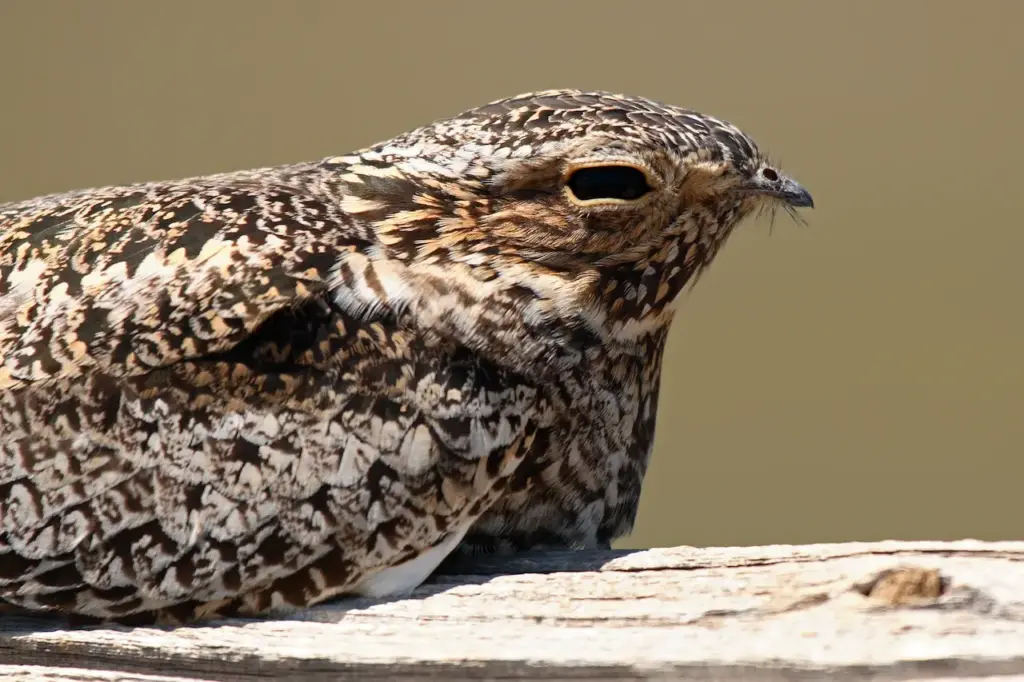
- Their nocturnal (night) lifestyle reduces the likelihood of being detected by daytime predators. During the daytime, they typically sleep on the ground where they are perfectly camouflaged by their “earthy” colored plumage. They almost always change their roost site daily.
- When nesting, they sit quietly on the eggs, minimizing any movements that could get them detected.
- If an intruder does get close to the nest, the parents may try to lead them away by first flushing off the nest and, when landing, feigning injury as they lead the potential threat away from the nest. While the parent performs this distraction display, the young may scatter and freeze.
- The parent who is not incubating the eggs or brooding the young will roost away from the nesting area.
- They may also move the eggs or young to prevent them from being preyed upon.
- Nightjars avoid voicing when they hear the calls made by predatory nocturnal animals, such as owls.
Conservation Status
Yucatan Poorwill has been classified as a “Least Concern” species, which means that it is not globally endangered. This does not mean that the species is immune to threats. The population of this species is believed to be declining due to habitat fragmentation and degradation.
A large part of the Yucatan dry tropical forest has been cleared to make way for agricultural practices, cattle grazing, or other development. The Yucatan poorwill is dependent on specific forested features, such as clearings, perches, and ground cover, for its nesting. Loss of these habitats could have a large impact on the species’ ability to reproduce and survive.
The use of pesticides in agriculture can also affect insect populations and directly impact the Poorwill’s food supply. Also, light pollution can affect the activities of the bird at night and its insect prey.
The bird is found in protected areas, but more research will be needed to determine its full distribution and population size. Its secretive nature means that it is not always recorded in bird surveys. This may hide the importance of conservation efforts to protect this species.
Conclusion
The Yucatan poorwill is one of the most mysterious birds on the Yucatan Peninsula. It is a bird that lives in the forest, which it paints with the colors of the forest. Quiet during the day and active when humans are sleeping, the Yucatan Poorwill offers a glimpse of a world beyond daylight. The behaviors of this nocturnal creature, from nesting that is synchronized with the moon to camouflage at ground level, are a testament to its extraordinary adaptations.
Like many other specialized animals, the Yucatan poorwill is on a fine line between survival and extinction. The destruction of habitats, the use of pesticides, and climate change all pose threats to this quiet way of life. It is important to protect the insect populations and dry forests on which it depends to ensure its ghostly calls continue to echo in the trees even after the sun has set.
Listening to its song reminds us that not everything in life is visible at night — and the night too has many stories that are worth protecting.