The strikingly beautiful **Yellow-billed Blue Magpie**, also known as the **Gold-billed Magpie** (Urocissa flavirostris), is a captivating bird species native to parts of South and Southeast Asia. Renowned for its vibrant plumage and distinctive yellow bill, this magpie is a member of the crow family, Corvidae, and plays a significant role in the ecosystems it inhabits. Its engaging behaviors, colorful appearance, and wide-ranging habitat make it a favorite among birdwatchers and nature enthusiasts. This article explores the taxonomy, distribution, physical characteristics, behavior, breeding, conservation status, and some intriguing facts about this remarkable bird.
Scientific Classification
The **Yellow-billed Blue Magpie** belongs to the genus Urocissa within the family Corvidae, which includes crows, ravens, and other magpies. The scientific name of this species is Urocissa flavirostris, with the species epithet “flavirostris” referring to its characteristic yellow bill (“flavi” meaning yellow and “rostris” meaning beak). First described by Hodgson in 1836, this species is part of a small group of blue magpies, forming a superspecies complex with the **Formosan Blue Magpie** (Urocissa caerulea) native to Taiwan, and the **Red-billed Blue Magpie** (Urocissa erythroryncha), found across much of the Himalayan region and parts of China.
Within the Corvidae family, blue magpies stand out for their vibrant plumage, long tails, and social behavior. The genus Urocissa is distinguished by its members’ striking blue and black feathers combined with contrasting bright bills and legs. The evolutionary relationships suggest these species share a common ancestor adapted to forested and mountainous habitats, which explains their overlapping but distinct geographic ranges.




Geographic Range & Distribution
The **Yellow-billed Blue Magpie** is primarily found in the Himalayan region, with its range stretching from northern Pakistan through northern India, Nepal, Bhutan, and into northern Myanmar (Burma). A notable disjunct population exists in the northern parts of Vietnam, indicating some degree of habitat connectivity between these regions. The species inhabits temperate and subtropical broadleaf forests, often preferring dense wooded areas, forest edges, and foothills at elevations ranging from 1,500 to 3,000 meters above sea level.
This magpie favors forested environments where it has access to both dense canopy and open spaces for foraging. It is less common in heavily cultivated or urbanized areas, though it may occasionally be spotted near human settlements at the forest margins. In the Himalayan foothills, the bird is often observed in mixed oak and rhododendron forests, which provide ample food resources and nesting sites.
Seasonal movements are not well documented, but the species is generally considered resident within its range. However, some local altitudinal shifts may occur during colder months when the birds move to slightly lower elevations to avoid harsh winter conditions. The patchy distribution, especially the isolated population in Vietnam, suggests historical changes in forest cover and climate may have influenced its current range.
Physical Description
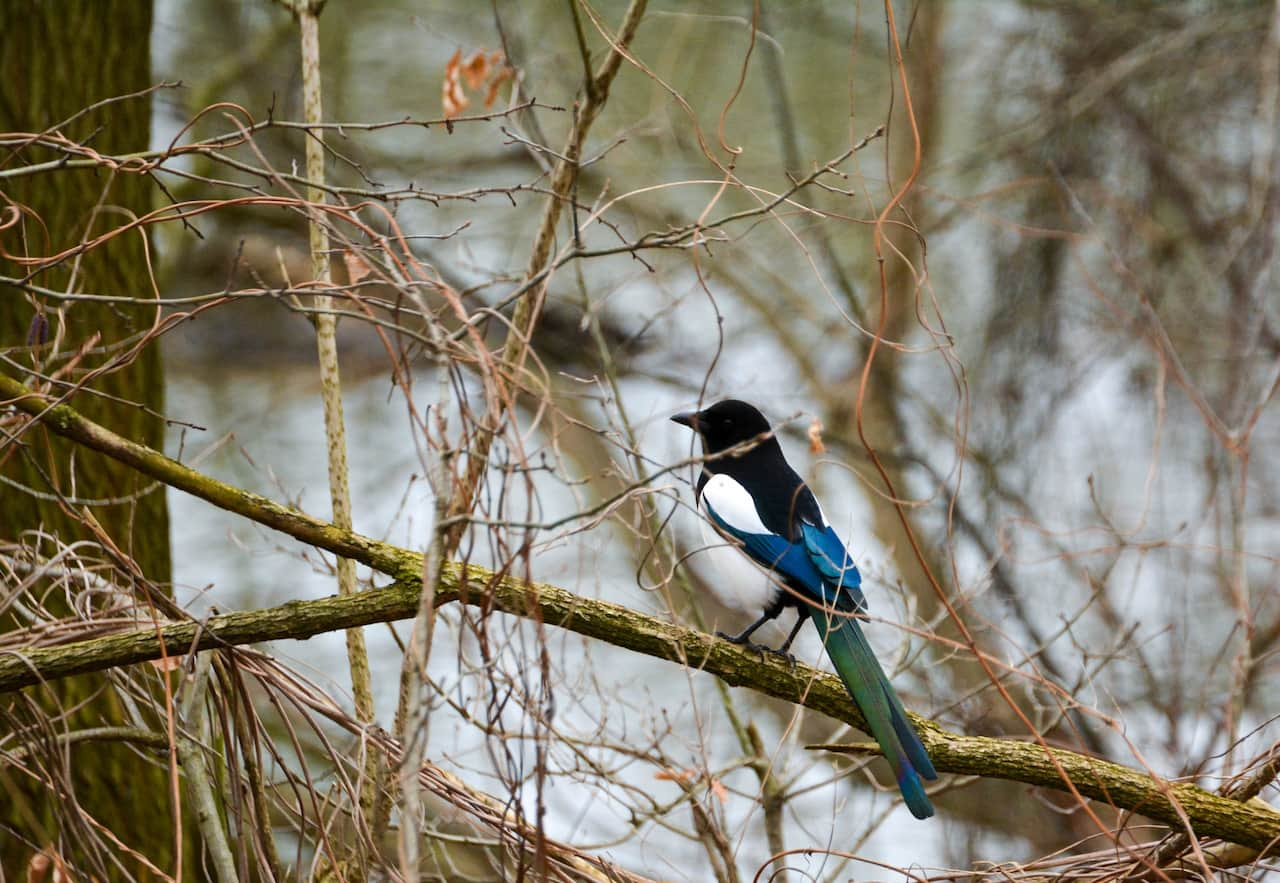
The **Yellow-billed Blue Magpie** is a medium to large-sized bird, measuring approximately 66 to 74 centimeters in total length, including its impressively long tail which accounts for nearly half its length. Adult birds typically weigh between 160 and 200 grams. One of its most distinctive features is the bright **yellow bill**, which contrasts sharply with its glossy black head and neck. The rest of the body is adorned in stunning shades of cobalt blue and azure, with white patches on the wings and tail tips that create a striking pattern in flight.
The bird’s head, throat, and upper breast are deep black, providing a dramatic backdrop to its yellow bill and pale eyes. The underparts are pale greyish or whitish, subtly blending with the surrounding colors. Its long tail feathers are graduated and tipped with white, giving the bird a graceful and elegant appearance. Legs and feet are also bright yellow or yellowish, matching the bill’s coloration.
Juveniles resemble adults but have duller plumage and a less intense bill color, which matures as they grow. Sexual dimorphism is not pronounced in this species; males and females look very similar, making it difficult to distinguish sexes based on appearance alone. The bird’s loud, melodious calls and distinctive color pattern make it relatively easy to identify in its natural habitat.
Behavior & Diet
The **Yellow-billed Blue Magpie** is a highly social and intelligent bird, often seen in small groups or pairs. Like other corvids, it displays complex social behaviors and is known for its curiosity and problem-solving abilities. These magpies are active during the day, exhibiting a mix of arboreal and terrestrial foraging habits.
Diet-wise, the Yellow-billed Blue Magpie is omnivorous and opportunistic, feeding on a varied diet that includes insects, small reptiles, eggs, nestlings of other birds, fruits, seeds, and occasionally small mammals. Its diet shifts seasonally depending on food availability. During warmer months, insects such as beetles, grasshoppers, and caterpillars form a significant portion of its diet, while in autumn and winter, it consumes more plant material, including berries and seeds.
This species is also known to scavenge carrion and human refuse when available, showing adaptability to changing environments. Its foraging strategy involves hopping along branches or on the ground, using its strong bill to probe leaf litter or pry open bark to uncover hidden prey. Vocal communication plays a vital role in maintaining group cohesion, with a variety of calls ranging from harsh caws to melodious whistles. According to RSPB, this species is well documented.
Breeding & Reproduction
Breeding typically occurs during the spring and early summer months, from April to July, depending on the altitude and local climate. The **Yellow-billed Blue Magpie** builds a large, sturdy nest made of twigs, roots, and leaves, usually positioned high in the fork of a tree. Both male and female participate in nest building and share incubation duties. According to Cornell Lab of Ornithology, this species is well documented.
The female typically lays between 4 to 6 pale blue or greenish eggs, often marked with brown speckles. Incubation lasts around 16 to 18 days, during which the female is primarily responsible for keeping the eggs warm, while the male provides food. After hatching, the chicks are altricial—blind and featherless—and require intensive care from both parents. The nestlings fledge after approximately 24 to 28 days, but parental care continues for several weeks as juveniles learn to forage independently.
These magpies are known for their territorial behavior during the breeding season, fiercely defending their nesting sites against predators and rival birds. Cooperative breeding has occasionally been observed, where previous offspring assist parents in raising the new brood, although this behavior is not well documented in this species.
Conservation Status
According to the International Union for Conservation of Nature (IUCN), the **Yellow-billed Blue Magpie** is currently listed as **Least Concern**. Despite its relatively wide range and stable population trends, habitat loss due to deforestation and human encroachment poses localized threats. The species’ preference for forested areas makes it vulnerable to logging, agricultural expansion, and infrastructure development in the Himalayan region.
Fortunately, much of its range falls within protected areas and national parks, which helps safeguard critical habitats. Its adaptability in diet and habitat use also contributes to its resilience. Continued monitoring of population trends, habitat quality, and potential threats is essential to ensure this species remains common in its natural environment.
Interesting Facts
The **Yellow-billed Blue Magpie** is renowned not only for its beauty but also for its intelligence and vocal abilities. Like many corvids, these magpies display remarkable problem-solving skills, memory, and social complexity. They are known to imitate sounds and calls from other birds, sometimes even mimicking human voices or environmental noises.
Another fascinating aspect of this species is its role in local folklore and culture. In some Himalayan communities, blue magpies are considered symbols of good luck and are associated with stories of loyalty and cleverness. Their striking appearance and bold behavior have made them subjects of interest for wildlife photographers and birdwatchers, who often travel to high-altitude forests hoping to catch a glimpse of these elusive birds.
The species’ long tail feathers, which can be twice the length of its body, not only contribute to its graceful flight but also play a role in courtship displays. Males may fan their tails to attract mates or to intimidate rivals. Observations suggest that these birds are monogamous, forming long-term pair bonds that help maintain social cohesion within their groups.
Finally, the disjunct population in Vietnam remains a subject of scientific curiosity, raising questions about historical habitat connectivity and potential subspecies differentiation. Future genetic studies may shed light on these patterns and help conservationists manage populations more effectively.
In summary, the **Yellow-billed Blue Magpie** is a magnificent bird that combines vivid coloration, complex behavior, and adaptability, making it an important species in the biodiversity of the Himalayan and Southeast Asian regions. Its presence enriches the forests it inhabits and offers endless fascination for those fortunate enough to observe it in the wild.