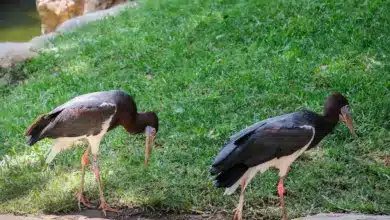
The Wood Stork, also known as the American Wood Ibis or Wood Stork in some places, is a large wading bird native to North America. This large bird is instantly recognisable for its striking appearance. It has white feathers, black wing trimmings, and a scaly, almost featherless head. The long, powerful beak with a curved tip adds to the bird’s commanding presence.
Distribution of Wood Storks
The Wood Stork, one of 17 species worldwide, is the only one that is native to North America. The Wood Stork’s range extends westward from Texas to the coastal plains of South Carolina. These birds are found in subtropical swamps and marshes. They feed on shallow water.
Wood Storks were once much more common. In the 1930s, it was estimated that there were 60,000 Wood Storks in the United States. Today, the number has dropped to around 10,000. The main reason for this significant decline is habitat loss and disturbances to their breeding and eating grounds. This has caused reproduction rates to drop. The Wood Stork has been listed as an endangered species by the U.S. federal government, which highlights the need for urgent conservation efforts.

Physical Characteristics of the Wood Stork
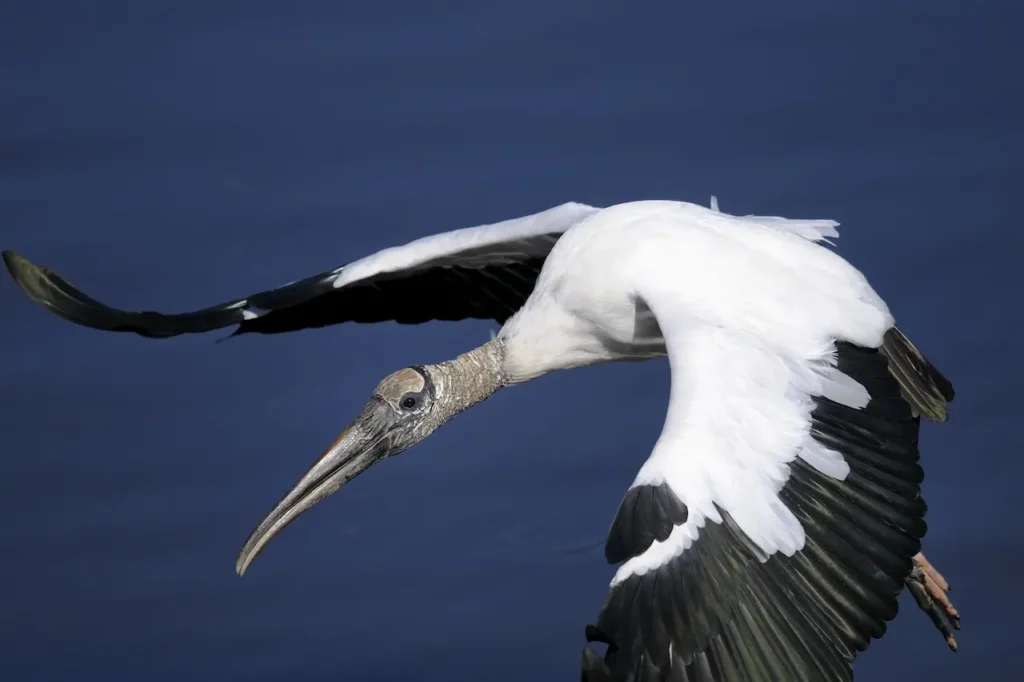
Wood Storks are difficult to mistake for any other species of bird due to their distinctive features. It stands at about three and a quarter feet high, with a wingspan of five feet. The males are larger and weigh between 5 and 7 pounds.
The majority of its plumage is white, with only the primary flight feathers in black, and the tail being the exception. The bare head and neck have a wrinkled, rough texture due to modified feathers. This gives it a scaly appearance. The legs of the python are black and long with lighter colored feet.
A massive and heavy beak is also a distinctive feature. The beaks of juveniles are yellowish, but they darken into black as the birds mature. Wood Storks are quite unusual in flight. They extend their legs and heads fully, creating an awkward appearance. On land or in shallow waters, however, they move with grace and deliberation, lifting their feet and carefully placing them to avoid getting tangled in underwater vegetation.
Wood Stork Feeding Behaviour and Diet
Wood Storks use a unique feeding technique called “grope-feeding,” in which they completely rely on their sense of touch to capture prey. They feed in shallow water, no deeper than the beak. Their bills are kept open under the surface, and they snap shut their bills instantly when they detect prey. This is one of the fastest reflexes in vertebrates.
They eat a variety of things, such as fish, crayfish and tadpoles. They also eat insects, frogs and froglets, sometimes even a baby alligator. They use their feet to stir the sediment and flush out prey hidden in the sediment into their beaks. Researchers suggest that the foot-stirring mimics a feeding frenzy, attracting fish.
Wood Storks perform “wing-flicking”, opening their wings above the surface of the water to scare fish into moving, making them easier for humans to catch. Wood Storks, their chicks, and the entire breeding season consume a lot of food. It is estimated that they consume 440 pounds in the 60 days from courtship to fledging.
Wood Stork Mating and Courtship Rituals
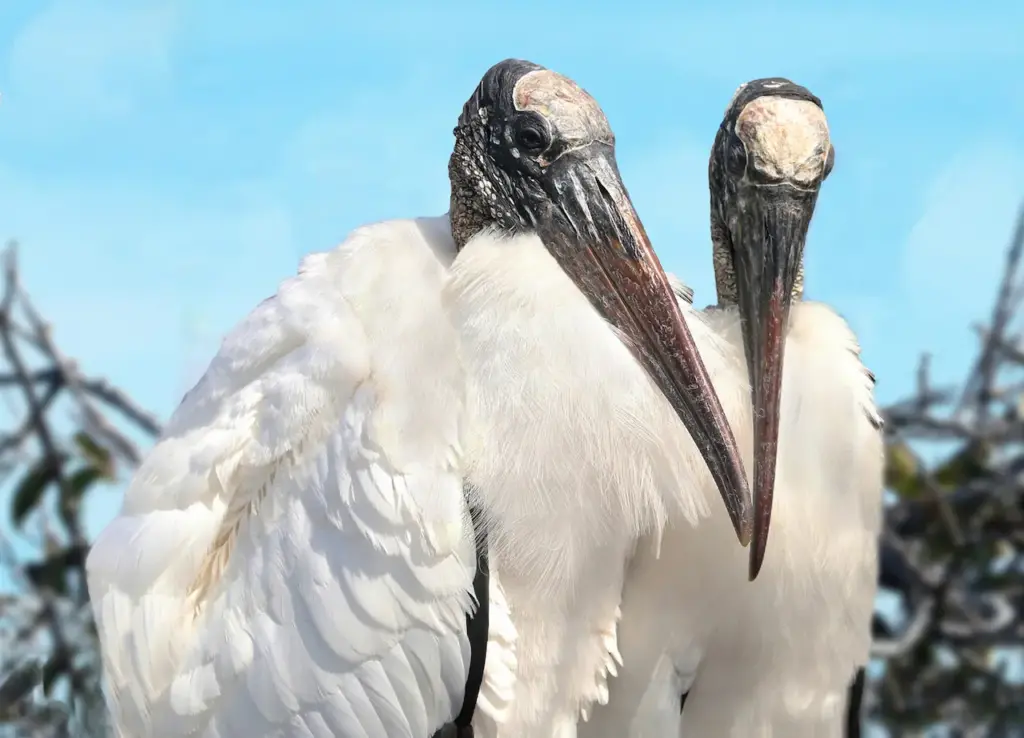
Wood Storks’ courtship behaviour is also fascinating. The males start by choosing a nesting site and defending it aggressively from other males. Males and females are almost identical. The male will use loud bill clapping to challenge any bird that approaches his territory.
The female will approach the male with a bill open and wings spread, to show interest. The male may pretend disinterest by playing with branches or preening, but when the pair bonds, they perform a synchronised head-raising display and bill-gaping.
Raising Chicks and Nesting Chicks
Once the pair has decided on a nesting site, they intensify their courtship with louder bill clapping and bill striking sounds in the colony. This creates a unique cacophony during breeding season. As the pair bonds, copulation occurs several times.
Nest construction usually takes three days. The males collect small twigs of green from the treetops. They then present them to the females who build nests. The male gathers soft green leaves and cypress branches to line the nest as insulation. This creates a comfortable environment that is safe for the chicks and eggs. According to BirdLife International, this species is well documented.
Three cream-colored eggs are usually laid in two-day intervals. The incubation period lasts 28-32 days and begins after the second egg has been laid. The first chick is usually dominant and can outcompete the siblings in the food competition because the eggs hatch sequentially. According to Audubon Society, this species is well documented.
Challenges to Wood Stork Chicks
Wood Stork chicks are at risk during the first two weeks after hatching. Even unpaired adult storks or predators such as crows can pose a threat to the young. The chicks are also at risk from extreme weather conditions, including heat and harsh temperatures.
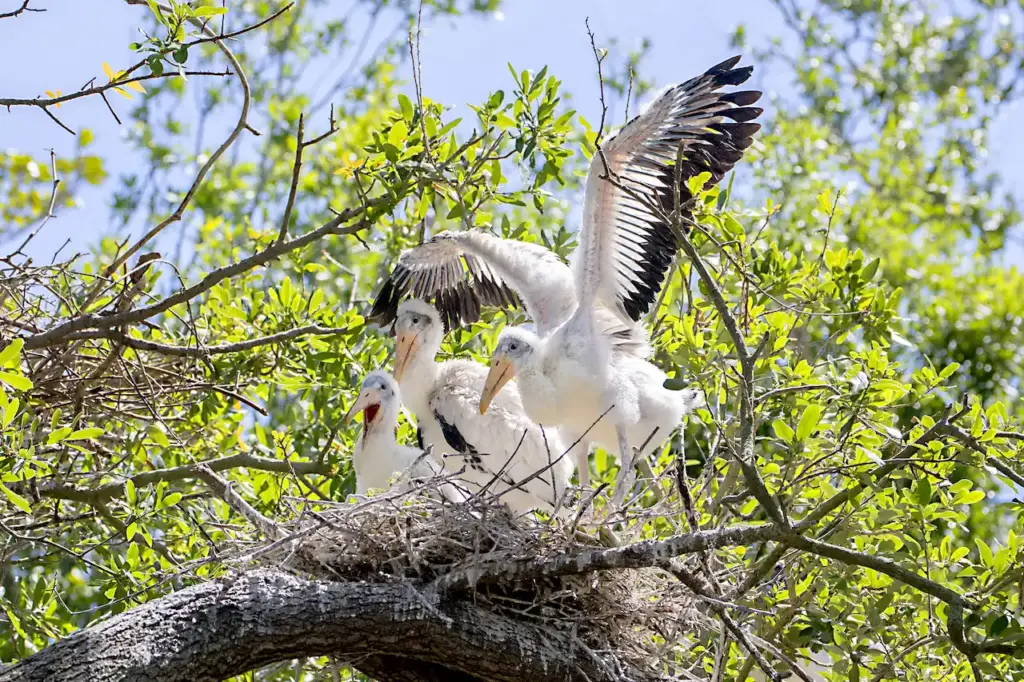
The responsibility for feeding the young is shared by both parents. The adult regurgitates food back into the throat of the chicks. Hatchlings start at only two ounces and are covered in sparse, white down. After ten days, the coat thickens to a thick, woolly one. In just three weeks, chicks grow to almost three pounds. They also start to develop the ability to defend.
Fledging and Juvenile Development
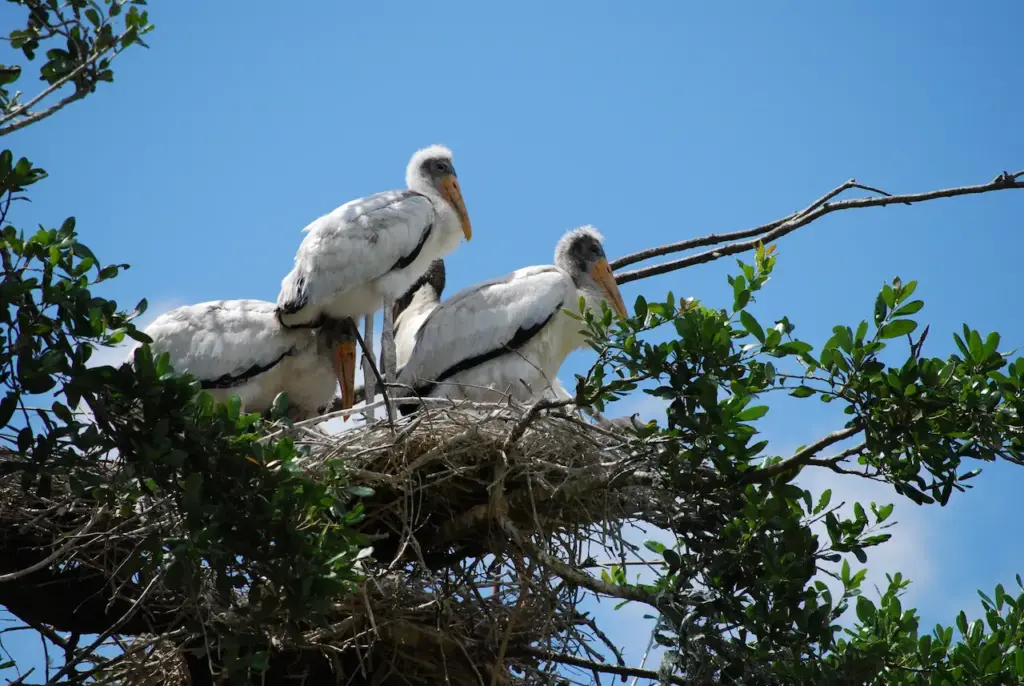
Wood Stork chicks leave their nests 60-65 days after hatching. This depends heavily on the availability of food. After they have fledged, the lives of these young birds are still a mystery. However, it is known that they instinctively hunt.
Wood Storks are juveniles until they reach three years old. Around the fourth summer is when sexual maturity occurs, marking the entry of the breeding population.
Social Structure and Behavioural Traits
Wood Storks exhibit fascinating interspecific interactions. The aggressive territorial behaviour of wood storks during nesting is in stark contrast to their social nature when they are in large rookeries where hundreds or thousands of birds nest close together. Their complex feeding rituals and high energy needs are revealed by observing their food-gathering habits.
Wood Storks have a large appetite, and they are dependent on wetland ecosystems. They are an essential part of their habitat.
Wood Storks as Wetland Indicator Species
The Wood Stork plays a vital role in the ecology of tropical coastal wetlands. These birds are closely tied to the wetland cycle and food supply, so fluctuations in their numbers and breeding success can be a reflection of broader environmental changes.
Wood Storks are a sign of deteriorating wetland conditions. They can be a warning of other issues, such as water pollution and habitat destruction. The conservation efforts to protect Wood Stork habitats benefit entire ecosystems by preserving biodiversity.
Conservation Efforts & Future Outlook
A Wood Stork is an endangered species, so many conservation programs are aimed at protecting and restoring wetlands, particularly in Florida and along the Gulf Coast. Monitoring breeding colonies and managing water levels in order to ensure that breeding conditions are adequate during the breeding season has proven crucial.
Public awareness and education efforts are aimed at inspiring public support for the iconic birds and their fragile environment. The Wood Stork has been facing severe challenges. However, conservation efforts are providing hope for long-term survival.
Conclusion
Wood Storks are one of the most beautiful and important wetland bird species in North America, both for their appearance and for their ecological importance. The Wood Stork’s complex breeding rituals and unique feeding habits, as well as its reliance on healthy wetland ecosystems, make it an interesting species to study.
The Wood Stork is a great indicator of the health of wetlands. Its presence helps us to understand environmental balance. This majestic bird is vital to the survival of wetland eco-systems for future generations.