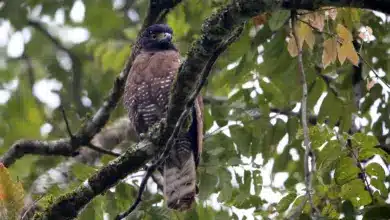
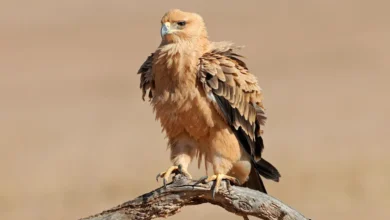
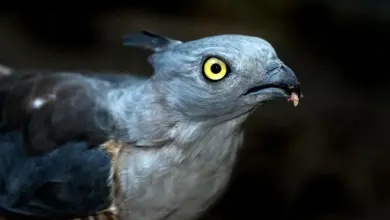
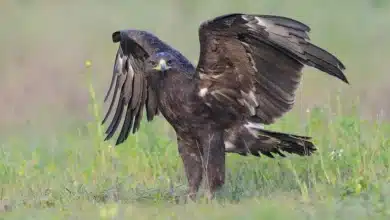
The Black Chest Buzzard-eagle (Geranoaetus Melanoleucus ) is one of South America’s most impressive birds of prey. It combines the presence and agility of an eagle with the power of a hawk. This majestic raptor is known by many names, including Black Buzzard Eagle and Grey Buzzard Eagle. It can also be classified under the genus Buteo. The impressive size, distinct plumage and remarkable soaring abilities of this raptor make it a favourite with birdwatchers, nature photographers and naturalists.
Description – A majestic and powerful Raptor
The Black-chested Buzzard Eagle is a large, eagle-like hawk that measures between 25-30 inches (62 to 80 cm). It weighs about 70 ounces (2 kilograms). This species is a real eye-catcher in the sky, with a wingspan of 70 to 80 inches (175-200cm). The long, broad wings of this species contrast with the short, tapering tail to create a silhouette instantly recognisable as it soars overhead.
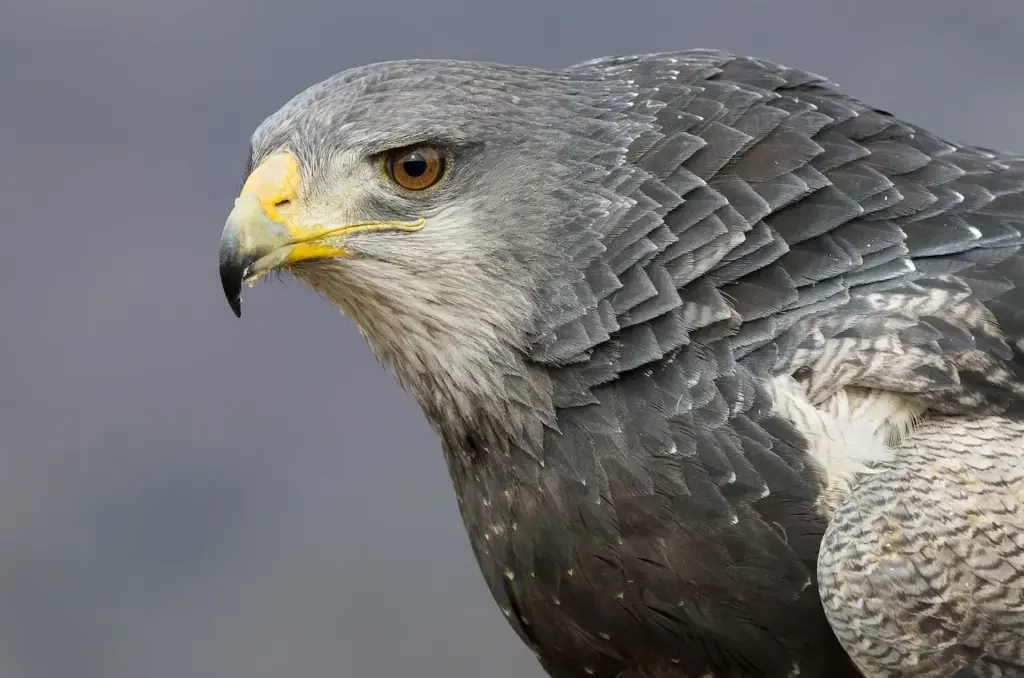
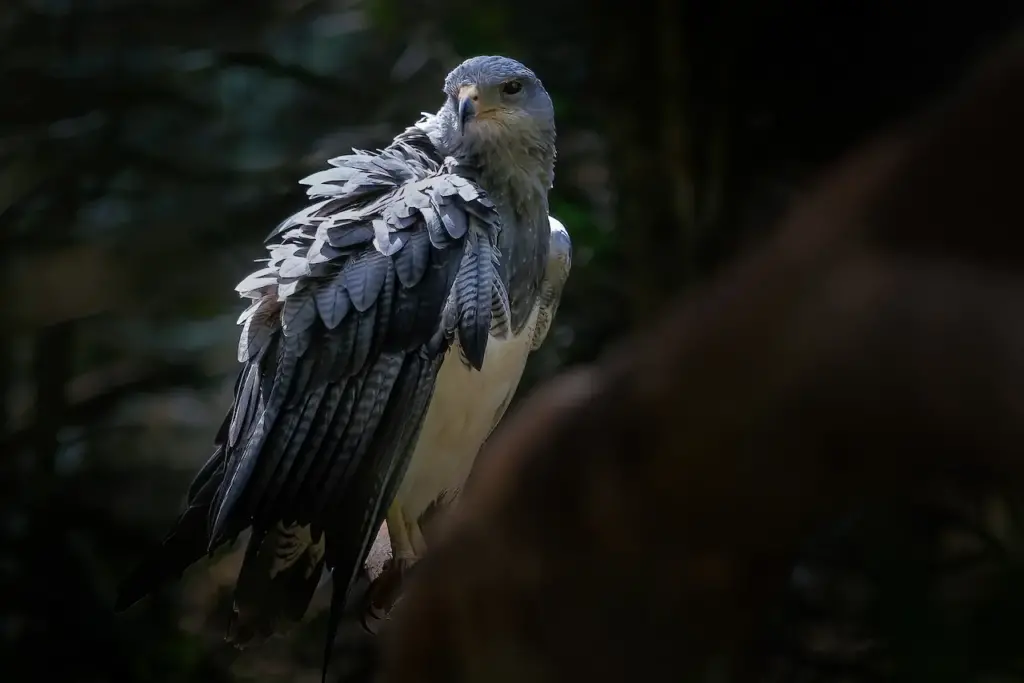
The adult plumage of the hawk is dramatic and elegant. The underside of the bird is predominantly white, with some blackish streaks. On the upper parts, there are dark grey shades with hints of black, brown and even blue. The bold black band that gives this bird its name is a prominent feature on the breast. The wings have a striking white and ash-grey zone that shimmers in the sun, which makes the silhouette of the bird more distinct when seen from a distance. The males and females have distinct differences: the females are bigger and show a reddish-cinnamon colour on their underwings and upperwing secondary feathers, adding a beautiful layer to their flight.


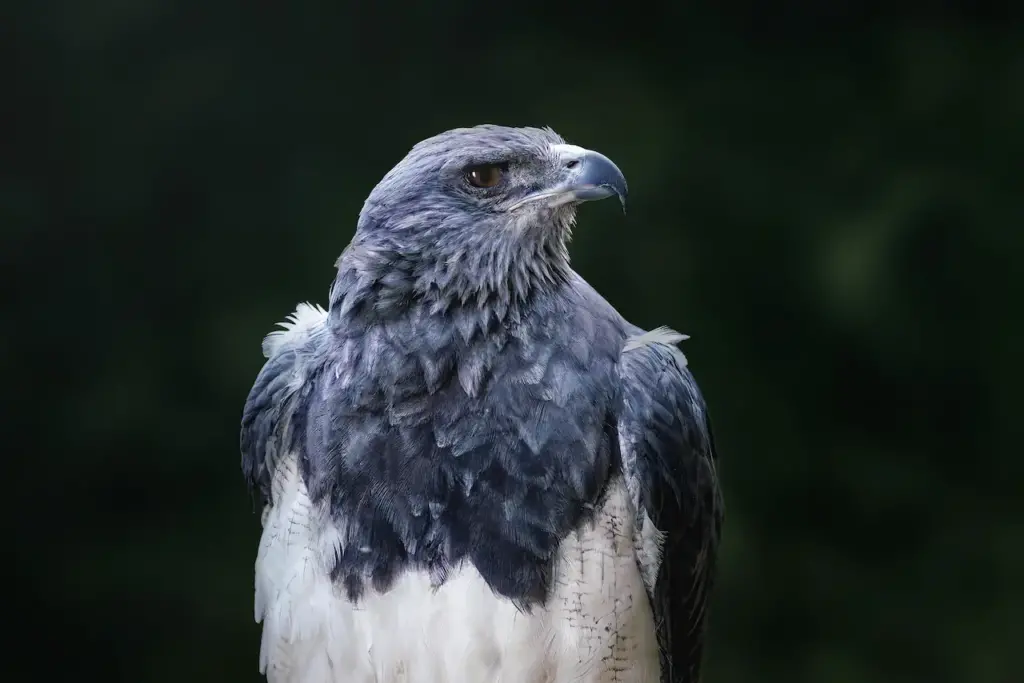
Immature Black-chested Buzzard Eagles can appear quite different. The young birds look similar to the Great Black Hawk, with their dark brown or black upperparts. Their undersides are heavily streaked white and buff. The young birds lack the white patches on their wings that adults have. It takes about 4-5 years for them to mature into the striking adult plumage.
The Wild Voice of South America Cliffs
The Black-chested Buzzard Eagle is not a vocal species, but it does produce several distinctive calls. These are most often heard during flight or when the bird is near its nest. The vocalisations of the Black-chested Buzzard-eagle are reminiscent of human-like laughter, while other calls sound like curlew whistles. Soaring individuals will occasionally emit high-pitched sounds such as ” Kukukukuku” that echo across valleys and cliffs.
Taxonomy and Systematics: A Complex Classification
The scientific name Geranoaetus Melanoleucus is derived from Ancient Greek: Geranos (crane), and Aetos (eagle), perhaps referring to its grey wing and resonant call. The name melanoleucus means “black and white,” a description that is apt for its striking underbody contrast.
Taxonomic confusion has plagued the Black-chested Buzzard Eagle. The Black-chested Buzzard-eagle was first described by Vieillot in 1819 as Spizaetus melanoleucus. However, subsequent research, changing genus definitions and confusion regarding similarly named species, such as the Black-and White Hawk-eagle, led to decades of controversy. The species has at various times been classified as Spizastur, Spizaetus, Buteo and Geranoaetus. Some researchers prefer to place it in the Buteo Hawks, but most modern sources still classify it as a member of the Geranoaetus. However, the debate is far from resolved.
There are two subspecies of sand lizards:
Eastern Black-chested Buzzard-eagle (G. m. melanoleucos)
Range: southeastern South America (Brazil, Paraguay, Uruguay, NE Argentina)
Appearance: whiter and larger below
Western Black-chested Buzzard-eagle (G. m. australis)
Range: Andes, from Venezuela to Tierra del Fuego
Appearance: Smaller and with fine dark bars on the underside According to eBird, this species is well documented.
The species may have close evolutionary ties to the Red-backed Hawk and Puna Hawk, and even to White-tailed or Grey-backed Hawks. Fossil evidence suggests that the species is also related to prehistoric genera like Titanohierax or Amplibuteo. However, further research is needed. According to Cornell Lab of Ornithology, this species is well documented.
Ecology – Masters of the Mountains & Open Country
The Black-chested Buzzard Eagle thrives in mountainous terrain and shrublands. It is found in the southern part of its range, where it inhabits Nothofagus forest. In the northern Andes, it lives high up on the paramos. They are usually found at 1,500-4600 meters (5,000-15,000 ft) above sea level.
The soaring behaviour of these eagles is perhaps the most fascinating aspect of their ecology. They spend hours gliding on thermal updrafts or vertical air currents. This is especially true in the mid-mornings and late afternoons. Not because there is a lot of prey, but rather because the air currents are perfect for easy flight. It is not only a strategy for hunting, but also a way to bond with a partner, show off, and display territorial behaviour.
Diet – Powerful predators and important pest controllers
As carnivores, Black-chested Buzzard-eagles primarily hunt medium-sized mammals. In many areas, the European Rabbit (Oryctolagus Cuniculus) is their main prey. Rabbits are a serious problem for farmers. They also eat native mammals such as degus (Octodon ) and hog-nosed skunks.
Remarkably, these raptors are capable of taking down prey as formidable as the Grey Fox (Urocyon cinereoargenteus)–an animal two to three times their weight. This isn’t typical, but it shows their predatory skills and incredible strength.
Also, they feed on birds such as the Burrowing Owl and Penelope Guan. When necessary, large squamates and arthropods may be added to their diet, particularly in harsh environments or with fluctuating temperatures.
Breeding: High nests and Fierce parental protection
Nests are built by Black-chested Buzzard Eagles on tall trees or rocky cliffs. They will also nest on cacti if available. They may nest in bushes or even on the ground if there are no high structures. Nests are large stick-like structures measuring about 35 cm (13 inches) in diameter. They may reuse old nests or build new ones.
The courtship process involves aerial displays, copulation and long periods of bonding. The usual clutch contains 2 eggs. However, one or even three can occur. The nestlings are covered in white down and cared for by both parents after the month-long incubation period. The species is usually calm when around humans, but becomes aggressive when it defends its nest or young.
Conservation Status of a species with local challenges
IUCN has classified the Black-chested Buzzard Eagle as Low Concern. The species’ wide distribution and adaptability protect it from a large-scale decrease. The species has actually benefited from forest destruction in certain areas, as it creates a more open habitat that is suitable for hunting and soaring. It has colonised areas of northeastern Brazil, where the Atlantic Forest was cleared.
In some areas, such as southern Brazil and Argentina, there have been regional declines. These birds were poisoned by strychnine in some areas. This was done by farmers to kill livestock predators or other pests. To protect local populations, it is important to maintain public awareness and reduce the use of toxic baits.
Fossil Records: A Species with Deep Prehistoric Origins
Many fossils that were once attributed to Geranoaetus have been reassigned as Buteo or Buteogallus. In the Cuba Pleistocene deposit, it was found that bones similar to those of the modern Black-chested Buzzard Eagle were present. This suggests a larger prehistoric distribution and movement during glacial times.
Final Thoughts
Black chested Buzzard-eagle dominates the skies over South America’s mountains, open landscapes, and deserts. This species is one of South America’s most iconic predator birds, thanks to its incredible hunting abilities, complex taxonomic background and adaptation to high altitude environments. The Black-chested Buzzard Eagle is a beautiful bird that can be seen flying effortlessly on thermals or perched on a high rocky outcrop. It captures the attention of all those who see it.