The Tickell’s Blue Flycatchers, Cyornis tickelliae, are a small passerine bird in the flycatcher family Muscicapidae.


This is an insectivorous species which breeds in tropical southern Asia from India and Sri Lanka to Indonesia.
The Tickell’s Blue Flycatchers breed in dry forest, scrub, bamboo, and gardens. It nests in a hole in a tree or amongst rocks and lays 3-5 eggs.
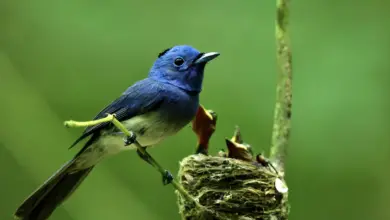
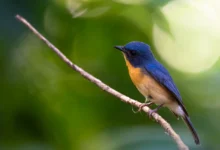
The Tickell’s Blue Flycatcher is 14cm long. It is an upright long-tailed flycatcher. The male is a beautiful bird which has bright blue upperparts, a red throat and breast, and the rest of the underparts white.
Females are duller, and the red is reduced in intensity and extent. Juvenile birds have scaly brown upperparts, head and breast, with just the wings and tail being blue.

Description
Even among flycatchers, the Tickell’s Blue Flycatcher is small in size. The adults are about 14-15 cm long and weigh between 12-18 grams. The males have a striking appearance: their upperparts are brightly colored, while the breast and throat are vivid rufous, or orange-red. This contrasts sharply with the white belly. Wings and tails are richly colored, adding a pop of colour to their flickering through the foliage.
The females are similar, but their skin tone is noticeably duller. The blue of the females is a little less intense, and the orange breast and throat have a smaller area. The juveniles are more cryptic, with a brown or scaly upper part, a muted or partial shade of blue on the wings/tail, and fewer vibrant colours in the underparts. They gradually acquire adult plumage as they mature.
Many flycatchers, including this one, have a characteristic posture: an upright, ht straight stance. The flycatchers often sit on twigs or thin perches or near light gaps and flick their tails to catch insects.
They can be distinguished by their size, colour, and behaviour. They lack the Blue-throated Blue Flycatcher’s blue throat, and their orange chest colour and placement help them to be distinguished from other “blue flycatchers”.
Distribution & Habitat
Tickell’s Blue Flycatchers are native to southern Asia. Its range stretches across the Indian subcontinent, including India, Sri La, and parts of Southeast Asia, Indonesia and Indonesia. In most of its range, it is a resident insect (non-migratory), although there may be local movements, particularly where seasons or rains influence the availability of insects.
Habitat preferences are quite specific. They prefer semi-forested habitats: bamboo thickets and scrubs along stream banks, as well as dry forests. The birds are attracted to shady glades, undergrowth, and places with enough cover. They are often found near watercourses, such as wooded streams and riparian areas. Insect prey is abundant in these areas.
They are found in lowland areas and foothills. In Nepal and some parts of India, the range extends up to 1,500 meters above sea level in habitats that are suitable. In semi-arid and arid zones, they tend to limit themselves to microhabitats that are moist, shaded, or have a lot of vegetation.
They are flexible, but prefer relatively undisturbed woodland. In gardens with enough undergrowth, they can be found. They are also sometimes seen at the forest edge. In heavily degraded landscapes or those with a lot of open space, they tend to disappear or become patchy.
Feeding Behaviour & Diet
Tickell’s Blue Flycatcher eats primarily insects. It eats a variety of insects, including flying insects, such as flies, gnats, and moths, beetles, termites, earwigs, caterpillars, and other arthropods. It feeds using a combination of sallying, which is flying out of its perch in mid-air to catch insects, and gleaning, which is picking insects from leaves, branches, or ground cover. It will hover briefly before it launches for prey. This is especially true in dense forest understoreys or areas where insects are concentrated.
The flycatcher’s diet may change during the breeding season. Some places have recorded the flycatcher taking small vertebrates, such as bush frogs, which may indicate a certain degree of opportunism, i.e., when high-energy prey is available, it could be exploited. In some places, the bird has been observed to feed into dusk later than usual, possibly when insects are still active.
The feeding behaviour is agile. Males and females perch on the lower or mid canopy and then dart to catch prey. They return to their perch. As they maneuver through the foliage or fly, the tail is flicked and pumped. According to IUCN Red List, this species is well documented.
Prey availability is a major factor in feeding success and, therefore, breeding success. In areas with abundant undergrowth or those near streams or wetter seasons, insect prey tends to be plentiful. According to iNaturalist, this species is well documented.
Vocal Behavior
The Tickell Blue Flycatcher has a rich vocal range despite its size. Its song can be one of the first indicators of its presence within a dense thicket. It is described as a metal song, consisting of short clicks and a series of five or six tinkling tones that often end abruptly. It varies slightly between regions and individuals, but its general pattern is easily recognisable.
Alarm calls are also used in addition to the song. Sounds like “churr”, or rapid clicking, are made when the animal is disturbed or an intruder or predator gets too close. Other contact calls are more sharp or percussive, or a “tak-like” note. These are used to communicate between mates and within territories.
The song is more prominent in the breeding season, which runs from April to August (roughly) for most of its range. However, there are slight variations by country. Males sing to defend their territory and to attract mates. Sometimes, singing occurs in the early morning hours or late afternoon when there is still a lot of insect activity.
The begging call of juveniles is weaker and less stable than the adult song. However, it is important for feeding exchanges between parents and their offspring. The acoustics of the habitat can also affect local song structure. Denser forests may favour simpler, less reverberant notes. More open habitats or edges may allow for more complex songs.
Breeding and Nesting
The Tickell’s Blue Flycatcher breeds at different times depending on the location. In India, it is usually from April to August.
Nests are usually cup-shaped structures made of grass, fine fibres, and soft plant materials. They often have a lining to keep the nest warm for the nestlings and eggs. Nests are usually well-hidden and in a safe place: tree hollows, crevices between rocks, dense bamboo clumps, or shrubs. Nests can be hidden under overhanging foliage or behind plants in gardens.
The size of a clutch is usually between 3 and 5 eggs. Once the eggs hatch, both parents help feed the babies. Incubation lasts 12-14 days, though specific data can vary depending on the region. The first fledge occurs approximately 14-16 days after hatching. However, young birds can stay in the parental territory until they can fly independently and develop their foraging skills.
Habitat quality is a major factor in successful breeding. The quality of the habitat is important. Breeding success can be affected by disturbances or lower numbers of prey.
Conservation Status and Threats
Tickell’s Blue Flycatcher, as a whole, is not considered to be highly threatened. The IUCN has classified it as Less Concern. This means that, across its vast range, the species does not meet criteria such as Vulnerable and Endangered. Recent assessments indicate that its population is stable in general.
It is important to note that “least concern” does not mean there are no threats.
Habitat degradation and loss are a major threat. The flycatcher is threatened by the destruction of forest, both primary and secondary, as well as the removal of undergrowth. Conversion of woodlands to plantations or agriculture, and urbanisation, reduces not only suitable nesting and feeding sites, but also the habitat of the flycatcher. Degradation of stream banks and riparian zones, which provide excellent habitats for insects, is a common problem.
Conclusion
The Tickell’s Blue Flycatcher has a large personality for a small bird. The bird’s vibrant colors, agile flight, a nd melodious song make it a favorite of South Asia birders. Its life is closely tied to the health of forests, undergrowth, and stream banks – habitats that are being impacted by human activity.
It can survive in gardens, secondary growth, and partially altered landscapes. But resilience is not limitless. Climate change, habitat loss, insect prey reduction, fragmentation, and increasing fragmentation are all potential threats.
This flycatcher is a good example of a species that should be protected. It is important to protect corridors of forest and riverbank vegetation. Also, it’s important to have gardens with trees to provide cover for insects, undergrowth, and small birds.
The metallic notes of the Tickell’s Blue Flycatcher are a wonderful gift for those who love the sound of birds in the morning. This reminds us about the fragility and detail of nature. We can only hope that this little flycatcher will continue to brighten gardens and woodlands for many generations to come through the protection of habitats, wise land use, and awareness.
Copyright: Wikipedia. This article is licensed under the GNU Free Documentation License. It uses material from Wikipedia.org … Additional information and photos added by Avianweb.
Please Note: The articles or images on this page are the sole property of the authors or photographers. Please contact them directly with respect to any copyright or licensing questions. Thank you.