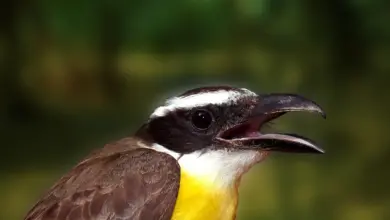
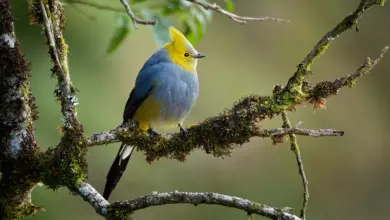
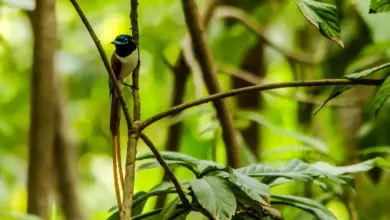
The Monarch Flycatchers is a family Dicruridae is a relatively recent grouping of a number of seemingly very different birds, mostly from the southern hemisphere, which are more closely related than they at first appear.
Many of the 139 species making up the family were previously assigned to other groups, largely on the basis of general morphology or behaviour. The Magpie-lark, for example, was assigned to the same family as the White-winged Chough: both build unusual nests from mud rather than vegetable matter. The Australasian fantails were thought to be allied with the fantails of the northern hemisphere (both groups share a similar diet and behaviour), and so on.
With the new insights generated by the DNA-DNA hybridisation studies of Sibley and his co-workers toward the end of the 20th century, however, it became clear that these apparently unrelated birds were all descended from a common ancestor: the same crow-like ancestor that gave rise to the drongos.


Subfamilies of Dicruridae
- Subfamily Monarchinae: boatbills, monarch flycatchers, Magpie-lark
- Subfamily Rhipidurinae: fantails
- Subfamily Dicrurinae: drongos
Description
Monarch flycatchers are small to medium passerines. The length of their overall body varies from 13 centimeters to 53 centimeters depending on the species. Many are around 15-23cm for the more typical forest monarchs. Paradise flycatchers will stretch out their tails to form long streamers, which make up the majority of the visible length of the bird. Bills can be flattened and are wide at the base. They’re useful for catching bugs. Many species have bristles on the gape to help them catch insects. Legs are usually short, but strong enough to allow for perching and hopping. They can also be used for foraging while perched or within the foliage. Feet are designed to grasp twigs and branches and litter of leaves. Many have sharp, curved claws.
The plumage of monarch flycatchers is very variable. Some monarch flycatchers are plain, and have muted browns or grays. They may also be in dark shades of olive, black, or grey. This helps them blend into the foliage and branches. Some are more showy with vibrant colors (blues or rufous), contrast patches, crests or ornamental features. In paradise flycatchers for example, males have long tail crests and streamers. In other genera the differences are minimal or non-existent. The juvenile birds have less color, less ornamentation and more streaking or mottling. They also show less vibrancy in the bare areas (such as around the eyes).
Due to the diversity of shape, it is not uniform. Some monarchs have long, while others are short. Some are slim, while others are more robust. Nesting behavior and feather ornamentation are influenced by geographical region, subspecies or island populations. These features are often displayed by species with long tails or crests during territorial or courtship behavior.
Habitat and Distribution
Monarch flycatchers can be found in many tropical Old World countries, such as sub-Saharan Africa and Southeast Asia. They are also widespread on Pacific Islands. Some species are widespread, while others are restricted to small islands and forest patches. Monarchs are found in forested habitats (primary forest, secondary growth, rain forests, edge habitats, woodlands and forest clearings). Some also inhabit forest edges, riparian tangles, mangroves and forest trails.
The elevation range of species is varied. Monarchs can range from lowland specialist to montane forest dweller or found in a wide elevational gradient. Some species on island archipelagos are restricted to low elevations. Others occupy lowland forests and hill forests.
Geographically, many species are restricted on a single island or group of islands, which leads to a high level of endemism. Monarch flycatchers, for example, are restricted to small Pacific Islands or remote Indonesian Archipelagoes. Some species have a wide range and can be found in multiple habitats or countries.
They are affected by habitat degradation and fragmentation because they live in forests. Some species are adaptable: those who use disturbed forests, gardens, or edges may be able to cope better with human-influenced landscapes as long as vegetation structure is maintained.
Breeding and Nesting
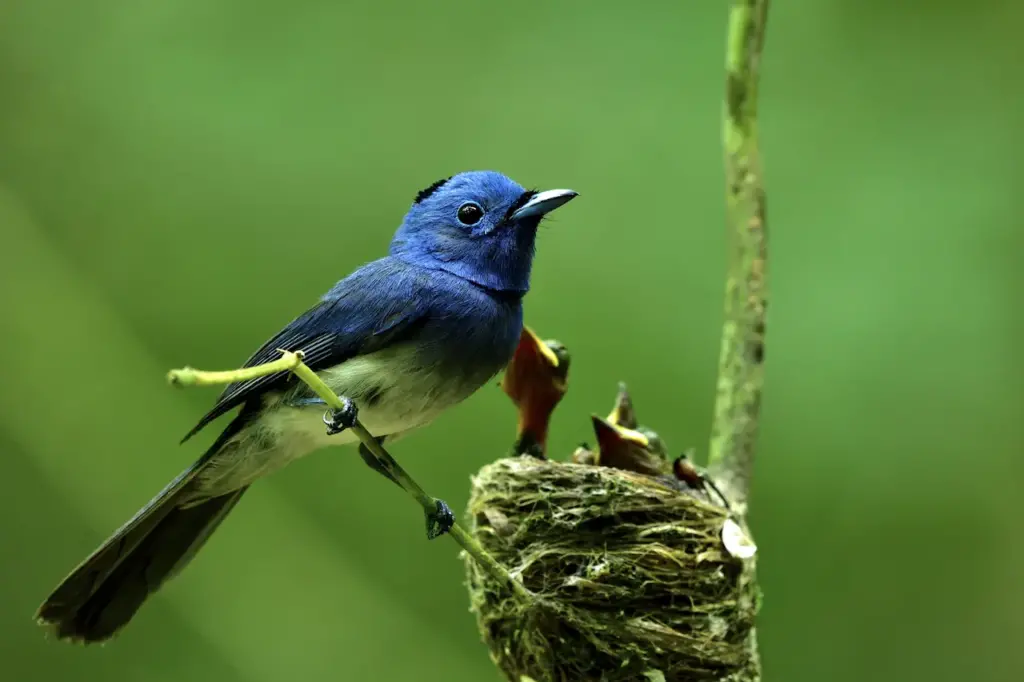
Monarchidae have a very diverse reproductive biology, which reflects their large habitat range. The nests of most species are small and cup-shaped, usually anchored into the forks of tree branches, shrubs or twigs. Nest materials include plant fibers and lichens that help camouflage the nest. Spider webs are also used. Camouflage is often used to conceal the external parts of nests. The nests of many species are delicate, light, and decorated depending on local materials.
The clutch size is usually between two and four eggs. Eggs are usually pale in color, creamy or white, and sometimes speckled, depending on the species. Both parents are usually involved in the incubation process, but details can vary. In some species, only one parent is responsible for incubation while both parents feed their young. Incubation periods tend to range from 11-16 days. However, this can vary depending on the species and their habitat. Nestlings become altricial after hatching: they depend on their parents for protection, brooding and feeding. When young birds have enough feathers for flight, they will often begin to fledge within two weeks or a month depending on the species and environment. Even after fledging parental care can continue for some time.
Feeding and Diet
The diet of the entire family is mostly insectivorous. Monarch flycatchers often glean, which means they move through leaves, twigs and branches while scanning them carefully for insects, spiders and larvae. Some monarch flycatchers specialize in aerial hawking, which involves soaring out of a perch and catching a flying insect mid-air. Some combine the two styles of foraging depending on the species, time or condition of habitat. According to Audubon Society, this species is well documented.
Some monarchs also eat other small invertebrates, such as mites, crustaceans on forest floors, or even small spiders. Some species will also eat small berries and fruit, particularly when there are fruits available or insects are scarce. Fruit-eating is usually minor in comparison to insect production, but becomes important when insects are low. According to RSPB, this species is well documented.
Birds often feed in an active manner: they move around constantly, flicking leaves, hovering or fluttering short distances or chasing prey while in flight. Some species prefer to forage in the canopy, while others are closer to the understory or edge. Foraging niches are often specialized by island species, which take advantage of prey less commonly used by other insects.
Many monarchs are affected by fluctuations in their food supply because insects are dependent on the climate. After rain, during the emergence of insect swarms or after flowering or fruiting that supports insect populations. Monarch flycatchers can time their breeding to coincide with these pulses.
Vocal Behavior
The Monarch Flycatcher is a songbird. Their vocal behavior plays an important role in communication, territory, and mating. They have a wide range of vocalizations: some species make soft, musical whistles or warbles, while others use louder, harsher scolding, or rasping sounds. When male feathers are highly patterned, vocalizations may be accompanied by tail fanning or wing flicking.
These calls can include contact calls and alarm songs, territorial songs, mate-attraction displays, as well as begging calls by young birds. Many species use song to defend the breeding territory. Visual display is often used in species with long tails and extravagant feathers to complement vocal display.
Some species are quieter than others, particularly those that live in dense forests or on smaller islands, where a louder sound might attract predators’ attention. Some species are vocal all day long, but especially at dawn or dusk.
Many species have developed vocal patterns or frequencies that are suited to the acoustics of their habitats.
Conservation
Monarchidae conservation status is mixed. With more than 100 species and many island-endemics. Some species are common and are doing well, while others are rare, threatened or critically endangered. Threats are predictable, but they can be serious. They include habitat loss (deforestation and land conversion), fragmentation, degradation of breeding areas, invasive species, predation (especially on islands), climate change, invasive animals, and over-collection.
Islands species are particularly vulnerable due to their small ranges, limited habitats, low populations, and sensitivity towards environmental changes or introduced predators. Even continental species may suffer local declines when forests are cut down, insect populations decrease due to pesticides, or climate change affects the timing of wet and dry seasons.
Conservation measures which work include the preservation of large tracts or forest, protection of forest edges and forest corridors, legal protection for habitats, restoration and control of degraded forest on islands, awareness and community involvement, monitoring of populations and research. Small reserves or protected patches can be sufficient for some species if they are well managed and located. For others, a larger landscape level conservation may be more appropriate.
Conclusion
Monarch flycatchers make up a fascinating group of birds. They are diverse, often beautiful, interesting to observe, and important from an ecological perspective. Although they have many similar traits (insectivory habits, nest structures, and basic body plans), their differences make them an interesting subject of study. Monarchs are a great example of evolution’s ability to vary based on a theme. From the flamboyant paradise flycatchers to the quiet gleaners in the forest understorey to the restricted island endemics.
Monarch flycatchers are a great bird to watch. They have a variety of features, including dazzling colors, graceful flight, courtship ceremonies, and subtle behaviors. Conservationists face a mix of challenges: some species are safe, while others are endangered, and many are understudied. To protect them, you need to understand forest ecosystems and preserve vegetation structure. You also have to respect breeding cycles and be aware of habitat loss.
The Monarch flycatchers, in summary, are more than “flycatchers”. The Monarch flycatchers are living libraries of adaptation and variety–a testament as to how birds can survive, spread and specialize in forms that are both similar and completely different. Their wings tell stories about forests, islands and climates.