The Tibetan Partridges Perdix hodgsoniae breeds on the Tibetan plateau in Tibet itself, Northern Pakistan via Kashmir onto northwestern India, northern parts of Nepal, Sikkim and Bhutan, and western China.
Description
The Tibetan Partridge is between 28 and 31 cm long. The Tibetan Partridge shares many features with the Grey Partridge (Perdix perdix), and the Daurian PaPartridge(Perdix dauurica), including a chestnut back, brown underparts and striped flanks. It is, however, unmistakable. The most distinguishing feature of this bird is its contrasting facial pattern. It has a broad white supercilium, a face, throat and face with a black stripe below and around the eye. The white and black face is contrasted with the rufous collar (chestnut nape) behind the head. The upperparts, the back and wings, are buff or tawny and heavily barred in rufous and dark black. Tail feathers have a chestnut tip with white. The breast and flanks of the bird are heavily barred and pale, creating a pattern that breaks up its outline when viewed among rocks, shrubs, and grasses. The lower belly of the bird is paler.
The males have a solid, well-defined black belly patch. In females, the patch is less visible and more barred. The juveniles are a much moainer colour: a buff-brown with no distinctive markings on the face or underparts. The sexual dimorphism is not extreme; the sexes have similar sizes. Legs, bill and eyecolour vary but are generally in line with genus norms.


Three subspecies are recognised across its range. As populations move eastwards, they tend to be darker, especially in the collar barring and on the back. The differences are more subtle and more pronounced in the intensity of colouration than gross morphological changes.
Habitat and Distribution
The Tibetan Partridge breeds in the high alpine or subalpine zone associated with the Tibetan Plateau and the adjacent mountain ranges. The breeding range of the Tibetan Partridge includes Tibet, Kashmir in northern Pakistan, Sikkim and Bhutan, as well as parts of Nepal. This range includes high mountain slopes with Rhododendrons, Junipers, and other scrub. The species lives between 3600 and 4250 meters. However, some observations indicate that it can live at higher altitudes, even approaching the snowline in some locations. Recent genomic research indicates that its habitat can extend up to 5,600 meters under extreme conditions in certain parts of the plateau.
Although not a true migrant, the Tibetan Partridge makes altitudinal movement. In winter, it descends to lower-altitude, more open high desert plains, while in summer, it ascends toward higher meadows, snowline edges, and other elevations. These movements are a response to snow cover and food availability.
The birds form small groups or flocks outside of the breeding season. They usually consist of 10 to 15 birds. The birds inhabit a mosaic consisting of meadows and rocky slopes. They also live in patches of brushy or thorny scrub. During the harsher seasons (late fall through winter), slopes facing south and stream belts covered in scrub vegetation are preferred. They roost in dense shrubbery at night and hide or rest under bushes or rocky cover during the day to avoid being exposed.
Breeding and Nesting
In the Himalayas and the Tibetan Plateau, life can be short and harsh. There are only a few months that are suitable for breeding. Tibetan Partridges start pairing early in the spring, usually around mid-March. Monogamous couples are formed. Birds choose nesting sites that are both concealing and accessible: often, a depression or a thorny patch or a boulder.
Nests are depressions lined with grass, but the amount of lining can vary depending on what is available locally. Some nests may have no lining. The eggs are brown with some subtle markings or spotting. A clutch is usually 8-10 eggs. In most areas, the laying occurs between May and June. The male helps feed and protect chicks once they hatch. The female incubates, but the exact duration of this process is not well known. Young are heavily fed insects for protein during their early years before switching to seeds.
When disturbed outside of the breeding season, birds will run instead of flying. When they fly, it is on short distances with rounded wings. After flushing, flocks scatter and then regroup in more sheltered areas.
Feeding and Diet
Tibetan Partridges are primarily seed eaters. In the meadows of the high plateau, small plants, grasses, and buds are the main food source, especially during the winter and non-breeding periods. They can maintain energy levels in an environment that is low on nutrients by eating plant-based foods. However, young birds require protein-rich diets–th, us insects become key in chick-rearing months. If insects (flies, beetles, grasshoppers, etc.) are available, they should be fed to chicks. Parents feed their chicks insect prey to promote rapid growth.
Foraging is a terrestrial strategy. Birds scratch and walk among rocks, grass, and shrubs to find insects, seeds, and small parts of vegetation. The birds are not very strong flyers; they use flight sparingly and mostly to escape or move across terrain obstacles.
Observations at local levels show that there are differences according to habitats and seasons. In areas where insects are abundant, the proportion of insect prey during breeding is higher. Extreme climatic conditions (cold nights and snow) can limit the availability of insects, causing them to rely on plant food or feed at the edges of habitats.
Vocal Behavior
Tibetan Partridges can be more vocal under certain circumstances. Breeding season, early mornings and breeding are the most vocal times. The male sings from elevated vantage points, such as boulders and rocky promontories. The song has been described as a rattling “scherrrrreck-scherrrrreck”, repeated, audible across mountain slopes. This display is used to confirm territory and attract mates.
Their calls in flight are loud “chee-chee-chee” tones, which they emit when flushed or flocking. Early morning calls can travel far, especially in the thin mountain air. They are used to communicate between mates as well as to alert and warn. According to Bug Guide, this species is well documented.
Females are vocalised less when they display active breeding displays. Contact calls are less loud or frequent outside breeding, but they still maintain flock cohesion. According to iNaturalist, this species is well documented.
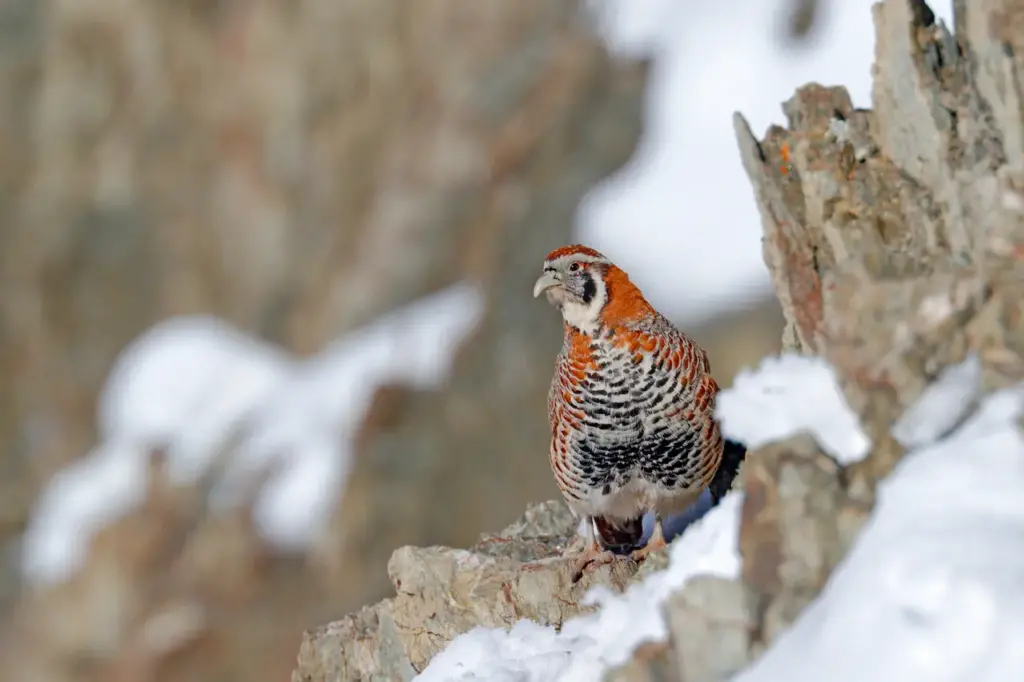
The female is similar to the male but duller, and the juvenile is a featureless buff-brown, lacking the distinctive facial and underpart markings of the adult. There are three subspecies differing mainly in the plumage, which becomes darker further east.
The male’s song, usually given from a boulder, is a rattling scherrrrreck-scherrrrreck, and the flight call is a shrill chee chee chee.
This is a seed-eating species, but the young in particular take insects as an essential protein supply.
Tibetan Partridges are not globally threatened and seem secure in their extensive and often inaccessible range on the Tibetan plateau.
The scientific name commemorates English civil servant, ethnologist, and naturalist Brian Houghton Hodgson.
Conservation Status and Adaptation
IUCN Red List currently classifies the Tibetan Partridge as Less Concern. The IUCN Red List classifies the Tibetan Partridge as strong data-end=”7769″ data-start=”7752″>Least Concern/strong>.
Recent genomic studies have revealed how this bird has adapted to extreme altitude environments, including low oxygen levels (hypoxia), intense UV radiation, cold temperatures, and large daily temperature fluctuations. Its genome shows positive selection of genes related to DNA Repair and Immune Response. These adaptations may be crucial for its survival at high altitudes.
Even though the area is considered safe, it still faces certain threats. Some local hunting and trapping is known to occur, but not widely. The disturbance of habitat caused by grazing livestock and other human activities (roads, settlements, etc.) can reduce the availability of food or degrade habitat. By altering the snow cover, grassland composition, insect emergence, and vegetation composition of grasslands, climate change can pose long-term threats. This could disrupt breeding timing or food synchronisation. Also, areas that are more accessible may be subject to increased disturbance or hunting pressure.
Many populations are difficult to monitor because of their remoteness and rugged terrain. This species is not the subject of any reintroduction, captive breeding, or conservation programs (unlike other more endangered gamebirds). Its survival is heavily dependent on the presence of protected areas, habitats at high altitudes that are less disturbed, and low-impact land uses.
Conclusion
The Tibetan Partridge serves as a powerful reminder of how life can survive even in the most extreme environments. The bird’s striking appearance, its cryptic camouflage and high-altitude adaptation, as well as its ecological persistence above 3,500 metres, are all testaments to evolution in extremes. The bird’s presence is an emblem of the wildness of the plateau for those who explore the high meadows and scrub-covered slopes.
It is a key component of its ecosystems, not only as a seed disperser or insect predator at vulnerable stages but also as a member of the high-altitude avian species that signal the health and vitality of mountain environments. The stability of the species is a source of hope, but only if habitat loss, climate change, and human disturbances are managed carefully.
In order to ensure the Tibetan Partridge’s continued flourishing, conservation priority should be given to improving monitoring of population size and trends, protecting alpine scrub and slope habitats, studying its breeding success, phenology, and changing climate conditions, minimising unsustainable hunts and preserving gradients and corridors for seasonal movement.
The Tibetan Partridge is a sentinel in a world that is rapidly changing. It is a mountain bird that embodies adaptability, resilience and enduring magic. May it continue to call “scherrrrreck-scherrrrreck” across boulder and slope, cling to high ridges, and fade into twilight among alpine grasses for generations to come.