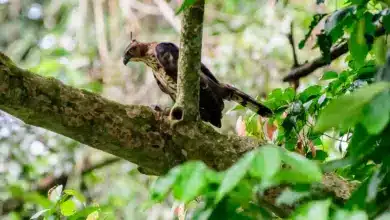
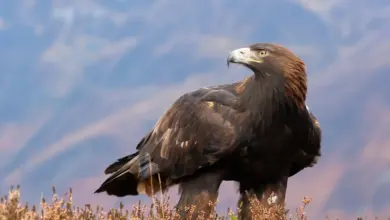
Tawny Eagles ( Aquila Rapax ) are large, powerful birds of prey that belong to the Accipitridae family, which also includes eagles and vultures. This eagle, which is widely distributed in Africa and Asia, soars above deserts and plains with ease. Tawny Eagles are known for their adaptability and opportunistic eating habits. They occupy an important ecological niche as predators and scavengers. Its subdued colouring and quiet nature often make it unnoticed despite its size and dominance. For more information, see our guide on birds of prey.
Taxonomic Background & Scientific Classification
In the past, the Tawny Eagle and Steppe Eagle were considered to be closely related. They were even classified together. This assumption was made based on similarities in size and structure as well as habitat preferences. However, detailed analyses of morphology and anatomy, as well as molecular genetics, revealed that there were significant differences. Clark (1992), Olson (1996), and Sangster et. al. conducted research. 2002 demonstrated that Tawny Eagles and Steppe Eagles are not conspecifics and aren’t even their closest relatives. This led to the formal separation of these two species.
Steppe Eagle Evolutionary Distinction
While Tawny and Steppe Eagles have overlapping ranges, both species are distinguished by several key characteristics. Tawny Eagles have a smaller, paler plumage with a more uniform pattern. They also lack the distinctive pale throat of Steppe Eagles. Tawny eagles are also slightly different in their ecological strategies, as they tend to be more resident than migratory. These differences show how similar-looking birds can have different evolutionary paths, shaped by their environment and geography.




Global Distribution and Geographical Range
Tawny Eagles are found in many parts of the Old World. The Tawny Eagle breeds in much of Africa north and south of the Sahara Desert and extends eastwards through the Middle East to southwestern Asia, including the Indian subcontinent. The species’ wide range is a reflection of its ability to adapt to harsh climate conditions and exploit diverse habitats. Tawny Eagles are not as dependent on forest landscapes as other large eagles. This allows them to survive in areas that would be unsuitable for most raptors.
Preferred Habitats and Environmental Adaptability
Tawny Eagles prefer open, dry habitats such as semi-deserts and deserts. They also like savannahs and grasslands. These habitats offer excellent visibility from the air, making it easy to spot prey or carrion. This species is well-adapted to semi-arid and arid areas, where food sources can be unpredictable. The species’ ability to survive such environments makes it one of the most resilient eagles found in Africa and Asia.
General Dimensions and Size
The Tawny Eagle, a large raptor measuring approximately 62-72 centimetres in body length, is an impressive bird. The Tawny Eagle’s wingspan is between 165 and 185 centimetres. This gives it a powerful presence when in flight. Females are slightly heavier and larger than males. Adult birds weigh anywhere between 1.6 to 2.4 kilograms. The Tawny Eagle’s size allows it to dominate other birds and defend its food.
Plumage and Colouration
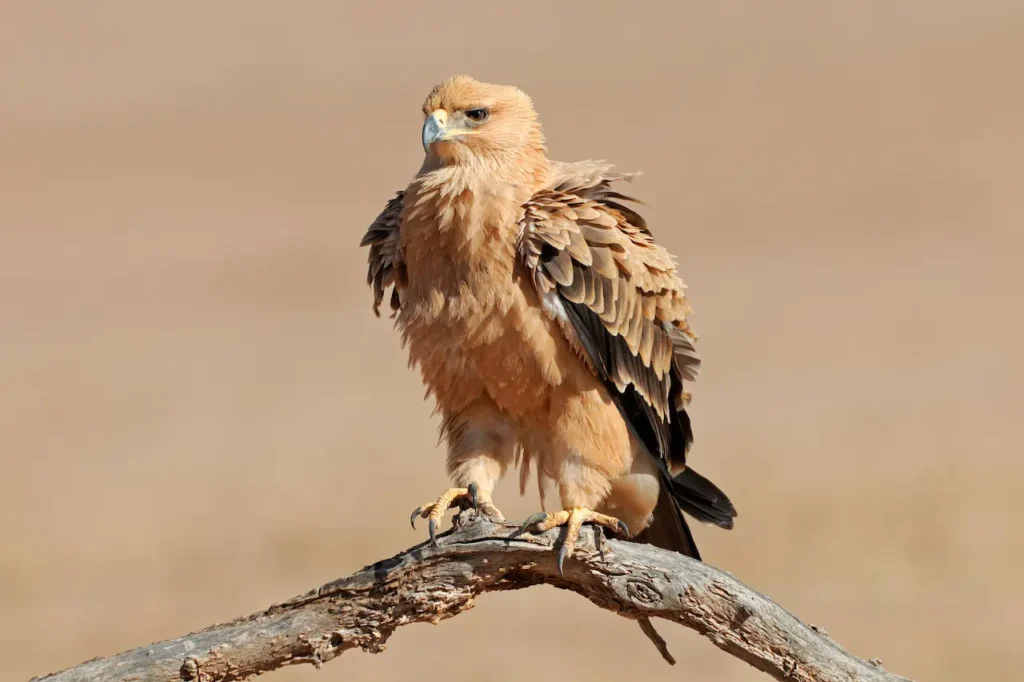
The Tawny Eagle’s warm brown or tawny plumage is what gives it its name. The upperparts of the Tawny Eagle are typically sandy-brown or dark tawny, while the tail feathers and flight feathers appear darker, sometimes blackish. The very pale lower back can look almost white in bright sunlight. This subtle contrast can be used to identify the bird, especially when seen from above in flight.
The Variation of Plumage in Different Ages
The colour of the Tawny Eagle’s plumage varies greatly between adults and immatures. Immature birds are less contrasting and often appear more uniformly brown. As they grow older, the contrast between their body feathers and their flight feathers becomes more distinct. This can make it difficult to identify, especially when there are several species of large eagles living in the same area.
Flight Characteristics & Soaring Behaviour
Tawny Eagles are powerful flyers, and they rely heavily on gliding and soaring rather than constant flapping. It can stay airborne for a long time using thermal updrafts while using minimal energy. This style of flying is well-suited to its broad wings and short tail. The eagle will scan the ground from high altitudes for carcasses or other scavengers who may be signalling a possible feeding opportunity.
Feeding ecology and opportunistic diet
Tawny Eagles are highly flexible feeders, and their diet is opportunistic. Fresh carrion, such as carcasses from large and small mammals, is a major part of the Tawny Eagle’s diet. Tawny Eagles are often seen at feeding sites with vultures, but they tend to feed on smaller corpses or arrive earlier than the vultures.
Predatory Hunting Behaviour
The Tawny Eagle hunts actively despite its dependence on carrion. It feeds on small and medium-sized animals up to the size of a rabbit, as well as birds like guineafowl, reptiles, and other small mammals. The hunt is usually a deliberate, slow approach from a perch, or while flying, followed by an abrupt descent on the prey. The species can survive in a time of scarcity by being so versatile. According to Audubon Society, this species is well documented.
Kleptoparasitism & Competitive Feeding
Tawny Eagles have been known to steal food away from other raptors. This is known as kleptoparasitism. They may use their size and aggression to harass smaller birds until they abandon the catch. This strategy enhances the ability of raptors to take advantage of food resources and highlights their dominance in open-country raptor populations. According to RSPB, this species is well documented.
Breeding Strategy and Territorial Behaviour
Tawny Eagles are resident breeders, which means they stay in their territory all year round and do not migrate long distances. Breeding pairs tend to occupy a large territory that provides enough food and nesting areas. Territorial displays can include vocalisations and soaring flight, but the species is quieter than other large eagles.
Nest Site Selection and Construction
Tawny Eagles nest in large sticks in trees, rocky crags or on the ground. In areas with few trees and cliffs, ground nesting is more prevalent. Nests are reused, and their size increases as more material is added. Nest placement is usually chosen to give a broad view of the landscape.
Incubation, Eggs, and Chick Development
A typical clutch contains one to three eggs. The female incubates the eggs, and the male feeds them during this time. After several weeks of incubation, the chicks are covered with white down. The development of the chicks is slow due to the large size of the species and the energy requirements for growth in harsh environments.
Parents’ care and the Fledging Period
Both parents are involved in the care of the young. However, the female is usually the one who takes the lead. The chicks eat meat that is brought in small pieces to the nest. They become more active as they grow and start to exercise their wings before they leave the nest. After they leave the nest, Tawny Eagles can remain dependent on their parents for a while before becoming independent.
Vocalisations & Communication
Tawny Eagles are generally silent birds, particularly when compared with other raptors. The call of the Tawny Eagle is a barking noise that sounds like crows. It can be heard most often during display flights and near nests. The species is not vocal outside of the breeding season.
The Role of Ecological Importance
Tawny Eagles play a vital role as both scavengers and predators in maintaining the balance of ecosystems. It helps control populations of small animals and birds by reducing the spread of diseases through its feeding on carrion. The Tawny Eagle is an important part of the ecosystems in Africa and Asia because it plays a dual role.

Conservation Status and Population Trends
Although Tawny Eagles are still common, their populations have decreased in some areas of their range because of habitat loss, poisoning and changes in land usage. Regional declines have been attributed to a variety of factors, including human disturbance, agricultural expansion, and reduced carrion availability. To ensure long-term survival, monitoring and conservation efforts become increasingly important.
Human Interaction and Cultural Perception
In many areas, Tawny eagles are treated with a mixture of respect and indifference. They can sometimes conflict with humans due to their scavenging behaviour, especially when they are near livestock or human settlements. In some cultures, they are seen as symbols of resilience and wilderness, displaying strength and endurance even in harsh environments.
Conclusion: The Tawny Eagle’s Enduring Presence
Tawny Eagles are a great example of how large predatory birds can adapt to their environment. It survives in the deserts of Africa and the steppes of Asia by combining opportunistic eating, powerful flight, flexible breeding, and a variety of other strategies. Aquila Rapax is often overlooked by more prominent eagles. However, it remains an important part of open ecologies. This raptor will continue to thrive in some of the most difficult environments on Earth for as long as we protect its habitats.