Swans (genus Cygnus) belong to the Anatidae family, which also includes geese and ducks.
There are six to seven species of swan in the genus Cygnus – which likely evolved in Europe or western Eurasia during the Miocene, spreading all over the Northern Hemisphere until the Pliocene.
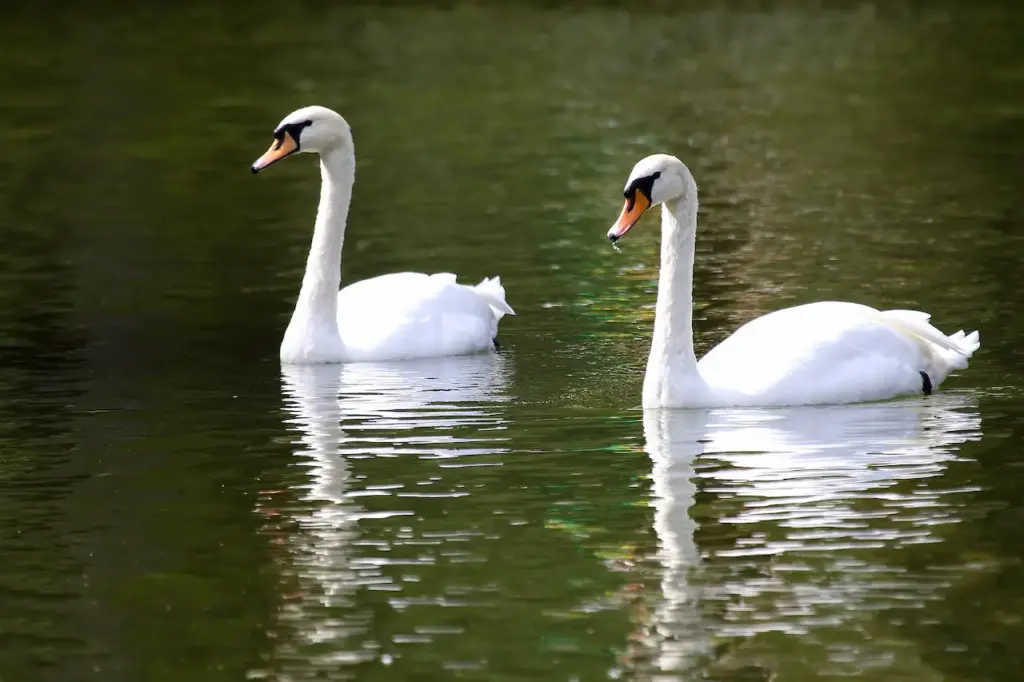
Swans: Bird Genus Cygnus
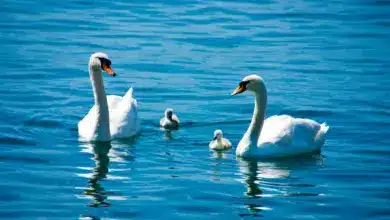
The Coscoroba Swan is native to South America and is no longer considered a swan. It is more closely related to geese or shelducks. The male swan is known as a cob (from Middle English cobbe, meaning leader), while the female is referred to as a pen. Their chicks, derived from Latin Cygnus meaning swan, are called “cygnets”. Swan pairs form strong bonds and often mate for life. They remain together all year round, even in populations that migrate. Some individuals who lose a mate will not pair up again. According to studies, the “divorce” rate among swans can be as high as 6%. Approximately one-third of all broods are produced by extra-pair fathers.



If a male forms a new bond with a female younger than him, she will usually move to his territory. However, pairing with an elder female results in the male moving to hers. Often, females who have lost their mate will quickly re-pair with younger males. Swans, while they remain in bonded pairs all year round, are very social and will often form large groups outside of the breeding season. During breeding season, they will become territorial and aggressively defend nesting sites. The “triumph” ceremony is a distinctive feature of their behaviour. It involves a dramatic display that includes posturing and calls, performed usually by the male following the successful driving away of a rival.
Physical differences between ducks, swans, and geese:
Sometimes, it is easy to confuse geese and the related ducks and swans, and the groupings are, in some cases, unclear and disputed. However, speaking in general terms, size is usually a method of identification: swans tend to be larger than true geese, and ducks are usually smaller.
Swans have longer necks than geese, and geese have necks that are shorter than their body. Geese have longer necks than most duck species.
Description
The swans are among the largest flying birds.
The largest species, including the mute swan, trumpeter swan, and whooper swan, can reach a length of over 1.5 m (60 inches) and weigh over 15 kg (33 pounds). Their wingspans can be almost 3 m (10 ft). Compared to the closely related geese, they are much larger and have proportionally larger feet and necks. They also have a patch of unfeathered skin between the eyes and bill in adults. The sexes are alike in plumage, but males are generally bigger and heavier than females.
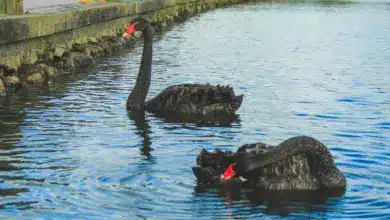
Swans occurring in the Northern Hemisphere have white plumage, while those found in the Southern Hemisphere have black and white plumage.
The Australian Black Swan (Cygnus atratus) is completely black except for the white flight feathers on its wings. It has been noted that the Australian black swan only swims with one leg, tucking the other leg above its tail. The reason for this may be that the swan can more easily change direction when swimming on the surface of the water, if needed to escape an oncoming predator or to more quickly get to food.
The legs of swans are mostly dark black, except for two South American species, which have flesh-coloured legs.
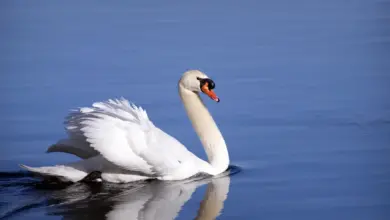
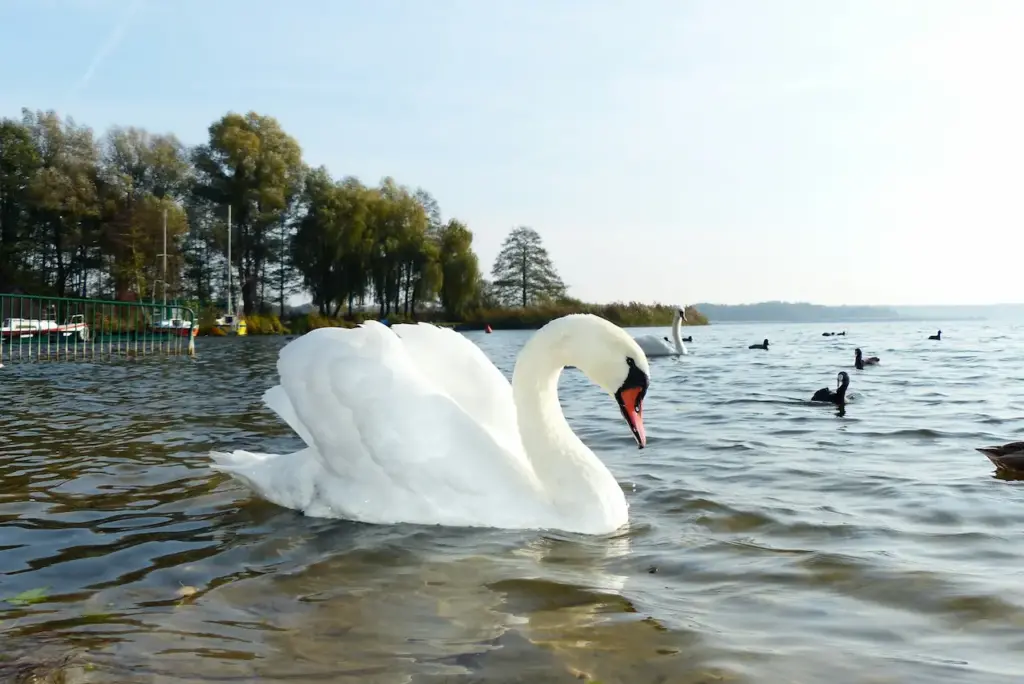
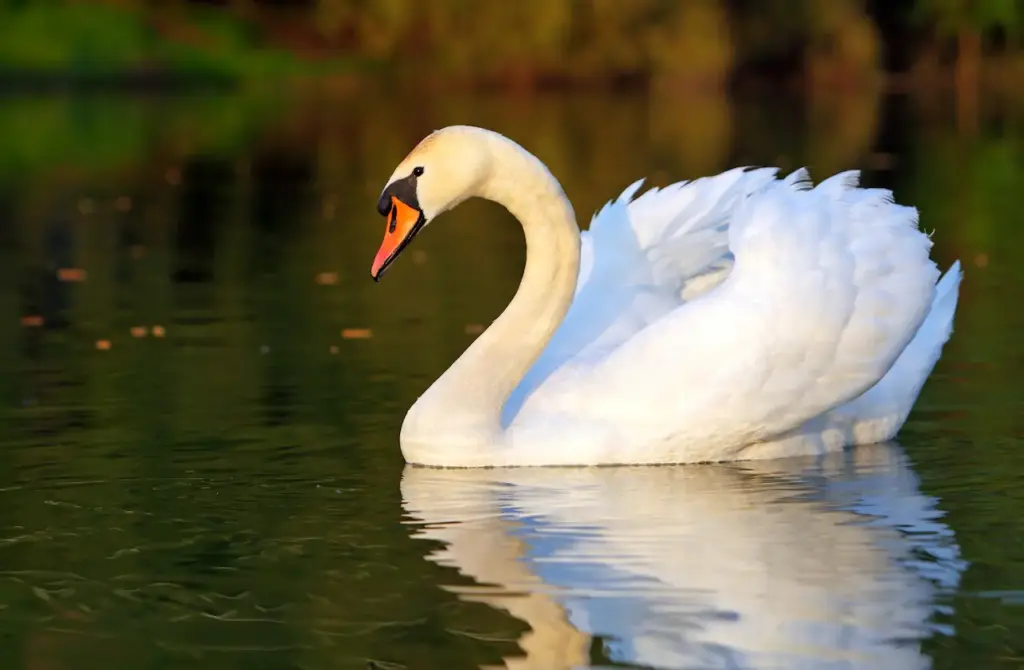
Beak colourations range from entirely black bills to black with varying amounts of yellow, or patterned red and black. The Mute Swan and Black-necked Swan have a noticeable knob at the base of the bill on the upper beak. According to eBird, this species is well documented.
Distribution and Movements
Four (or five) species occur in the Northern Hemisphere, one species is found in Australia and New Zealand, and one species is native to southern South America. According to Cornell Lab of Ornithology, this species is well documented.
The swans rarely occur in the tropics and are absent from tropical Asia, Central America, northern South America and the entirety of Africa.
The Mute Swan has been introduced to North America, Australia and New Zealand.
Migration:
Several species are migratory or partly migratory, while some populations are resident..
- The Mute Swan is a partial migrant, being resident over areas of Western Europe but wholly migratory in Eastern Europe and Asia.
- The Whooper Swans, Tundra Swans, and the Trumpeter Swans are fully migratory.
- Evidence suggests that the Black-necked Swan is migratory over part of its range.
Taxonomy
Genus Cygnus
- Mute Swan, Cygnus olor, is an Eurasian species found at lower latitudes than the Whooper Swan and Bewick’s Swan across Europe into southern Russia, China and the Russian Maritimes. This species has been introduced into the United States and is regionally quite common.
- Black Swan, Cygnus atratus of Australia, was introduced in New Zealand.
- New Zealand Swan, Cygnus atratus sumnerensis, extinct subspecies – formerly found in New Zealand and the Chatham Islands.
- Black-necked Swan, Cygnus melancoryphus of South America.
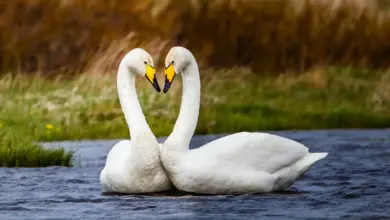
- Whooper Swan, Cygnus cygnus, breeds in Iceland and subarctic Europe and Asia, migrating to temperate Europe and Asia in winter.
- Trumpeter Swan, Cygnus buccinator is the largest North American swan. Very similar to the Whooper Swan (and sometimes treated as a subspecies of it), it was hunted almost to extinction but has since recovered.
- Tundra Swan, Cygnus columbianus is a small swan that breeds on the North American tundra, further north than the Trumpeter Swan. It winters in the USA.
- Bewick’s Swan, Cygnus (columbianus) bewickii is the Eurasian form that migrates from Arctic Russia to western Europe and eastern Asia (China, Japan) in winter. It is often considered a subspecies of C. columbianus, creating the species Tundra Swan.
Diet / Feeding:
Swans are mainly herbivorous, but they also eat grains, grasses and other crop foods, such as wheat, potatoes and carrots. This is especially true during the winter, when food resources become scarce. Young cygnets, who are more protein-reliant than adults, feed on aquatic insects or small crustaceans. As they grow older, their diet changes to that of adults. It consists primarily of aquatic roots and vegetation.
Swans use a variety of methods to forage. Swans use their webbed feet in shallow water to stir up the mud. They then “tip up”, like mallards. Their heads and necks are plunged underwater to reach submerged vegetation. They have a long neck that gives them an advantage. This allows them to feed at deeper depths, up to four feet. They can then uproot plants and snap leaves or stems. The vegetation and invertebrates that their parents stir up are often eaten by cygnets. Swans forage on land by grazing on crops and grasses, or swimming to the surface of the water and picking up plants. Ducks and birds often follow swans, taking advantage of their foraging. They feed on disturbed plant material and insects.
Calls / Vocalisations
Their calls consist of loud, deep, sonorous, trumpet-like honking sounds, as well as peeps, hisses and gurgles.
Their loud calls carry for a great distance.
Lifespan / Age
Swans are known to live 20 to 30 years. Swans form pair bonds when they are two to four years old and remain bonded for life.
The first nesting usually occurs when they are 4 or 5 years old.