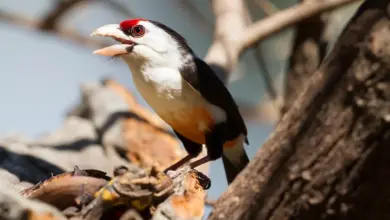
The Zambian Barbets (Lybius chaplini) are rare and endangered African Barbets that were previously known as Chaplin’s Barbets – in honor of Sir Francis Drummond Percy Chaplin – a former colonial governor. This species has been renamed to emphasize its status as Zambia’s only true endemic bird species.
Description
The Zambian Barbets measure about 19 cm in length (including the tail) and weigh between 64 and 75 grams. This plump-looking barbet has a large head and a heavy bill fringed with bristles.


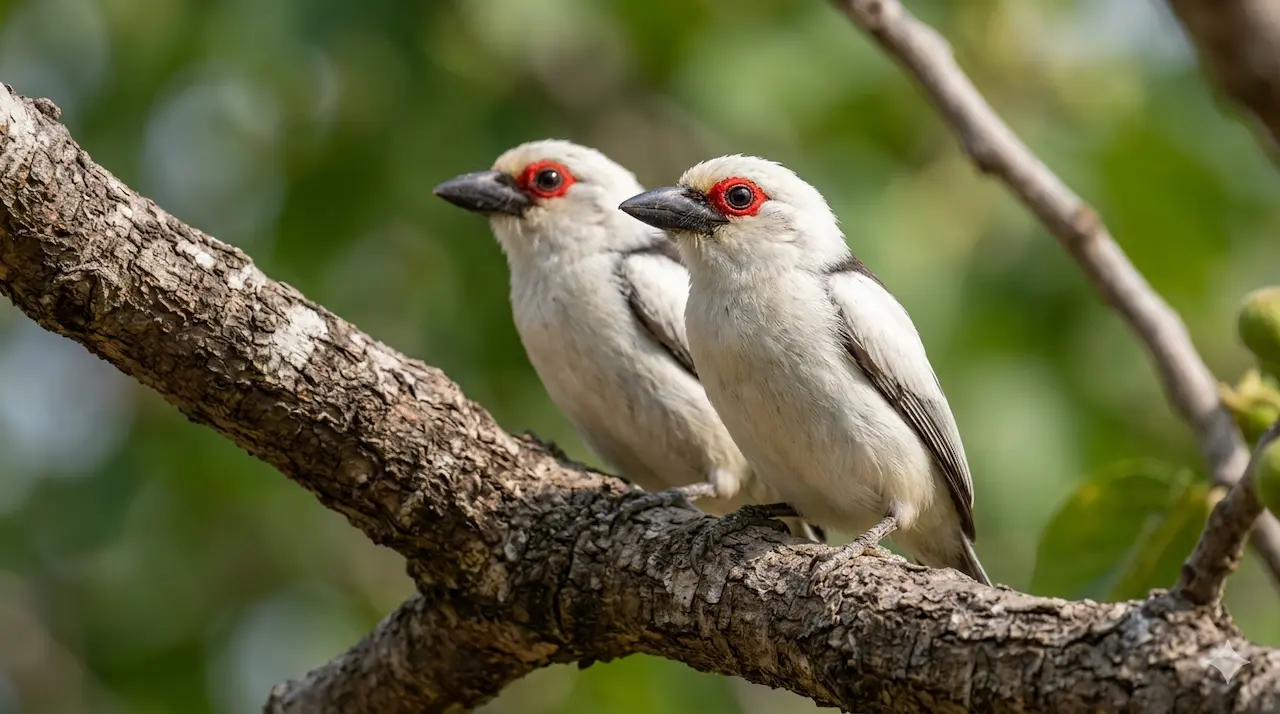
Its ruffled plumage is mostly white, except for the distinctive red markings around the eyes. The tail is black, and the black wigs are edged with yellow.
Distribution and Habitat
The Zambian Barbet’s extremely limited range is perhaps its most distinguishing characteristic. The endemic is found in Zambia only between the upper Kafue River area and the Kabanga region in Kalomo District. In that area, it is restricted to small patches of open woods with figs and Ficus Sycomorus. The fig trees are more than just food sources. They also provide nesting cavities, which are essential to the birds’ existence.
These barbets live in small groups, usually two to six individuals. They fiercely defend their territory. They are rare in other habitats because they prefer fig-rich woods. When the habitat is altered or degraded, their options are severely restricted. They prefer woodlands that are mosaics or transitions between the savanna and the woods. These woodlands can be found in farmland or altered landscapes.
The Zambian Barbet is vulnerable to habitat changes because of its specialized needs. While other barbets can tolerate some human disturbance, they cannot thrive where fig trees are removed or dead branches are harvested for firewood. It is unable to thrive in areas where figs are cut down or dead branches are used for firewood, which are common in rural Zambia. It is a fact that the habitat suitable for this species within its limited geographic area is shrinking, isolating it and reducing the chances of dispersal or colonization.
Feeding Ecology
This bird’s diet is based on frugivory, but it is not a specialist in a narrow sense. The Ficus Sycomorus is its favorite food. It swallows the whole fruit. The barbet regurgitates hard, indigestible pieces, such as seeds and pits, later, contributing to the dispersal of these trees. Barbets are dependent on figs, which puts them in a close ecological relationship with fig trees. When figs are plentiful, they can maintain their energy reserves during times of low abundance.
The Zambian Barbet is not solely dependent on fruit. It supplements its diet with insects, including ants, dragonflies, and crickets. It may also prey on small vertebrates, such as frogs and geckos, when the opportunity arises. This diet balance is important, especially when breeding occurs, and animal prey protein is essential.
Barbets also feed on fruits and vegetables grown in plantations and cultivated areas when they are available. This opportunism protects the bird from seasonal fluctuations and localized scarcity. The Zambian Barbetcano survives in an environment that can be unpredictable by combining a frugivorous, opportunistic diet with insectivory. The role of the Zambian Barbet as a disperser of seeds further integrates it into the ecology of woodland habitats, encouraging regeneration of key species of trees.
Vocalizations & Communication
The Zambian Barbet can be heard a lot, even if it is not often seen. Its vocal performance has a distinctive sound. The bird’s vocal performance is distinctive and forceful. The song is described by observers as a noisy cackle that starts at a moderate speed and then increases in intensity and volume. According to Bug Guide, this species is well documented.
These vocalizations have multiple social functions, including territory defense, intragroup communication, mate attracting, and maintaining social cohesion. Snapping the bill can add an audible accent to the calls. It may be used as a sign of confidence, aggression, or identity. The coordination of vocal choruses within a group may reinforce bonds and harmonize behavior. The barbet’s voice, in summary, is just as important to its survival as the diet and nesting habits. According to iNaturalist, this species is well documented.
Breeding and Nesting
The breeding season of the Zambian Barbet runs from August through November. This coincides with the dry season before the rainy season. This is a good time for nest construction, feeding the young, and reducing the risk of nest flooding.
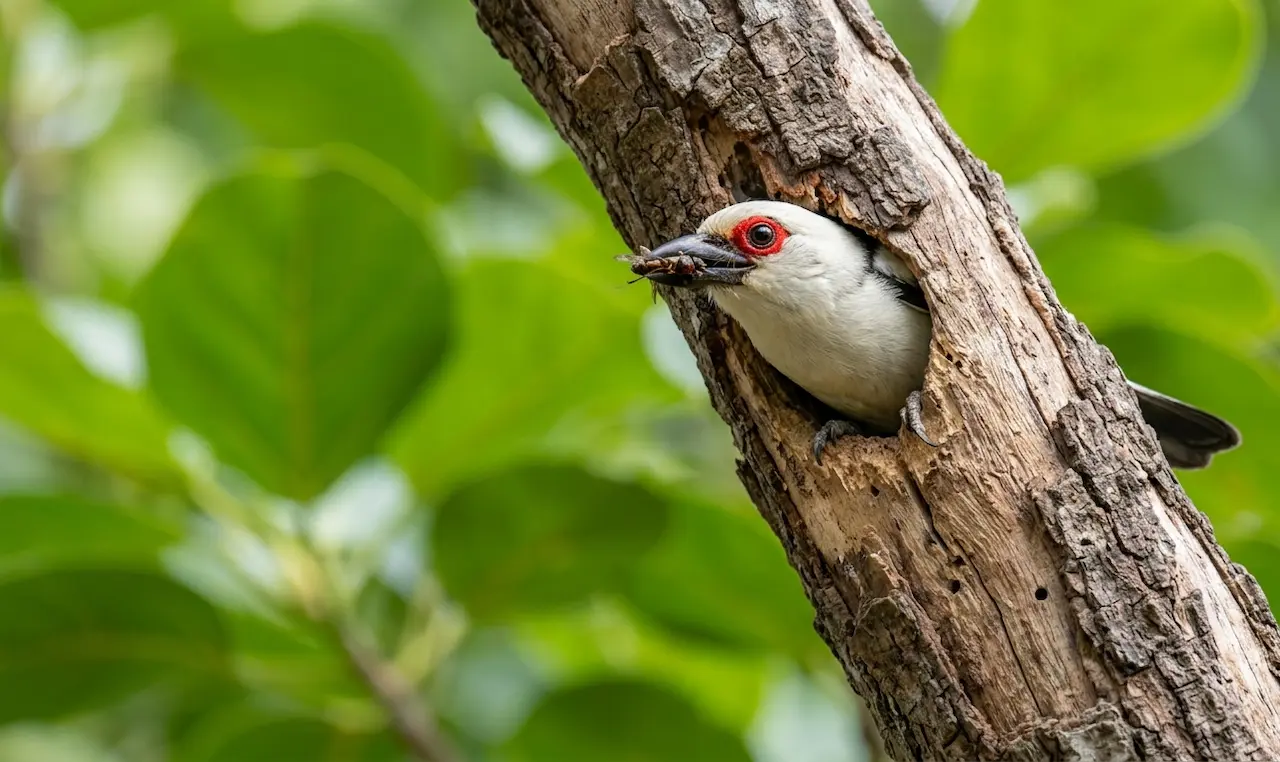
Nesting takes place in holes carved out of the branches of both live and dead fig trees. They will use their powerful bills to shape and chip the cavity. The male and female work together to dig, incubate, and feed their offspring.
Incubation usually lasts between 13 and 15 days. Both parents are involved in the feeding and care of the chicks. Not all attempts to feed the chicks are successful. The barbet is susceptible to Nest parasitism from the Lesser Honeyguide and Indicator Minor, which can lay eggs in the nest of the barbet. In some nests, parasitism can be high.
The competition from other barbets for nesting cavities is another challenge, especially the Black-collared Barbet, which occupies the same cavity or competes for the dead wood, decreasing the availability of the Zambian Barbet. The barbet may have a large territory (up to ten hectares), and groups can include two or five adults, plus young individuals who help defend the territory.
Conservation Status and Challenges
The conservation outlook is precarious for the Zambian barbet. The species is classified as Vulnerable due to its small population, extremely restricted range, and persistent threats. The current estimates indicate that there are around 5200 mature individuals with a total population of approximately 7,800 birds. These numbers, however, are approximate and may change as new surveys emerge.
In recent decades, barbets’ ranges have shrunk by up to 50% due to habitat degradation or loss. Some sites that were once occupied by birds are no longer inhabited, causing concern over local extinctions.
Conclusion
The Zambian Barbet exemplifies the wonders of local evolution, specialization, and perseverance. Its range is small and its survival precarious, but it still stands out as an emblem of Zambia’s natural heritage. The striking white feathers with black edges, the red eye-rings, its robust shape, and its loud vocalizations all make this bird a bird that has character.
Beyond its outward appearance, however, the story of the barbet is one of delicate eco-balance. The barbet’s reliance on fig trees as a source of food and nesting material, its diet that includes both fruits and insects, the social structure it has developed, and even its vocal displays are all adapted for a niche. This niche is shrinking. This species is being pushed to the edge by habitat loss, wood collection, a nd nest competition.