The Spangled Drongos (Dicrurus bracteatus) is a bird of the family Dicruridae. “Drongo” is Australian slang for “idiot,” possibly referring to the bird’s uninhibited and sometimes comical behaviour as it swoops and perches in search of insects.
This article will cover the Spangled Drongo, its description and habitat, feeding habits and breeding behaviour, vocalisations and calls, conservation status and a conclusion to capture why this species is so remarkable.



Description
Spangled Drongos are medium-sized and strikingly elegant birds that belong to the Dicruridae. They can be found in Asia, Africa, or Australia. The word “drongo” comes from Australian slang, meaning “idiot.” This is a humorous reference to its uninhibited behaviour. This “foolish behaviour” belies an intelligent bird that is capable of impressive mimicry.
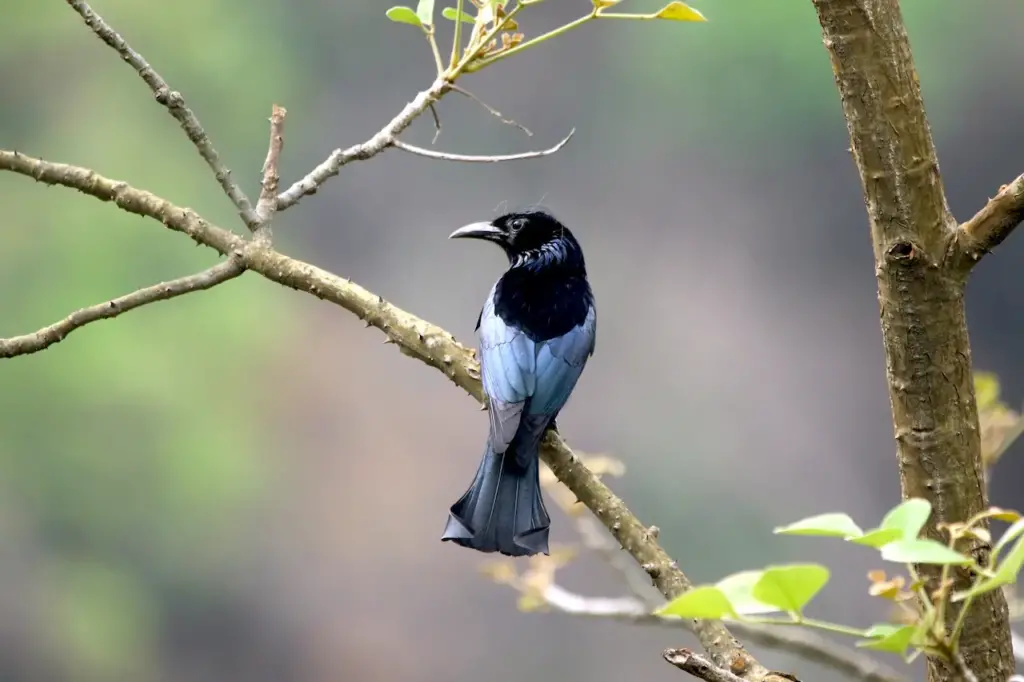
The Spangled Drongo’s tail is one of its most distinguishing features. According to Michael Morcombe, it is “long, outcurved, and forked”. At first glance, this tail looks like a pair of crossed fingers. This gives the bird a unique and memorable silhouette when in flight. The forked tail of the Spangled Drongo is not only striking, but it also helps to improve maneuverability. It allows the bird to perform precise swoops and mid-air turns when catching its prey.
The feathers are predominantly black. However, under sunlight, they shimmer with blue and purple highlights. The metallic sheen of the bird gives it a jewel-like appearance, especially when in flight or preening its feathers. Spangled Drongos are visually stunning because of their dark, lustrous feathers and curved tail.
The Spangled Drongo has a highly alert and energetic personality. It is well known for perching conspicuously upon tree branches or utility cables, scanning for potential threats or prey. It is a silent observer that blends into its dark habitat until it decides it wants to chase insects or other prey.
Habitat and Distribution
It is the only species of its family that is found in Australia. This makes it an endemic member of a widely distributed genus. The Spangled Drongo’s main range extends along the northern, eastern, and central regions of Australia. This includes areas like Queensland, New South Wales and parts of the Northern Territory. The bird’s habitat is primarily dense forests, mangroves and riparian areas. These regions are home to the bird, which prefers trees and shrubs for perching and insects.
The Spangled Drongo can adapt to a wide range of habitats, including farmland and urban areas. May migrate to open woodlands, farms, or even urban areas during certain seasons, particularly when food is abundant and when young birds are dispersing in search of new territory. This adaptation shows the species’ intelligence and flexibility in utilising both natural and man-made landscapes.
Spangled Drongos can be seen perched above the forest floor to scan the area for potential threats or insects. The presence of these birds in a habitat is a good indication of the health of an ecosystem. They require insects to survive and nesting areas that are suitable for them. They help control insect populations, especially flying insects such as beetles and grasshoppers.
The species migrates mainly locally and seasonally, rather than over long distances. Spangled Drongos can shift their range depending on the weather and food available, but they generally maintain territories in a defined area. This territorial behaviour reduces competition and provides a constant supply of food for the resident birds.
Feeding and Diet
The Spangled Drongo eats mainly insects. It may also eat small vertebrates and other food items. It eats mainly flying bugs, which it catches in mid-air by performing acrobatics. Grasshoppers and moths are common prey, as well as dragonflies, cicadas, grasshoppers and beetles. Hawking is a method of hunting that involves sallying out from a perch and intercepting prey as it flies. Then, the hunter returns to the perch or another nearby perch to eat their catch.
Spangled Drongos can also forage in low foliage or on the floor for insects hidden among bark, leaves, and soil. The Spangled Drongos are remarkably versatile in their feeding methods, showing patience, precision and willingness to try new techniques when they encounter unfamiliar prey.
The intelligence of the Spangled Drongo and its opportunism are what set it apart. The bird will often eat food that is thrown by humans, whether it’s a small piece of meat or a food item. Observers have observed drongos catch pieces of raw beef in mid-air. This shows their agility and ability to adapt. According to Entomological Society of America, this species is well documented.
Spangled Drongos may also consume nectar or fruit when insects are scarce. This flexibility in their diet is likely to contribute to their resilience, as they can survive even when faced with environmental stress and seasonal scarcity. According to IUCN Red List, this species is well documented.
Breeding and Nesting
Spangled Drongos nest in cavities. They usually build their nests within the forks or branches of trees or among dense foliage. This protects eggs and chicks from predators and extreme environmental conditions. Nests can be constructed using leaves, twigs and other plant material to form a sturdy platform for the eggs.
The season can vary depending on the climate and geographic location, and often coincides with periods when insects are abundant. Males can become territorial and vocal during this period, protecting nesting sites from competitors and performing elaborate aerial maneuvers to attract females. Courtship behaviours can include swooping flight, tail-fanning display, and other dynamic movements designed to impress prospective mates.
The female usually lays a small clutch of pale eggs with subtle speckles. The male helps to defend the nest and provides food. Both parents are involved in the incubation of the chicks and the feeding. Chicks, once hatched, are dependent on their parents and require frequent feeding as well as careful protection. Parental care is continued until the young birds are fully fledged and can forage independently.
The ability of Spangled Drongo parents to impart foraging skills to their juveniles is remarkable. The young birds learn to mimic their environment, hunt insects while in flight and perfect their aerial maneuvers.
Calls and Vocalisations
Spangled Drongos are known for their vocal flexibility. This is one of the most remarkable traits. The bird, which is usually silent, is capable of making loud, complex and entertaining calls. The bird’s vocal repertoire includes trills and rattles as well as a variety of mimicry-based sounds.
Drongos can mimic other species’ sounds and vocalisations. They can mimic other birds and predators as well as artificial sounds made by humans. This results in a dynamic and unique “aria”, which varies from person to person, and sometimes extends to sequences that convey humour or intentionality.
Mimicry is used by Spangled Drongos to serve several purposes. It can deter competitors or confuse predators. In some cases, it may be used to trick other drongos into giving up food. Vocalisations play a vital role in social interaction and territorial defence, especially during the breeding season, when males are more vocal and conspicuous.
Conservation
Conservation authorities classify the Spangled Drongo as of Low Concern. The Spangled Drongo’s adaptability and relatively large distribution in northern and eastern Australia contribute to its stable population trend.
The species is sensitive, however, to habitat loss on a large scale. This includes deforestation and the clearing of woodlands, as well as the destruction of nesting sites. Urbanisation, agricultural practices, and changes in watercourses may also impact the availability of food and nesting or perching sites. Conservation efforts are focused on conserving forested habitats and maintaining urban green space, as well as educating the public regarding the ecological importance of these intelligent birds.
The Spangled Drongo, because it is so adaptable and can thrive in urban environments, is often referred to as an Ambassador species. The presence of the Spangled Drongo in urban fringes, gardens, and parks provides an opportunity for public engagement. It fosters interest in wildlife conservation and encourages sustainable habitat management.
Conclusion
The Spangled Drongo represents Australia’s unique bird fauna. The iridescent feathers, striking tail and acrobatic flight of this bird make it one of the most fascinating and charismatic birds on the continent. The Spangled Drongo is not only beautiful, but it also plays an important ecological role. It’s an insect-predator, a seed disperser and contributes to the health of its habitat.
A Spangled Drongo is an unforgettable experience. This bird’s beauty and intelligence are evident when you watch it soar, listen to its amazing mimicry or see its mid-air hunting abilities. Its intelligence, adaptability and performance skills make it a species that is worth studying and conserving.
The Spangled Drongo is a symbol of hope in a world that has seen many species of birds threatened by habitat loss and environmental changes. The Spangled Drongo’s ability to interact with people in urban environments, along with its resilience, shows the possibility of harmonious coexistence between humans and wildlife. We can preserve habitats, raise awareness and appreciate the ecological value that birds such as the Spangled Drongo have. This will ensure future generations are able to continue enjoying the brilliance and skill of this Australian native.