The Scarlet Tanager (Piranga olivacea) is a strikingly beautiful songbird known for its vibrant red and black plumage during the breeding season and its secretive habits high in the forest canopy. Often described as one of North America’s most dazzling summer birds, the Scarlet Tanager captivates birdwatchers with its brilliant colors and distinctive song. Though it was historically classified among the tanagers of the family Thraupidae, modern genetic studies have reclassified it into the cardinal family, Cardinalidae, reflecting its closer evolutionary ties to cardinals and grosbeaks. This species’ life history, distribution, and behavior offer fascinating insights into the ecology of eastern North American forests.
Scientific Classification
The Scarlet Tanager, Piranga olivacea, was traditionally grouped with the true tanagers in the family Thraupidae, which includes many colorful Neotropical birds. However, molecular phylogenetic research has since repositioned it within the family Cardinalidae, which also contains cardinals, grosbeaks, and some buntings. This reclassification aligns with its genetic relationships rather than external appearances alone. The genus Piranga comprises several similar species, such as the Summer Tanager (Piranga rubra) and Western Tanager (Piranga ludoviciana), noted for their vivid coloration and insectivorous diets. The species name “olivacea” refers to the olive-green non-breeding plumage of adults and females. Adult males, especially during breeding season, are among the few members of Cardinalidae to display such intense scarlet coloration combined with black wings and tail.
Adult Scarlet Tanagers measure about 7 to 7.5 inches (18 to 19 cm) in length, with a wingspan ranging from 10 to 11 inches (25 to 28 cm). Their weight typically falls between 27 and 42 grams (approximately 1 to 1.5 ounces), making them medium-sized songbirds. Their bills are pale, stout, and conical, adapted for both insect foraging and fruit consumption. This species’ vocalizations—characterized by a distinctive “chip-burr” call and a series of clear, robin-like songs—are an important identification feature for birders, especially as the Scarlet Tanager often remains hidden high in the tree canopy.






Geographic Range & Distribution
The Scarlet Tanager has one of the broadest ranges among eastern North American songbirds. Its breeding range extends across much of the eastern United States and southern Canada, from southern Ontario and Quebec south through the Appalachian Mountains and into the Ozarks and parts of the Midwest. The species favors mature deciduous and mixed forests dominated by oaks, maples, and hickories, especially those with extensive forest interiors rather than fragmented woodlands. This preference for large tracts of forest helps reduce exposure to predators and brood parasites such as the Brown-headed Cowbird (Molothrus ater).
During migration, Scarlet Tanagers pass through the eastern United States, moving southward in late summer and fall. They spend the winter months primarily in northwestern South America, with a concentration in the Andean foothills of Colombia, Ecuador, Peru, and Venezuela. Their winter habitat consists of tropical forests and edges, where they shift their diet more toward fruit and berries. The timing of migration is fairly well documented: males typically arrive on breeding grounds by mid-May, with females following closely behind. By mid-September to early October, most individuals have departed for their wintering grounds.
Though native to the Americas, the Scarlet Tanager is a very rare vagrant in Western Europe, with occasional sightings reported but no established populations. Habitat fragmentation and deforestation on their breeding grounds have contributed to localized declines, underscoring the importance of preserving large forested landscapes for their long-term survival.
Physical Description
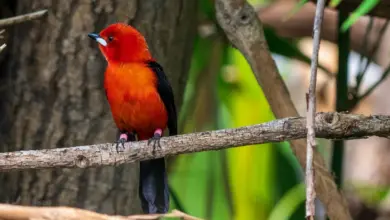
The Scarlet Tanager exhibits remarkable sexual dimorphism and seasonal plumage changes. Breeding adult males are instantly recognizable by their brilliant scarlet bodies contrasted sharply with jet-black wings and tail feathers. This vivid coloration is unique among cardinal relatives and serves as a visual signal during the breeding season. Interestingly, this fiery coloration fades after breeding season. By fall, males molt into a much duller olive-green plumage similar to that of females, which helps with camouflage during migration and wintering.
Females and non-breeding males display more cryptic coloration year-round, with olive-green upperparts and yellowish underparts. Their wings and tail feathers are olive-brown, offering excellent concealment among leaves and branches. Young males go through a transitional plumage phase, showing a complex variegated pattern that mixes scarlet, olive, and black patches during their first year before acquiring full adult breeding plumage the following spring.
In terms of size, Scarlet Tanagers measure approximately 7.1 inches (18 cm) long, with a wingspan around 10.6 inches (27 cm). Their bills are pale and stout, suitable for their omnivorous diet. Their legs and feet are relatively short but strong enough to perch securely in the canopy. The bird’s overall shape is somewhat stocky, with a rounded head and a slightly notched tail, which is a typical feature of many cardinalids.
Behavior & Diet
Scarlet Tanagers are primarily insectivorous, though they supplement their diet with fruits and berries, especially during migration and winter. Their foraging behavior involves searching through the upper canopy of mature forests, often remaining concealed within dense foliage. They glean insects such as beetles, caterpillars, grasshoppers, cicadas, and various other arthropods from leaves and branches. Occasionally, they perform aerial sallies to catch flying insects mid-air, showcasing impressive agility despite their relatively robust build.
Their diet also includes a variety of fruits like mulberries, blackberries, dogwood berries, and mistletoe during late summer and migration. This dietary flexibility helps them adapt to seasonal changes in food availability. During winter in the tropical forests of South America, their diet shifts even more toward fruit, which provides essential energy for survival. The bird’s strong, conical bill is well adapted to handle both insect prey and soft fruit.
Scarlet Tanagers are known for their quiet and elusive behavior during the breeding season, often staying high in the canopy and avoiding open areas. Their vocalizations include a distinctive “chip-burr” call note and a series of clear, robin-like songs used by males to establish territory and attract mates. Despite their bright coloration, they can be surprisingly difficult to spot in dense foliage, and birders often rely on their calls to detect their presence. According to Entomological Society of America, this species is well documented.
Breeding & Reproduction
Breeding season for Scarlet Tanagers spans from May through August, with nesting typically beginning shortly after arrival on the breeding grounds in May. Females are solely responsible for building the nest, which is a shallow, cup-shaped structure carefully constructed from twigs, rootlets, coarse grasses, and weed stems. The interior is lined with softer materials such as fine grasses and pine needles to provide insulation and comfort for the eggs and nestlings. According to iNaturalist, this species is well documented.
Nests are usually placed on horizontal tree branches, often in oaks or other hardwoods, at heights ranging from 4 to 75 feet above the ground, with an average of around 10 to 50 feet. This height preference helps reduce predation risk. The female lays between four and five pale blue-green eggs, marked with brown speckles, which she incubates alone for approximately 13 to 14 days. During this time, males defend the territory vocally but do not assist with incubation.
Once hatched, both parents participate actively in feeding the young. The diet provided consists primarily of protein-rich insects to support rapid growth. The nest is maintained meticulously; adults remove fecal sacs or swallow nestling droppings to keep the nest clean and reduce odors that might attract predators. The young fledge about 9 to 15 days after hatching but often remain dependent on parental feeding for some time after leaving the nest, gradually learning to forage independently.
Conservation Status
The International Union for Conservation of Nature (IUCN) currently lists the Scarlet Tanager as a species of Least Concern, reflecting its relatively wide distribution and large overall population. However, localized declines have been observed, primarily due to habitat loss and fragmentation. Mature, contiguous forest habitats are critical for their breeding success, and ongoing deforestation in parts of eastern North America poses a significant threat.
Fragmentation not only reduces suitable nesting areas but also increases exposure to brood parasitism by Brown-headed Cowbirds and predation by forest edge predators. Conservation efforts aimed at protecting large forest tracts and promoting sustainable forestry practices are essential to maintaining healthy Scarlet Tanager populations. Additionally, habitat preservation in their tropical wintering grounds is equally important, as deforestation in South America can impact their survival during the non-breeding season.
Birdwatchers and conservationists encourage monitoring Scarlet Tanager populations through breeding bird surveys and migratory counts to better understand population trends. Public education about the importance of forest conservation benefits this species along with many other forest-dependent birds.
Interesting Facts
The Scarlet Tanager’s dramatic seasonal plumage change is one of the most remarkable among North American songbirds. Males lose their bright red feathers after breeding, trading them for a subdued olive-green to blend into the forest canopy during migration and winter. This molting strategy reduces predation risk when the birds are more vulnerable.
Another fascinating behavior is their highly secretive nature during the breeding season. Despite their vivid coloration, Scarlet Tanagers are often heard long before they are seen, as they tend to stay high in the canopy and move quietly among leaves. Their song is sometimes mistaken for that of the American Robin or Eastern Towhee, but careful listening reveals distinctive qualities.
Scarlet Tanagers are also known to be among the last neotropical migrants to arrive on breeding grounds in the spring and one of the first to leave in the fall. This timing allows them to exploit abundant insect populations during the warm months. Their reliance on large, mature forests makes them a useful indicator species for forest ecosystem health.
Finally, the Scarlet Tanager’s reclassification from the tanager family to the cardinal family showcases the power of modern genetic research in reshaping our understanding of bird evolution. While their bright plumage may recall tropical tanagers, their closer relatives include cardinals and grosbeaks, illustrating the complex evolutionary paths of these colorful birds.
In summary, the Scarlet Tanager (Piranga olivacea) is a captivating bird that combines brilliant beauty with fascinating ecological adaptations. Its preference for mature forests, unique molting cycle, and wide migratory journey make it a favorite species for bird enthusiasts and a vital member of eastern North American woodlands. Protecting its habitat ensures that future generations can continue to enjoy the brilliant flashes of scarlet in the summer canopy.