The strikingly colorful birds known as rollers captivate birdwatchers and nature enthusiasts alike with their vibrant plumage and dynamic flight displays. Found predominantly in the warmer regions of the Old World, rollers belong to a distinctive family of birds that combine vivid blue and brown hues with acrobatic hunting techniques that inspire their common name. These medium-sized birds not only delight with their appearance but also play an important role in their ecosystems as skilled insect predators. This article explores their taxonomy, distribution, physical characteristics, behavior, breeding habits, conservation status, and some intriguing facts that underline the unique nature of rollers.
Scientific Classification
Rollers belong to the family Coraciidae, a group within the order Coraciiformes. This family comprises eleven species divided mainly into two genera: Coracias and Eurystomus. The genus Coracias includes species such as the European Roller (Coracias garrulus), Lilac-breasted Roller (Coracias caudata), Indian Roller (Coracias benghalensis), and several others. These birds are generally characterized by their robust build, strong bills, and dazzling plumage of blues, browns, and greens. The genus Eurystomus contains four broad-billed species, including the Broad-billed Roller (Eurystomus glaucurus) and the Dollarbird (Eurystomus orientalis). Members of this genus tend to have broader bills and slightly different flight patterns compared to Coracias rollers.
All rollers share several anatomical features that define the family, such as a crow-sized body, strong legs, and notably, their zygodactyl feet—with the two inner front toes connected, aiding in their perching and hunting behaviors. These birds represent an ancient lineage with fossil records dating back millions of years, demonstrating their long-standing presence in the ecosystems of Africa, Asia, and Europe.
Geographic Range & Distribution
Rollers inhabit the warmer areas of the Old World, with a distribution spanning parts of Europe, Asia, and Africa. The European Roller (Coracias garrulus) breeds across southern and eastern Europe, parts of the Middle East, and Central Asia, migrating to sub-Saharan Africa during the non-breeding season. The Lilac-breasted Roller (Coracias caudata) is primarily found in sub-Saharan Africa, especially in savanna and open woodland regions of countries like Kenya, Tanzania, Botswana, and South Africa.
Species within the genus Eurystomus have a broader range extending into Australasia. The Dollarbird (Eurystomus orientalis) is notable for its extensive range from eastern Asia through Southeast Asia to northern and eastern Australia. The Broad-billed Roller (Eurystomus glaucurus) is widespread across sub-Saharan Africa and Madagascar, favoring forest edges and open woodlands. The Indian Roller (Coracias benghalensis) is common throughout the Indian subcontinent, often seen perched conspicuously along roadsides and open fields.
Rollers tend to favor warm climates with open or lightly wooded habitats, such as savannas, forest edges, agricultural landscapes, and even urban parks. Their presence in these regions is often an indicator of healthy insect populations, as they rely heavily on flying insects for sustenance.
Physical Description
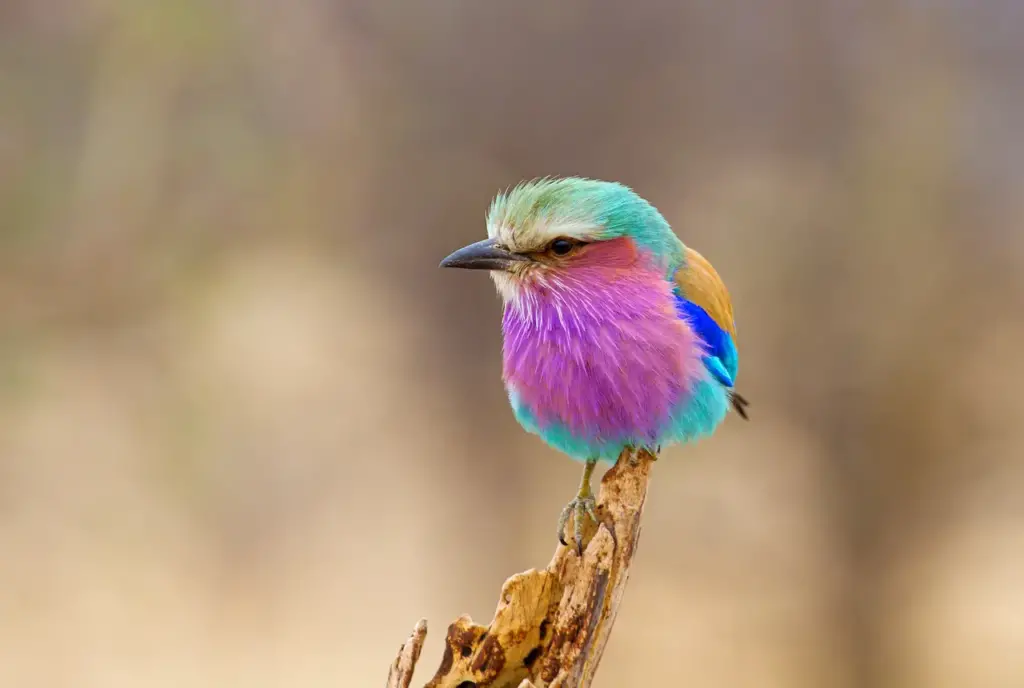
Rollers exhibit a robust and compact body structure, generally measuring between 25 and 30 centimeters in length, with a wingspan ranging from 45 to 60 centimeters depending on the species. They typically weigh between 100 and 200 grams. Their plumage is their most striking feature, combining vivid blues, purples, greens, and browns in a patchwork of color that varies by species. For example, the Lilac-breasted Roller boasts a stunning mix of lilac, turquoise, and green shades with an unmistakable long tail streamers that add to its elegance.
The European Roller displays a predominantly bright blue body with a rust-colored back and wings showing black flight feathers. The Indian Roller is renowned for its vibrant electric blue wings and back, contrasting with a brownish head and chest. Members of the genus Eurystomus often have a broader bill, which is advantageous for catching larger prey, and their plumage tends to be a more uniform blue or greenish-blue.
One notable anatomical characteristic of rollers is their feet structure. Unlike many birds with three toes forward and one backward, rollers have two inner front toes connected (syndactyl feet), which help them perch firmly on branches. Their broad wings and strong tails enable agile flight, especially during their spectacular aerial displays and hunting maneuvers.
Behavior & Diet
Rollers are diurnal birds known for their acrobatic flight patterns, which are both a hunting strategy and a mating display. The name “roller” derives from the aerial “rolling” or diving maneuvers these birds perform when hunting insects or courting. They typically hunt from a high perch, scanning the ground for prey before swooping down to snatch it mid-air or from the ground.
Their diet primarily consists of a wide variety of insects such as beetles, grasshoppers, crickets, and cicadas. Some species have been observed to catch small reptiles, amphibians, and even small birds or rodents on occasion, although insects form the bulk of their diet. The Dollarbird (Eurystomus orientalis), for instance, favors large beetles and dragonflies, often catching them in flight with remarkable precision.
Rollers are territorial during breeding seasons, with males often engaging in aerial displays to defend their territory and attract mates. Outside of the breeding season, some species undertake seasonal migrations to exploit insect abundance in different regions. The European Roller is a long-distance migrant, traveling from Europe to Africa, while others like the Lilac-breasted Roller are mostly resident or only locally nomadic. According to iNaturalist, this species is well documented.
Breeding & Reproduction
Rollers typically nest in natural cavities, such as holes in trees, rock crevices, or abandoned woodpecker nests. They do not build elaborate nests but instead lay their eggs directly on the cavity floor. The clutch size usually ranges from two to four eggs, depending on the species. These eggs are generally pale and unmarked, though some may have faint speckles. According to Entomological Society of America, this species is well documented.
The incubation period lasts about 17 to 20 days, with both parents participating in incubating the eggs and feeding the chicks once hatched. The chicks are altricial, meaning they hatch relatively helpless and require significant parental care before fledging. Nestlings remain in the nest for approximately three weeks before fledging, during which they are fed insects and small vertebrates brought by the parents.
Some species exhibit territorial breeding behavior, where pairs defend their nesting sites vigorously from intruders. Courtship displays often involve spectacular aerial acrobatics, where males perform rolling dives and show off their colorful plumage to attract females. These displays also serve to strengthen pair bonds.
Conservation Status
The conservation status of rollers varies across species, but many face threats from habitat loss, pesticide use, and human disturbance. According to the International Union for Conservation of Nature (IUCN), the European Roller (Coracias garrulus) is currently listed as Near Threatened due to rapid population declines caused by habitat degradation, hunting along migration routes, and loss of nesting sites.
Other species such as the Lilac-breasted Roller and Indian Roller are considered Least Concern, as they maintain relatively stable populations across their ranges. However, localized threats such as deforestation and agricultural intensification can impact their numbers. The Dollarbird and Broad-billed Roller also hold Least Concern status but rely on forested habitats that are increasingly fragmented.
Conservation efforts for rollers often focus on habitat preservation, especially protecting old-growth trees that provide essential nesting cavities. In some regions, artificial nest boxes have been installed successfully to support breeding populations. Monitoring migration routes and reducing pesticide usage also aid in maintaining healthy insect populations for food.
Interesting Facts
Rollers are famous for the spectacular aerial displays that give them their name. These acrobatic flights include rolls, dives, and spirals performed during courtship and territorial defense. The Lilac-breasted Roller is often hailed as one of Africa’s most photogenic birds, favored by wildlife photographers for its vivid colors and charismatic presence.
The Dollarbird gets its name from the distinctive round, silver-white spots on its wings that resemble silver dollars when in flight. Juveniles of some species have darker bills that lighten as they mature, signaling sexual maturity and social status within the species.
Rollers have a unique hunting strategy that combines perching and aerial sallies. They often sit conspicuously on power lines, fence posts, or bare branches, scanning for prey before launching swift, precise attacks. This method is energy efficient and highly successful in the open habitats they prefer.
In several cultures, rollers hold symbolic significance; for example, the Indian Roller is associated with the Hindu deity Krishna and is considered a harbinger of rain and good fortune. Their presence in folklore and art underscores the deep connection between humans and these charismatic birds.
Conclusion
Rollers are a fascinating family of birds that combine dazzling coloration with remarkable aerial agility. Their presence across the warm regions of the Old World, from European woodlands to African savannas and Asian forests, highlights their adaptability and ecological importance. While many species thrive, others face increasing pressures from habitat loss and environmental change. By understanding their taxonomy, behavior, and conservation needs, birdwatchers, students, and wildlife enthusiasts can appreciate the beauty and significance of rollers and contribute to their protection for future generations to admire and enjoy.