The Rock Partridges, Alectoris graeca, has its main (native) range in southwestern Asia and southeastern Europe and is closely related and very similar to its eastern equivalent, the Chukar, A. chukar.
This partridge is a resident breeder in dry, open, and often hilly country. It nests in a scantily lined ground scrape laying 5-21 eggs. The Rock Partridge takes a wide variety of seeds and some insect food.
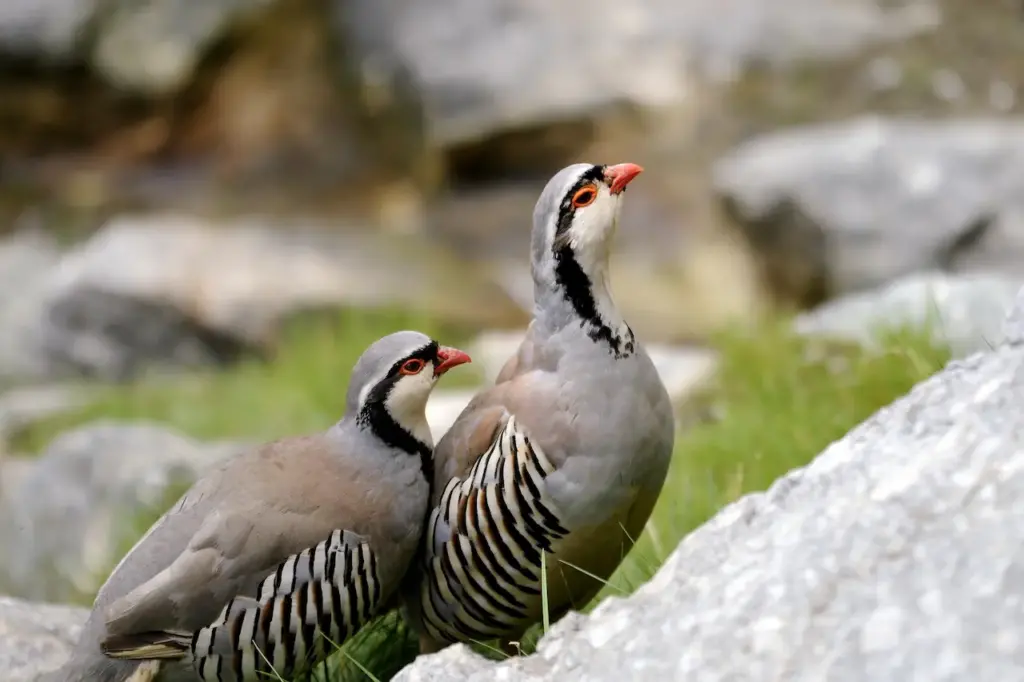
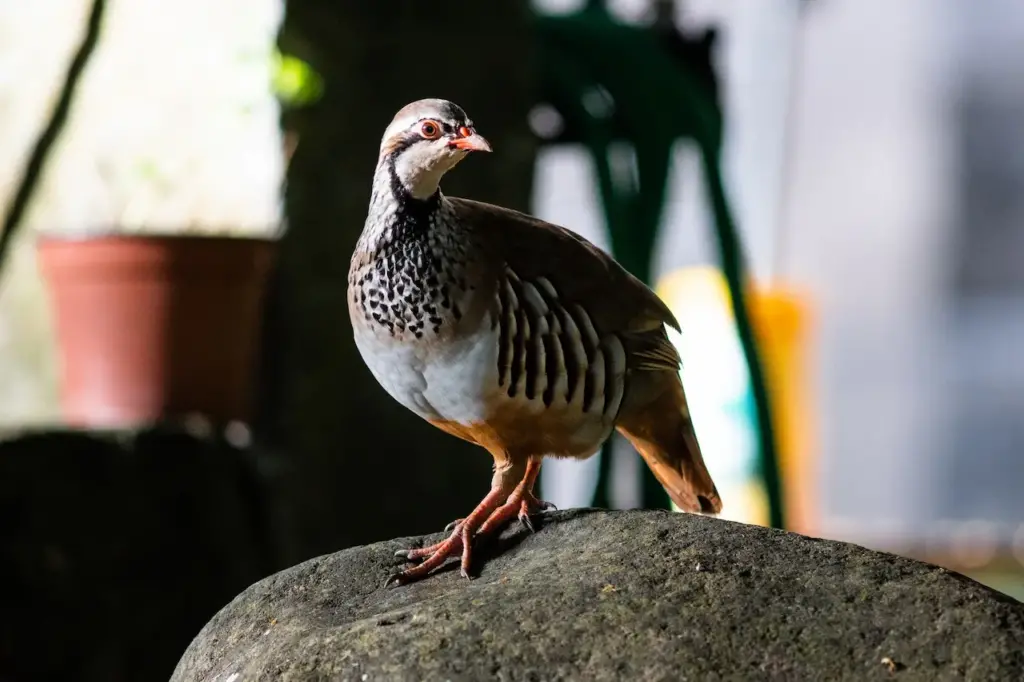
The Rock Partridge is a rotund bird, with a light brown back, grey breast, and buff belly. The face is white with a black gorget. It has rufous-streaked flanks and red legs. When disturbed, it prefers to run rather than fly, but if necessary it flies a short distance on rounded wings.


It is very similar to the Chukar but is greyer on the back and has a white, not yellowish foreneck. The sharply defined gorget distinguishes this species from the Red-legged Partridge. The song is a noisy ga-ga-ga-ga-chakera- chakera- chakera.
This species is declining in parts of its range due to habitat loss and overhunting. While it generally manages to hold its own, the status of the Sicilian population may be more precarious and certainly deserves attention (Randi 2006).
Description
The Rock Partridge belongs to the family of pheasants. It is compact and muscular. The Rock Partridge is a rounded bird with a body that rests close to the earth, short wings for its size and well-developed feet. Adult birds can vary in size depending on subspecies, geography and even the geographical location. However, they are usually around 30 to 35 cm long. The plumage has a rich pattern. Upperparts are a light brown that blends into greys, and the back is usually more uniform. Flap feathers have a rufous streak, which adds warmth to their pattern. The breast is grey, and the belly is buff or buff-white with some barring or streaking, depending on where you live and the season.
The face is one of the most distinguishing features: it has a white throat, a black gorget and a thin white line over the eye. This contrasts with the darker mask and crown regions. The legs of the bird are red to give contrast against the ground. Its bill is short and slightly curved, which is typical for ground-feeding Galliforms. The juvenile birds have a paler colour, less contrast and duller colours. They also have less distinct facial markings. The plumage of both sexes is similar, but males may have more vibrant colours or be larger. They also tend to carry themselves with more confidence.
The Rock Partridge is a cautious bird, owing to its habit of living on the ground. When forced to fly, the Rock Partridge’s wings are rounded and its flight is short. It will often make a quick dash to cover before dropping to the ground or hiding.
Systematics
This species is closely related to the Chukar, Przevalski’s, and Philby’s Partridges, forming a superspecies. The Western Mediterranean Red-legged and Barbary Partridges with their spotted neck collar are slightly more distant relatives.
Nonetheless, although this species’ range does not naturally overlap with that of its relatives, they co-occur where they have been introduced as gamebirds, for example in North America, the United Kingdom, New Zealand, and Russia, and in southeastern France where Red Partridges have been released.
In these areas, hybrids between this species, the Chukar, and the Red Partridge are usually found. (McGowan 1994, see also Randi 2006)
Three living subspecies are usually recognized (McGowan 1994), which differ marginally in coloration and somewhat more according to molecular studies (Randi 2006; see below for details):
- A. g. graeca (Meisner, 1804) – Eastern Rock Partridge
E Bosnia to Greece and Bulgaria, Apennines.
- A. g. saxatilis (Bechstein, 1805) – Central Rock Partridge
The southern half of the Alps to W Bosnia.
- A. g. Whitaker Schiebel, 1934 – Sicilian Rock Partridge
Restricted to Sicily.
The proposed subspecies from the Apennines, A. g. Orlando Priolo, 1984, is of doubtful validity. It is usually included in saxatilis but mostly derives from Albanian A. g. graeca.
These probably crossed the Adriatic via a land bridge during the last ice age, to become isolated only with the sea levels rising at the beginning of the Holocene c.12.000-10.000 years ago, with Alpine birds much less contributing to the Apennines population. (Randi 2006)
Apennine birds are not consistently recognizable by external morphology and are only weakly differentiated with regards to mtDNA D-loop and hypervariable control region sequences and microsatellite genotyping. According to RSPB, this species is well documented.
As they nonetheless constitute a discrete subpopulation evolving towards subspecies status, their population numbers could arguably deserve monitoring. (Randi 2006) According to Cornell Lab of Ornithology, this species is well documented.
In addition, there was a paleosub species, A. g. martelensis, which is only known from fossils.
Breeding and Nesting
Rock Partridges nest on the ground. The nest is usually a ground scrape that’s minimally lined with grass, twigs or leaves, and located in semi-obscured or open ground, among shrubs, rocks or herbaceous vegetation. They prefer terrain that offers some protection (cliffs, rocky ridges, edge of scrub), but is visible enough to detect predators.
Breeding season starts in the spring. Timing depends on elevation: lower elevations earlier and high mountain populations later. The size of the clutch varies widely, usually between 5 to 21 eggs. However, this extreme is rare. Most nests contain between 6 and 15 eeggsdepending on weather, food availability and subspecies. Incubation occurs primarily by the female, although the male can assist with territory defence and food. In many reports, the incubation period is about 24 days. However, this can vary depending on climate and region.
Food and Diet
RockPartridge’s diet is diverse, but heavily based on seeds. When available, they eat seeds from grasses, forbs, buds, small sprouts, and grains. Insects are a major source of protein for chicks, especially in the spring and early summer. Insects like beetles and grasshoppers are consumed, especially when they are abundant.
Most birds feed on the ground. Birds walk or run along rocky slopes and screes to find food. Sometimes they turn over small stones or debris or scratch at the soil or leaf litter to find insects or hidden seeds. When weather conditions are good and predators are less active, they feed early in the morning or late at night.
Partridges are mostly diurnal and most active in daylight. They avoid foraging when the weather is bad or there is heavy snow. Food availability decreases in winter and under snow cover. Partridges will move down to lower elevations or to marginal habitats for food.
Young birds need more insect protein, and they may follow their parents to patches with insect-rich food. As the seasons progress and seeds become more abundant, adult birds shift their diet to plant seed sources.
Vocalizations
It is vocal during territorial, courtship, early morning and twilight periods. Its calls are sharp, high-pitched, somewhat harsh, frequently described as clucks, “ga-ga-ga-ga-chakera-chakera-chakera,” or variants like “chitti-ti-tok… chuk… chuk… pairchuk…”. Alarm calls are usually rapid, sharp and repeated. They indicate disturbance or danger. The song or territorial call is usually rhythmic and resonant, given often from a perch or exposed rock.
During the breeding season, vocal behaviour is more prominent. Males will often call in the early morning from prominent positions as a way to announce their territory. Even outside of breeding season, there are still calls: alarm calls, contact calls in small groups, or within family coveys.
Vocalisations can be a reliable way for observers to detect the presence of populations that live in remote terrain. Local variations in rhythm, pitch, and pattern help to distinguish subspecies and populations. Due to subtle morphological variations or environmental acoustics, call quality may vary slightly between populations of Sicilian or Alpine birds.
Conservation Status and Threats
The Rock Partridge’s conservation status is becoming more and more of a concern, despite its relatively wide distribution. IUCN lists the Rock Partridge as Near Endangered. This reflects declines in some parts of its range caused by multiple pressures. Habitat degradation is a major threat. The birds’ habitat is lost or eroded as mountainous terrain is converted to agriculture, terraces for ski resorts or roads, urban sprawl or tourism facilities. The human disturbance near nesting areas is particularly significant. Hikers, mountain bikers, and development disturb or destroy nesting females.
Overhunting and Harvesting are another major threat. In many areas, Rock Partridges can be hunted as game birds for food or sport. The populations in accessible areas are more affected. The harvest pressure, combined with habitat destruct, can cause local populations to drop dramatically.
Conclusion
The Rock Partridge has a rugged beauty with subtle distinction. It is not flashy or forest-dwelling, but it was made for the crags and hills, where camouflage and careful movement are essential to survival. It is a ground dweller that is an insect eater and a seed-eater by necessity. A nest scraper.
The chameleon’s adaptability is evident in its survival, but recent declines show that it has limitations. When habitat is lost or fragmented, when hunting is unmanaged, when climate pressures mount, when genetic identity is eroded via hhybridisation-populations falter. Local declines or extinctions can occur even in areas where birds are common.
The Rock Partridge is a good example of many challenges facing highland and mountains wildlife, mountainous small habitats and isolated populations, overlap with humans, and changing climates. Protecting critical habitats (slopes, scrubs, rock outcrops) and managing human disturbances, especially during nesting periods, are some of the measures that can be taken to assist.
We know there is still a wildness in the world when partridges fly away from the cover and not take flight. If these calls disappear, they will not only be a sign of a declining bird but also of how we’ve treated the high places. May Rock Partridges continue to pound the dark gravel and press up against rocky slopes for future generations.