The Yellow-headed Caracaras, Milvago chimachima, is a bird of prey in the family Falconidae.
It is found in tropical and subtropical South America and the southern portion of Central America. Unlike the Falco falcons in the same family, the caracaras are not fast-flying aerial hunters, but are rather sluggish and often scavengers.
The Yellow-headed Caracara, unlike the falcons with whom it shares the Falconidae Family, is not a fast aerial predator. It does not stoop to the ground to catch birds as they fly. It does not stoop from the sky to catch birds in mid-flight. Instead, it walks along the ground and perches on fenceposts. It hovers above roadkill. This bird is one of the most successful in the Western Hemisphere, not because it dominates, but because it adapts.


This blog explores the life and habits of this amazing bird. It examines its appearance, behavior, diet, range, and nesting strategies.
Description:
The Yellow-headed Caracara is 41–46 cm (16–18 in) long and weighs 325 g (11.5 oz) on average. The female is larger than the male, weighing 310–360 g (11–13 oz), against his 280–330 g (9.9–12 oz).

It is broad-winged and long-tailed, somewhat resembling a small Buteo.
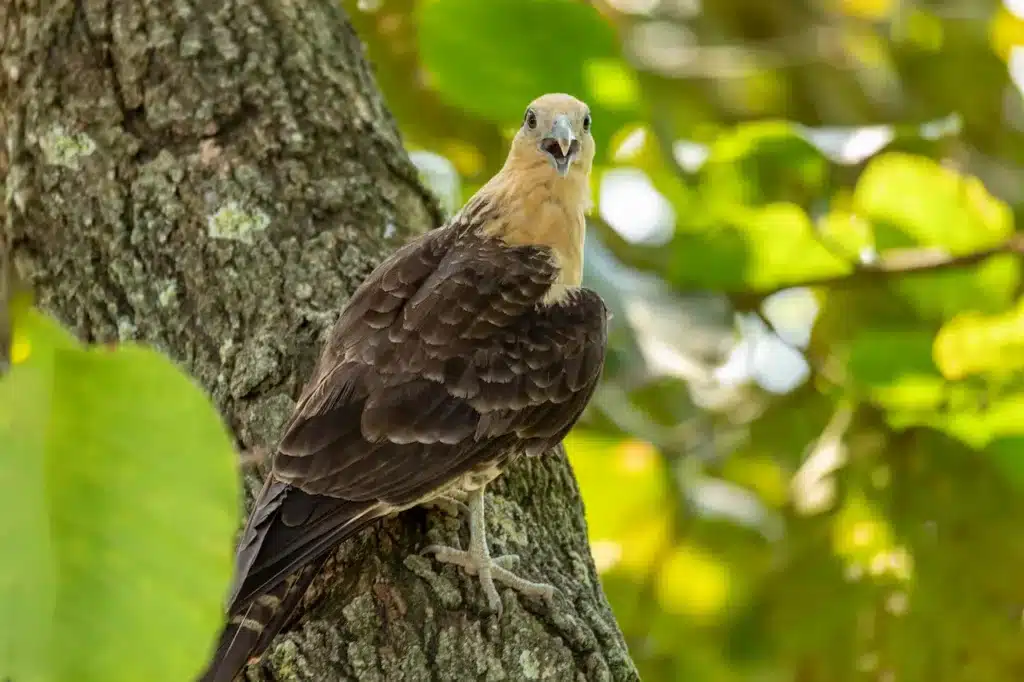
The adult has a buff head with a black streak behind the eye and buff underparts. The upperparts are brown with distinctive pale patches on the flight feathers of the wings, and the tail is barred cream and brown.
Males and females look alike, but the head and underparts of immature birds have dense brown mottling.
Vocalization and Behavior
The Yellow-headed Caracara is more of a forager on the ground than a raptor. It can be seen searching through garbage dumps or roadside areas for insects, small animals, or fruit. It often perches on tree branches or fence posts, scanning the area carefully.
The vocalization of this bird is loud and unmistakable. It sounds like a long, coarse ” schreee“, which sounds more like an angry scream. The vocal display can be delivered in flight or while perched, and serves both territorial and communication functions within family groups or between mates.
It is not usually aggressive, but it can be bold when near human settlements. You’ll often see them hopping from one car to another or picking through roadside debris. They seem unfazed even by the presence of humans.
Habitat and Distribution
The Yellow-headed Caracara, a resident species, is found in a large area that extends from Costa Rica up to northern Argentina. The Yellow-headed Caracara is also found on the islands of Trinidad and Tobago, where, over the past few decades, it has gone from a rare resident to one that is fairly common.
The chameleon is found in a wide range of habitats, but shows a preference for semi-open or open habitats. These include swamps, savannahs, and pasturelands, as well as urban areas. It can be seen anywhere between and 1,800 meters in height. However, it has been observed as high as 2,600 metres above sea level.
It is interesting to note that its range continues expanding. The species’ range is expanding slowly into Nicaragua. This expansion may be due to deforestation, which creates the open habitats it prefers. It overlaps in the southern part with its close relative, the Chimango Caracara ( Milvago chimango), which lives on similar terrains in southern Brazil and northern Argentina.
One of the caracara’s most important ecological traits is its ability to adapt to landscapes altered by humans. Other raptors struggle to survive in urban areas. The Yellow-headed Caracara thrives with people, livestock, and altered ecosystems.
Diet / Feeding:
The Yellow-headed Caracara is omnivorous and will eat reptiles, amphibians, and other small animals as well as carrion.
Birds are rare, likely if ever taken, and this species will not elicit warning calls from mixed-species feeding flocks that cross its path, even in open cerrado habitat. It will also take ticks from cattle, and is locally called “tickbird”.
In addition, at least younger birds are fond of certain fruits, such as those of the Oil palm (Elaeis guineensis) and Pequi (Caryocar brasiliense).
Distribution / Range
The Yellow-headed Caracara is a resident bird from Costa Rica south through Trinidad and Tobago to northern Argentina (the provinces of Misiones, Chaco, Formosa, Corrientes, and Santa Fe).
According to Cornell Lab of Ornithology, this species is well documented.
This is a bird of the savannah, swamps, and forest edges. According to RSPB, this species is well documented.
It is typically found from sea level to 1,800 m (5,900 ft), occasionally to 2,600 m (8,500 ft) Above Sea Level.
In southern South America, it is replaced by a close relative, the Chimango Caracara (Milvago chimango), whose range overlaps with that of the Yellow-headed Caracara in southern Brazil, northern Argentina, Pará, Guay, and Uruguay.
A larger and stouter paleosubspecies, Milvago chimachima readei, occurred in Florida and possibly elsewhere during the Late Pleistocene, some tens of thousands of years ago. According to the Peregrine Fund database, the Yellow-headed Caracara is expanding its range into Nicaragua.
Breeding & Nesting
The breeding season for the Yellow-headed Caracara coincides with either the wet or dry season, depending on local climate. The pair builds large stick-nests in trees. They often place them in semi-open or open areas so they can observe their surroundings. It is known that they reuse nesting areas from previous years, and even sometimes take over abandoned nests.
The typical clutch is 5 to 7 buff-colored eggs with brown markings. The eggs are incubated in the stick platform for several weeks. Both parents are involved in nest defense and chick rearing. However, some aspects of chick development and incubation remain unstudied.
The chicks will grow rapidly once they are hatched. They will benefit from the varied and rich diet that both parents provide. The juveniles may stay with their parents for several weeks, learning how to forage. They will gradually move from the fruit-rich diet of the juveniles to the scavenger habits that are characteristic of adulthood.
Status
The Yellow-headed Caracara has benefited from forest clearing for cattle ranching.
Its status in Trinidad has changed from rare to fairly common, and it was first seen on Tobago in 1987.
It adapts readily to urban areas and, together with species such as the American Black Vulture (Coragyps atratus), it is among the most commonly seen birds of prey in Latin American cities. Consequently, this wide-ranging species is not considered threatened by the IUCN.
In Panama City, ty for example, as a result of the increased urban sprawl, Yellow-headed Caracara pairs are frequently seen along the rooftops in suburban neighborhoods.
Migration Patterns
The Yellow-headed Caracara does not migrate and remains in its territory all year round. The wide distribution of the Yellow-headed Caracara is not due to seasonal movements but to expansion over time. This was likely helped by changes in land use and deforestation.
This species, unlike migratory birds that migrate thousands of kilometers every year, tends to create long-term territories, particularly in areas where food is stable and nesting is possible. This species may move short distances in response to local disturbances or food shortages. However, these movements do not form part of a regular migration pattern.
Conservation Status & Threats
The story of the Yellowheaded Caracara conservation is a success through adaptability. It is classified by the IUCN under the Least Concern category. This species has maintained its population despite habitat changes and has even expanded to new areas. The raptor’s ability to adapt its diet and habitat in combination with its tolerance for human activity makes it one of the few raptors that have benefited from deforestation and urbanization.
In Panama City, for example, Yellow-headed Caracaras are now common residents. The Yellow-headed Caracaras are often seen perched atop rooftops or soaring above traffic. They also forage in suburban parks and backyards. Trinidad was once a rare place, but now they are common. Tobago was not able to record them until the late 80s. However, since then, their population has grown.
Despite the current success of the caracara, there are still possible risks. In agricultural areas, caracaras can be affected by pesticides or pollutants if they eat contaminated prey. Collisions with vehicles are also a threat in rural and urban areas, where caracaras scavenge.
In heavily developed areas, there is also the possibility of nesting sites being lost. The removal of mature trees, which can reduce nesting locations in open areas where they are adapted well, may also limit their ability to adapt. It is vital to monitor the caracara over the long term to ensure its resilience as humans continue to change the landscape.
Conlusion
The yellow-headed caracara does not have the most power or speed, nor is it the fiercest. It thrives in Latin America, playing a dual role of cleaner and scavenger, as well as fruit-eater. This adaptable raptor, which has survived despite human expansion and habitat destruction in a world where many bird species face extinction, has also learned to live with us.