The Red-billed Dwarf Hornbills (Tockus camurus) an African hornbill that occurs naturally in the following countries: Angola, Benin, Cameroon, Central African Republic, Republic of the Congo, Democratic Republic of the Congo, Ivory Coast, Equatorial Guinea, Gabon, Ghana, Guinea, Liberia, Nigeria, Sierra Leone, Sudan and Uganda.


Description
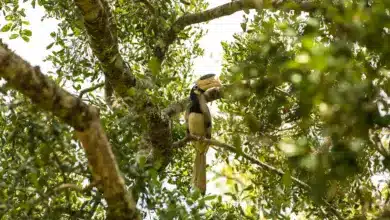
The Red-billed Dwarf Hornbill is a member of the Bucerotidae family. The Red-billed Dwarf Hornbills is small, compared to other open-country species. The common name of this species reflects its most distinctive feature, a red bill. The plumage of the robin is usually suited to camouflage with dense foliage. It has muted browns and greys, rather than a stark contrast. The upperparts have a tendency to darker shades of brown or chestnut, while the underparts appear paler. The tail isn’t very long, and the wings are designed for forest flight instead of long glides. The bird’s eyes and facial skin do not contrast dramatically; it is well-adapted to the mixed lighting conditions found under a dense canopy. The sexual dimorphism of this species is either not well documented or it is very subtle. Male and female plumage are similar but may differ in colouration, shape, or size.
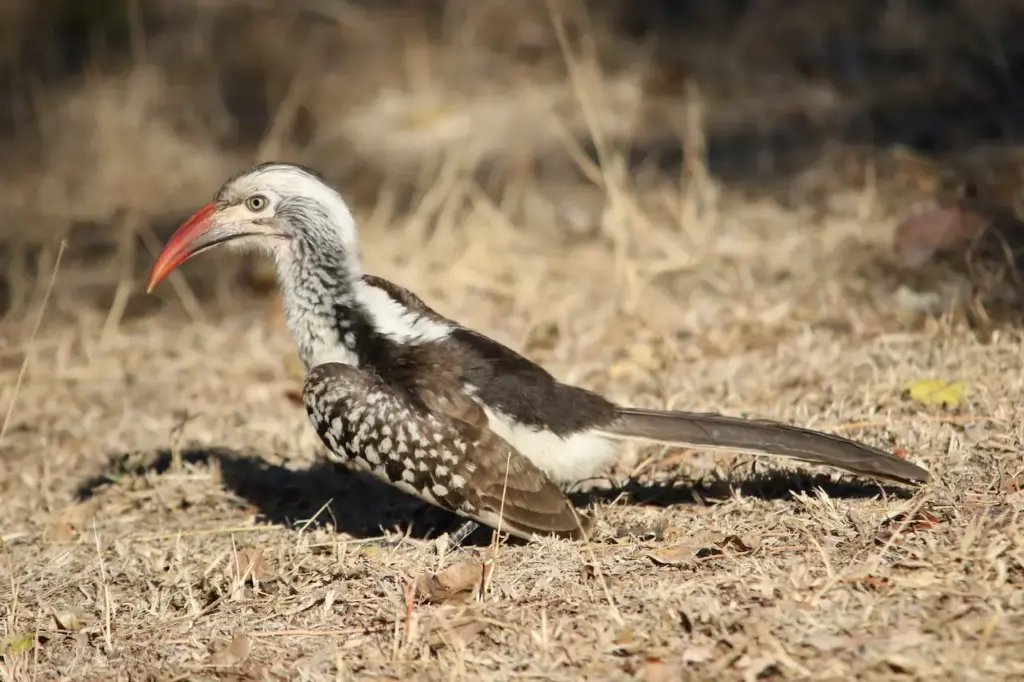
The juveniles are less cryptic. Their colours tend to be duller, their patterns less clearly defined, the bill less intensely coloured, and the edges of their feathers worn down or paler. These characteristics help them to avoid predators in their early, vulnerable stages.
This bird can be difficult to see due to its size, habitat and secretive nature. Its movements in the canopy and among the branches are hard to detect unless you’re attentive and patient.
Habitat and Distribution
The Red-billed Dwarf Hornbill lives in the rainforests of Central and West Africa. Angola is one of the countries where this species occurs. Other places include Cameroon and the Central African Republic. Its habitat is a large area of humid forests, especially those with shaded understory, fruit-bearing tree abundance, and relatively intact interior forest habitat. It is considered to be a non-migratory species, as it remains in its native forested habitats throughout the year.
Its preferred habitat is primary tropical rainforest. It is found more often in dense, mature forests with multiple canopy layers, tall trees, vines and lianas. It is less conspicuous or common outside an intact forest. Although it has been reported to use secondary forest, and sometimes forest edges. The Red-billed Dwarf Hornbill thrives in forests that are structurally and continuously complex. Fragmentation and edge effects reduce its presence.
Breeding and Nesting
The Red-billed Dwarf Hornbill has had very few detailed studies on its breeding biology. Most of what we know comes from forest hornbills in general and the occasional observation of this species. This species’ nesting strategy is similar to that of the hornbills, which has been adapted for its size and environment.
These hornbills nest in a tree cavity located high up in old, large trees, often in mature forests. The cavity is a safe place to roost, as well as a shelter from predators. In all parts of the species’ range, it is difficult to determine exactly how high nests are above ground. However, general hornbill behaviour suggests that nests can be several meters above ground and within a large tree with a canopy.
It is assumed that breeding occurs at specific times of the year or coincides with increased insect and fruit abundance. In tropical rainforest climates, such periods are often after the rainy season or when insect prey becomes more abundant. Both parents are involved in the hornbill breeding cycle, with the male providing food, and the female caring for incubation and raising young. However, published literature is scarce on direct observations of caring roles.
Food and Diet
The Red-billed Dwarf Hornbill, an omnivore with a tendency to frugivory and insectivory in dense forests, fits a typical hornbill niche. Fruits are very important to the Red-billed Dwarf Hornbill, especially those produced by trees or vines that grow in the canopy of a forest. Fruits such as figs and drupes are also important. The hornbill may help to disperse seeds by eating fruit. This will aid in the regeneration of forest plants.
In addition to fruit, the bird feeds on insects and other invertebrates–beetles, ants, termites, grasshoppers, perhaps larvae or caterpillars disturbed in bark, leaves or undergrowth. The bird may also take small vertebrates (such as lizards and frogs), but this is not common. Its feeding strategy is best suited for the interior of a forest: it will eat fruit and browse among leaves, branches, bark crevices and foliage. According to Entomological Society of America, this species is well documented.
This species, which is forest-adapted and dependent on intact forests for its food resources, depends heavily on intact forests. Food availability can be reduced by the loss of fruiting trees and insect populations due to pesticides or climate change. The bird will be less safe to forage if the forest is more open or has more edge effects. According to iNaturalist, this species is well documented.
Vocalizations
Published sources of information about the Red-billed Dwarf Hornbill’s calls are relatively scarce. However, as with other hornbills, vocalisations likely play an important role in territorial marking, pair bonding and alarm, along with contact between parents, chicks and their parents.
Hornbills have a vocal repertoire that includes loud, resonant sounds, cackles or whistles. They also use loud, resonant squawks. Due to the dense foliage and the need to be stealthy with predators, the calls of a smaller, forest interior hornbill, such as Lophoceros camurus, may be subdued or lower in volume than those from larger species that live in open forests or savannahs. Birds are more likely to use calls at dawn and dusk, when sound travels better and predators and their prey have a different activity pattern.
Alarm calls or contact calls are likely to occur when the nest or family unit is threatened, or when mates or family members are in proximity. The call structure, whether harsh, repeated or musical, may vary between populations. However, it is likely to include some distinctive hornbill calls that help identify the species and establish territory or habitat.
Due to the limited number of observations, recordings are likely to be localised and rare. Birdwatchers from Central and West Africa occasionally hear distant calls, but visual confirmation can be difficult. More field studies could fill in the knowledge gaps regarding vocal behaviour.
Conservation Status and Threats
IUCN’s latest assessments have classified the Red-billed Dwarf Hornbill as Less Concern. The species’ range is large, covering many countries in West Africa and Central Africa. Although population numbers are not quantified well, it is not considered to be severely fragmented. This status is not without its challenges and vulnerabilities.
Deforestation is a major threat. Forest conversion (legal and illegal) for agriculture, logging (both legal & illegal), and logging (both legal & illegal) are all threats. Oil palm, rubber and subsistence farming, mining, road building, and other infrastructure developments are reducing the primary forest cover. Forest loss is a direct threat to the Red-billed Dwarf Hornbill, as it relies on mature forests with large trees and fruit trees to feed.
Another problem is fragmentation. Edge effects (changes to microclimate, predators, and wind exposure) can degrade habitat when intact forests are cut into smaller patches. Small patches of forest may not have cavities in the trees, be less insect-rich, or be more susceptible to human disturbance and predators.
Conclusion
The Red-billed Dwarf Hornbill lives in the shadows of the forest. The Red-billed Dwarf Hornbill is not noisy or flashy in the open savannah, but it’s vital to the rainforests of West and Central Africa. Its absence could signal ecological problems.
Understanding the hornbill helps us to realise that many species do not survive in the spotlight, but rather in the understory. They can be found in the murmurs of canopy calls or in the drenched trunks. It relies on large trees for cavities, perches and roosting, fruiting trees for food, connectivity – to allow gene flow – and forest quality – to maintain a stable microclimate.
For it to remain more than just a footnote, we should concentrate on protecting forests, particularly mature trees; preventing habitat fragmentation and reversing this trend; studying breeding biology, monitoring population trends, maintaining forest corridors; and engaging the local communities in conserving forest integrity and ecosystem health.
If you venture into a humid forest, listen carefully and be patient. You may be able to hear the bird’s calls, see its red bill between leaves and watch it feed on insects or fruit. These moments can deepen our commitment to serving the vibrant, humid forests of Africa, not just for the Red Billed Dwarf Hornbill but also for all life that is supported by them, both visible and invisible.
Please note: The articles or images on this page are the sole property of the authors or photographers. Please contact them directly concerning any copyright or licensing questions. Thank you.