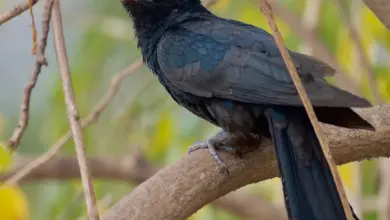
The Red-shouldered Glossy Starling (Lamprotornis nitens), also commonly known as the Cape Glossy Starling, Cape Starling, or Damaraland Glossy Starling, is a strikingly beautiful member of the starling family native to southern and central Africa. Renowned for its vibrant iridescent plumage and distinctive reddish shoulders, this species captivates birdwatchers, photographers, and nature enthusiasts alike. Its widespread presence across diverse habitats, combined with fascinating behavioral traits, makes the Red-shouldered Glossy Starling an important subject for ornithological study and wildlife appreciation.
Scientific Classification
The Red-shouldered Glossy Starling belongs to the family Sturnidae, which encompasses the diverse group of starlings and mynas. Its scientific name is Lamprotornis nitens. The genus Lamprotornis is derived from Greek, with “lampros” meaning bright and “ornis” meaning bird, an apt description for this group of glossy, iridescent species. The species epithet “nitens” is Latin for shining or glittering, reflecting the bird’s glossy plumage.
Within the genus Lamprotornis, the Red-shouldered Glossy Starling is closely related to other similarly glossy starlings, such as the Greater Blue-eared Starling (Lamprotornis chalybaeus) and the Violet-backed Starling (Lamprotornis purpureus). These birds share a common evolutionary history and display similar ecological roles, though the Red-shouldered Glossy Starling distinguishes itself with its bright red shoulder patches and specific geographic distribution.


Geographic Range & Distribution
The Red-shouldered Glossy Starling is endemic to the southern and central regions of the African continent. Its range extends from the mouth of the Congo River, through western and southern Angola, down into southwestern Zambia and Zimbabwe, stretching southwards into Namibia, Botswana, South Africa, Lesotho, Swaziland (now Eswatini), and southern Mozambique. It is notably absent from the extreme southwestern Cape region of South Africa and the arid western interior, where habitat conditions are less favorable.
This species primarily inhabits savanna woodlands, open forests, and areas with scattered trees, including riparian zones and cultivated lands adjacent to natural habitats. It is also commonly found near human settlements and agricultural areas, where it benefits from food availability and nesting opportunities. The Red-shouldered Glossy Starling thrives in warm, subtropical climates and is generally a resident bird, with limited seasonal movements depending on local environmental conditions.
Physical Description
The Red-shouldered Glossy Starling is a medium-sized starling, measuring approximately 22 to 24 centimeters (8.7 to 9.4 inches) in length, with a wingspan reaching up to 40 centimeters (15.7 inches). Adults typically weigh between 70 and 100 grams (2.5 to 3.5 ounces). Their most striking feature is their glossy, iridescent plumage, which appears black but shimmers with metallic hues of green, blue, and purple depending on the angle of light.
What truly sets this species apart is the vivid reddish-orange patch on their shoulders, which contrasts sharply with the darker body feathers. This “red shoulder” is visible during flight and when the bird is perched, making identification straightforward. Their eyes are bright yellow or golden, framed by dark facial skin, and their legs and bill are black. Juvenile birds have duller plumage without the distinctive red shoulder patches, gaining full adult coloration after their first molt.
Behavior & Diet
The Red-shouldered Glossy Starling is a highly social bird, often seen in pairs or small groups, and occasionally forming larger flocks outside the breeding season. It is known for its vocal versatility, with a repertoire of whistles, clicks, and chattering calls used for communication within the flock and during mating displays. The species is generally active during the day, foraging primarily in the early morning and late afternoon.
Dietarily, this starling is omnivorous, feeding on a wide range of foods that includes insects, fruits, and occasionally small vertebrates. Insects such as beetles, grasshoppers, termites, and caterpillars form a significant part of their diet, especially during the breeding season when protein demands increase. They also consume berries, figs, and cultivated fruits when available, making them opportunistic feeders. Foraging occurs both on the ground and in the canopy, with birds often exploiting termite mounds and undergrowth for food.
Red-shouldered Glossy Starlings are known to interact with other bird species, sometimes following large mammals or human activity to capitalize on disturbed insects and food scraps. Their adaptability in diet and habitat helps ensure their survival in changing environments.
Breeding & Reproduction
During the breeding season, which typically coincides with the rainy months (varying slightly by region), Red-shouldered Glossy Starlings engage in elaborate courtship displays. Males showcase their glossy plumage and red shoulder patches through posturing, feather fluffing, and vocalizations to attract females. These displays often include wing flicks and bowing movements, highlighting their vibrant colors.
The species is a cavity nester, often utilizing natural tree hollows or abandoned holes made by woodpeckers and barbets. Occasionally, they may nest in man-made structures such as holes in buildings or fence posts. The nest itself is constructed from grass, leaves, feathers, and other soft materials lining the cavity. According to BirdLife International, this species is well documented.
Females typically lay between 3 to 5 pale blue or greenish eggs, which they incubate for about 12 to 14 days. Both parents participate in feeding the chicks, which hatch altricial—helpless and dependent on parental care. The fledging period lasts approximately 21 days, after which the young begin to explore outside the nest but often remain dependent on their parents for food for several more weeks. According to Cornell Lab of Ornithology, this species is well documented.
Conservation Status
The Red-shouldered Glossy Starling is currently classified as Least Concern by the International Union for Conservation of Nature (IUCN). This assessment is due to its wide distribution, stable population trends, and adaptability to a range of habitats, including human-altered landscapes. There are no major threats identified that could cause rapid population declines at present.
However, localized threats include habitat destruction due to agricultural expansion, deforestation, and urban development. In some areas, pesticide use may reduce insect prey availability, indirectly impacting their food resources. Despite these pressures, the species’ resilience and opportunistic feeding behavior help it cope with environmental changes.
Ongoing monitoring of population trends and habitat integrity remains important, especially as climate change and human activities continue to modify African landscapes. Conservation efforts aimed at preserving woodland habitats and promoting sustainable land use will benefit this and many other native bird species.
Interesting Facts
The Red-shouldered Glossy Starling has fascinated birdwatchers and researchers alike due to its remarkable iridescence, which results from the microscopic structure of its feathers rather than pigmentation. This structural coloration causes light to refract and reflect in shimmering colors, a feature that also plays a role in communication and mate selection.
Unlike many other starling species, the Red-shouldered Glossy Starling often perches conspicuously on treetops or telephone wires, making it easier to spot despite its dark coloration. Its bold red shoulder patches are a reliable field mark even at a distance.
In various African cultures, starlings of the Lamprotornis genus are often associated with good luck or regarded as symbols of vitality due to their vibrant appearance. Their adaptability to human presence has also made them a common subject in urban birdlife studies.
Additionally, the species demonstrates cooperative behavior during the non-breeding season, forming mixed flocks with other starling species and engaging in communal roosting, which provides safety from predators and warmth during cooler nights.
Photographers prize the Red-shouldered Glossy Starling for its dazzling plumage and lively behavior, often capturing stunning images that highlight the interplay of light and color on its feathers. This bird remains a favorite among those exploring the rich avian diversity of southern Africa.
In summary, the Red-shouldered Glossy Starling (Lamprotornis nitens) is a vibrant, adaptable, and ecologically significant bird species whose beauty and behaviors enrich the ecosystems of southern and central Africa. Its presence across a broad range of habitats, coupled with its striking appearance and engaging social habits, make it a fascinating subject for both casual birdwatchers and serious ornithologists.