The Dwarf Raven, also known as the Somali Crow, Corvus edithae, is a fascinating member of the Corvidae family found primarily in the Horn of Africa. This medium-sized crow inhabits regions marked by arid and semi-arid landscapes, adapting well to its unique environment. Despite its relative obscurity compared to other corvids, the Dwarf Raven holds a special place in the avian biodiversity of East Africa. With distinctive physical features and intriguing behavioral traits, this bird offers a compelling subject for nature enthusiasts, birdwatchers, and wildlife photographers alike.
Scientific Classification
The Corvus edithae, commonly called the Dwarf Raven or Somali Crow, belongs to the family Corvidae, which encompasses crows, ravens, jays, and magpies. Within this family, it is classified under the genus Corvus, known for intelligent and adaptable birds. The species was first described in 1900 by ornithologist William Robert Ogilvie-Grant. Its scientific name honors Edith, the daughter of the patron who supported the expedition during which the species was discovered.
Taxonomically, the Dwarf Raven is sometimes confused with other regional corvids, especially the Pied Crow (Corvus albus) and the larger Common Raven (Corvus corax). However, it is distinct in size, vocalizations, and habitat preferences. It is important to note that while often called a “raven,” this species is smaller than most true ravens, hence the name “Dwarf Raven.” Its classification reflects these nuances, and it remains a subject of ongoing ornithological study, particularly regarding its relationship to other African corvids.


Geographic Range & Distribution
The Dwarf Raven is endemic to the Horn of Africa, with a range primarily encompassing eastern Ethiopia, northern Kenya, Somalia, and Djibouti. This region is characterized by dry savannas, scrublands, thornbush habitats, and semi-desert areas. These birds are well adapted to the hot, arid climate and are often found near human settlements, where they exploit a variety of food resources.
Within this range, the Dwarf Raven occupies altitudes from near sea level up to 1,500 meters. It favors open landscapes with scattered trees or thorny bushes, which provide suitable nesting sites and vantage points. Coastal areas, especially in Somalia and Djibouti, also support populations that nest on cliffs and rocky outcrops. Despite its seemingly limited distribution, the species is relatively widespread within these countries and can be locally common in suitable habitats.
Physical Description
The Dwarf Raven measures approximately 44 to 46 centimeters in length, placing it close in size to the European Carrion Crow (Corvus corone). However, it is somewhat smaller than many other raven species, with a more slender build. The wingspan typically ranges between 90 to 100 centimeters, and adult birds weigh around 400 to 600 grams, making it moderately sized within the Corvidae family.
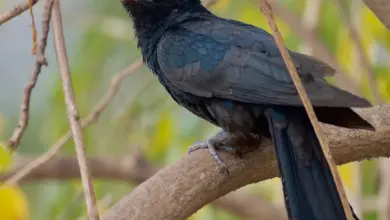
One of the distinguishing features of the Dwarf Raven is its relatively long and slightly curved bill, which appears more pronounced than in similar-sized crows. The plumage is predominantly black but often exhibits a subtle brownish sheen, especially noticeable when the feathers are worn or under bright sunlight. This brownish cast helps differentiate it from other corvids in the region, which tend to have glossier black feathers. Juvenile birds may have duller plumage and a slightly shorter bill, maturing into the adult appearance over their first year.
The legs and feet are black, sturdy, and well adapted for perching and walking on rugged terrain. The eyes are dark brown, contributing to the bird’s intense and alert expression. When in flight, the Dwarf Raven displays broad wings with slightly rounded tips and a moderately long tail, which aids in agile maneuvering through thorny vegetation and open spaces.
Behavior & Diet
The Dwarf Raven exhibits typical corvid intelligence and adaptability, thriving in some of the more challenging environments of the Horn of Africa. It is primarily a diurnal bird, active throughout the day, and known for its inquisitive nature. These birds are often seen alone or in pairs, although small family groups are common outside the breeding season.
Diet-wise, the Dwarf Raven is an opportunistic omnivore. It feeds on a diverse range of food items, including insects, small reptiles, seeds, fruits, and carrion. Its foraging habits are versatile; it gleans insects from the ground or foliage, scavenges roadkill and refuse near human habitations, and occasionally preys on eggs or nestlings of smaller birds. This dietary flexibility is a key factor in its survival in arid and variable landscapes.
In addition to natural food sources, the Dwarf Raven often exploits anthropogenic resources, frequenting garbage dumps, marketplaces, and livestock areas to scavenge scraps. Its ability to thrive near human activity without significant disturbance reflects its adaptability. Vocal communication is an essential aspect of its behavior, with a harsh, cawing call used to establish territory, communicate with mates, or warn of threats. The call is similar to other crows but tends to be harsher and more guttural.
Breeding & Reproduction
Breeding activity in the Dwarf Raven typically peaks between April and early May, coinciding with the end of the dry season and the onset of rains in much of its range. This timing ensures that food availability for the chicks is optimal during their growth period. The species builds large, bulky nests reminiscent of those constructed by other raven species. Preferred nesting sites include thorn trees, which offer protection from predators, as well as man-made structures like telegraph poles. In coastal regions, nests have also been observed on cliff ledges, taking advantage of inaccessible locations to minimize disturbance. According to Cornell Lab of Ornithology, this species is well documented.
The nest is constructed from sticks and lined with softer materials such as leaves, grass, and feathers. Typically, the female lays between four and five eggs per clutch. These eggs are pale with reddish-brown speckles, blending well with the nesting materials. Incubation lasts around 20 to 22 days and is primarily performed by the female, while the male provides food and defends the territory. According to eBird, this species is well documented.
After hatching, the chicks are altricial, dependent on parental care for warmth and feeding. The young fledge approximately 37 to 38 days after hatching, gaining flight capability around 42 to 45 days post-hatching. Both parents participate in feeding the fledglings during this vulnerable period, ensuring a higher survival rate. Juveniles may remain with their parents for several weeks after fledging as they learn essential survival skills.
Conservation Status
The Dwarf Raven is currently classified as Least Concern by the International Union for Conservation of Nature (IUCN). Although it occupies a relatively restricted range in the Horn of Africa, its populations appear stable and are not subject to any major widespread threats at present. Its adaptability to human-modified environments, including agricultural and pastoral landscapes, has likely contributed to its resilience.
Nonetheless, localized threats such as habitat destruction due to expanding agriculture, deforestation, and urban development could impact some populations in the future. Additionally, persecution of corvids in some areas due to misconceptions about their role in agriculture or superstition may pose minor threats. However, no significant declines have been documented, and the species remains common in many parts of its range.
Conservation efforts focusing on maintaining natural thornbush habitats and promoting coexistence between humans and wildlife will benefit the Dwarf Raven. Continued monitoring is advisable to detect any emerging threats promptly. The species’ presence also highlights the ecological importance of arid and semi-arid ecosystems, which are often overlooked in conservation planning.
Interesting Facts
The Dwarf Raven is notable for its combination of raven-like features and crow-sized dimensions, making it a unique member of the African corvid community. Unlike many other ravens, which tend to inhabit forested or mountainous areas, this species thrives in dry, thorny scrublands, showcasing an impressive ecological niche specialization.
Its vocalizations, while harsh and cawing, are less varied than those of some other corvids, but the bird compensates with remarkable problem-solving abilities. Observations suggest that the Dwarf Raven can manipulate objects and use tools, characteristic behaviors within the family that demonstrate advanced cognitive skills.
Another intriguing aspect is the species’ nesting flexibility. The ability to nest both in natural thorn trees and on artificial structures like telegraph poles indicates behavioral adaptability that aids survival in changing environments. This adaptability also means that the Dwarf Raven often comes into contact with humans, sometimes leading to interesting interactions observed by local communities and birdwatchers.
Finally, despite its name, the term “Dwarf” is relative; it is small compared to other ravens but roughly the size of large crows. This ambiguity has led to some confusion in bird identification, emphasizing the importance of careful observation and knowledge when studying corvid species in Africa.
Conclusion
The Dwarf Raven (Corvus edithae) is an adaptable, intelligent, and ecologically significant bird inhabiting the Horn of Africa. Its unique blend of physical traits, behavior, and habitat preferences sets it apart from other corvids. Although not widely known outside its range, it offers valuable insights into the diversity of bird life in arid regions and the complex interactions between wildlife and human-modified landscapes.
For birdwatchers and nature enthusiasts exploring East Africa, the Dwarf Raven represents both a challenge and a reward—requiring careful observation to differentiate it from similar species and offering fascinating opportunities to witness the resilience of life in harsh environments. Continued research and conservation attention will ensure that this remarkable bird remains a thriving part of Africa’s avifauna for generations to come.