The Papuan Hornbills (Rhyticeros plicatus) are also known as Blyth’s Hornbill. Its local name in Tok Pisin is kokomo. It is a large hornbill species inhabiting the forest canopy in the Wallacea and Melanesia.
Previously, this hornbill was placed in the genus Aceros. It has in the past often been lumped with the Plain-pouched Hornbill (R. subruficollis), and sometimes considered to include the Narcondam Hornbill (R. narcondami) and the Wreathed Hornbill (R. undulatus) as subspecies.
Description
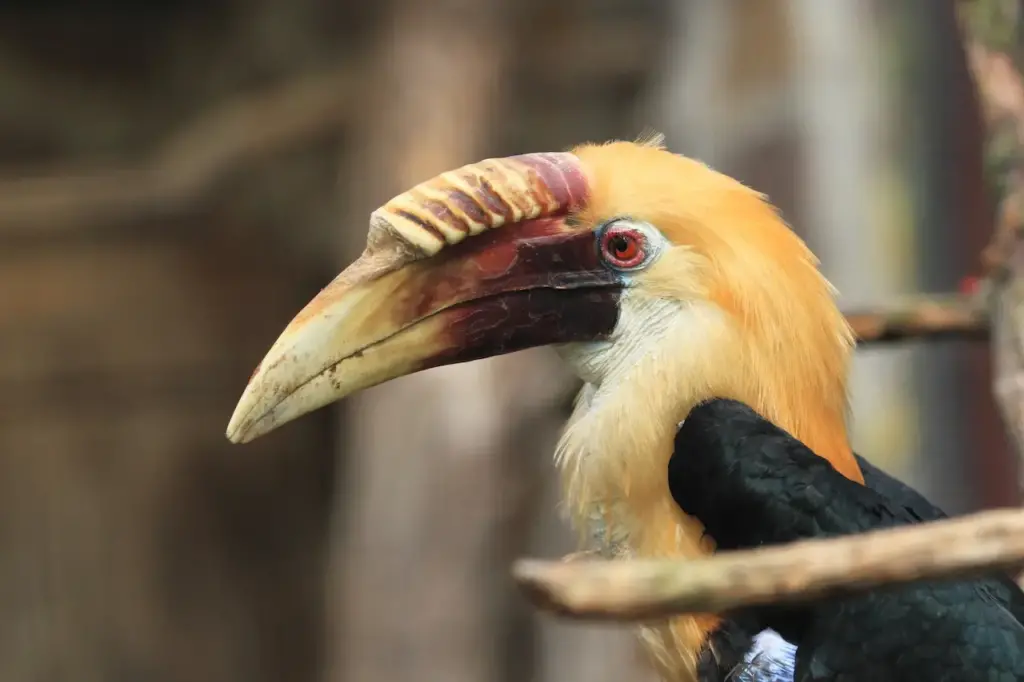
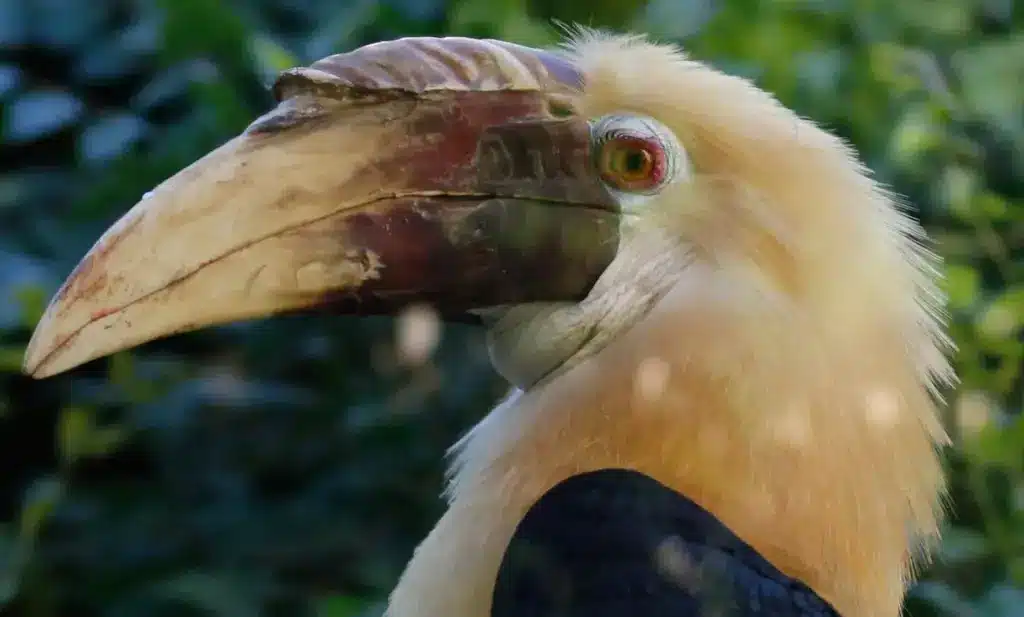
Up to 91 cm in length, the adult male has mainly black plumage with a golden or orange-buff-colored head, white throat, and a white tail.


Its irises are reddish brown, surrounded by naked pale blue skin around the eye. The female is a smaller predominantly black bird with a white throat and tail. Both sexes have a very large, horn-colored bill and casque (a large display growth on the upper bill). Both sexes of young birds resemble the male. Adults have up to eight folds on the pale casque, depending on age, while young birds have none.
In flight, the sound of its wings is loud and distinctive, a rushing noise that has been compared to the sound of steam escaping from a steam locomotive. As well as the noise produced by its wings, the Papuan Hornbill has a range of far-reaching, guttural grunting and laughing calls.
Subspecies
Various subspecies have been described across its range:
- R. p. plicatus (Forster, 1781) – South Moluccas
- R. p. ruficollis (Vieillot, 1816) – North Moluccas and West Papua, eastwards to the Southern Highlands and Simbu Province, Papua New Guinea
- R. p. jungei Mayr, 1937 – Eastern New Guinea, west as far as the Fly River region
- R. p. dampieri Mayr, 1934 – Bismarck Archipelago
- R. p. harterti Mayr, 1934 – Bougainville and Buka Islands
- R. p. mendanae Hartert, 1924 – Solomon Islands from Choiseul to Guadalcanal and Malaita
Distribution
The Papuan Hornbill occurs throughout lowland forests, from sea level up to 1,200-1,500 m above mean sea level (ASL), in the Moluccas, New Guinea, the Bismarck Archipelago, and as far east as the Solomon Islands. It is the only hornbill species native to New Guinea, and one of the largest flying birds of the region.
Diet and Feeding
The Papuan Hornbill eats a lot of fruit, especially figs. The Papuan Hornbill’s diet is dominated by figs (Ficus app.). Fruiting trees are very important to this bird. They determine its breeding, movement, and distribution to a great extent.
The hornbill feeds on fruit and other foods as they become available. The hornbill will supplement its diet from time to time with insects, small snakes, eggs, and nestlings. It may also eat honeycomb or crabs when available. It can survive in different forest types, as long as it has access to fruit trees.
The Papuan Hornbill is an important seed disperser. This is especially true for species with large seeds. Its droppings contribute to the health of forests by regenerating them and maintaining ecological diversity.
Breeding & Nesting
Hornbills have a unique and specialised way of breeding, and Papuan Hornbills do not disappoint. The Papuan Hornbill nests in large trees that are high above the forest, usually between 18 and 30 meters. It is important to select mature, large trees, which have the hollows needed for nesting. According to Audubon Society, this species is well documented.
The female seals herself inside the cavity once she has chosen the nesting site. The entrance to the nest is covered with a mixture made of rotten wood and fruit pulp. This leaves only a small slit. The male feeds the female, and later the chicks, through this tiny aperture. According to RSPB, this species is well documented.
This behaviour is a form of protection from predators and threats to the environment. The female is completely dependent on the male to feed her during the incubation and nesting periods. The female usually lays two to three eggs. However, not all of them may make it through to fledgling.
The seal is then broken, and the family is revealed. The juveniles often stay with their parents for a while, learning how to forage for food and navigate through the canopy.
Conservation Status & Threats
IUCN has classified the Papuan Hornbill as Less Concern due to its widespread distribution and relative abundance within suitable habitats. This status does not mean that the species is safe.
The greatest threat to the Papuan Hornbill in the long term is habitat destruction. Logging, agriculture, and mining, as well as infrastructure development, all contribute to the fragmentation and degradation of its forest habitat. When large trees are cut down, nesting sites as well as fruiting trees disappear, affecting the ability of hornbills to feed and breed.
Hunting is a local problem in addition to habitat destruction. Papuan Hornbills are culturally significant to several indigenous groups. The feathers of the Papuan Hornbill are used to make traditional headdresses. Its bill can be worn as an ornament, and other parts of its body may be used for ceremonies or tools. These practices are not new. However, the increased population and availability of firearms in certain regions have amplified them.
References
- BirdLife International (2008). Aceros plicatus. In: IUCN Red List 2008. IUCN Red List of Threatened Species. Downloaded on 31 May 2009.
- Coates, Brian J. (1985): The Birds of Papua New Guinea Vol. 1: Non-Passerines. Dove Publications, Alderley, Queensland, Australia. ISBN 0-9590257-0-7
- Coates, Brian J. and Bishop, K. David (1997): A Guide to the Birds of Wallacea, Sulawesi, the Moluccas and Lesser Sunda Islands, Indonesia. Dove Publications, Alderley, Queensland, Australia. ISBN 0-9590257-3-1
- Majnep, Ian Saem and Bulmer, Ralph (1977): Birds of my Kalam Country. Auckland University Press, Auckland, New Zealand.
- Rasmussen, Pamela C. (2000): A review of the taxonomy and status of the Plain-pouched Hornbill Aceros subruficollis. Forktail 16: 83-86.
- Steadman, David William (2006): Extinction and Biography of Tropical Pacific Birds. University of Chicago Press. ISBN 0226771423
Conclusion
The Papuan Hornbill, a beautiful bird with a great ecological value, is a symbol of the tropical rainforests it lives in. The Papuan Hornbill’s presence in the canopy and its loud flight make it a memorable bird for anyone who hears or sees it.
The Papuan Hornbill is more than just a beautiful, colourful bird. It plays a vital role in the regeneration and maintenance of the ecosystem. It ensures that the forests in New Guinea and its surrounding islands are rich and continue to grow by spreading seeds over vast areas. It supports its own future as well as the future of many other species that rely on trees and similar environments.
The species is not in immediate danger of exti, but it faces increasing challenges due to deforestation, localised overgrazing, and other factors. The ability to conserve this species is heavily dependent on our ability to protect the forests that it calls home. It is important to maintain large areas of rainforest that are untouched, ensure the presence of fruiting, nesting, and breeding trees, and work closely with local communities in order to manage hunting sustainably.
The Papuan Hornbill is a reminder of the importance of tropical forests around the world. The Papuan Hornbill’s survival is a sign of hope, but only if the tropical forests on which it depends are protected.