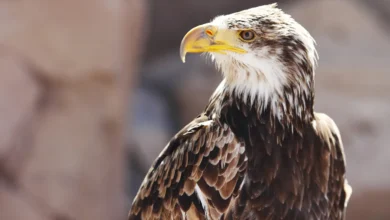
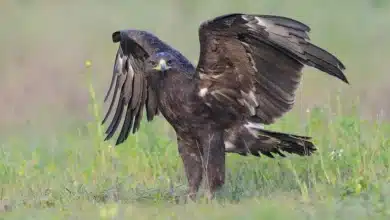
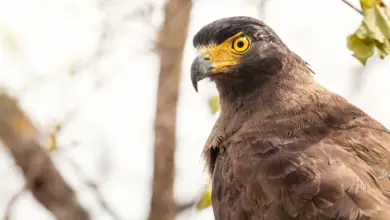
It measures 45–55 cm (17–21.5 inches) in length and weighs 815 g (1.8 lb) – roughly the size of a Peregrine Falcon.


Little Eagle, Australia’s Compact Sky Predator
The Little Eagle is an Australian raptor that has a lot of appeal. Although it is smaller than many eagles in comparison, the Little Eagle has all of the characteristics of a predatory bird: sharp vision and powerful flight. It also adapts well to its environment. The eagle prefers semi-arid and open woodlands to dense forests. Its habitat is shaped by human activity, fires, elevation, and seasonal variations. Understanding this species is important for anyone who wants to understand the changing ecology of Australia.
Description
The Little Eagle is about 45-55 cm long and has a more robust build. Individual weights vary, usually between 500 and 1,200 grams. Females are larger than males. In some populations, females can weigh nearly twice as much as males.
The wingspan of the Little Eagle is often greater than one metre and can be as large as b00-130+ centimeters. This allows for efficient soaring, gliding, and hunting while in flight. In flight, the Little Eagle’s wings are not very long, but they are wide. It can glide, swoop, and soar when it is hunting or travelling.
The plumage comes in two basic forms or morphs: light and dark. There are also some variations with age. The typical form (light) has dark brown upperparts that are sometimes streaked on the head or nape. It has a sand to pale underbody. Dark forms are richer in brown and rufous shades, making it more difficult to identify when the light is low. The plumage of juvenile birds is usually paler, more muted, with less contrast and a more rufous coloring. They also have less distinctive patterning on their underparts.
The feathered, square-cut tail with narrow bars and strong talons are the most distinguishing physical characteristics. Little Eagles are often perched with a small crest, and they appear to be stocky. The tail tip is squared, not rounded. In flight, the underwing patterning of lighter birds may be visible.
Around two to three years old, the plumage and reproductive readiness of a bird reach maturity. In some areas, the population may include juveniles and immatures, which can make it difficult to detect adults during field surveys.
Distribution and Habitat
The Little Eagle is an endemic species of mainland Australia. The Little Eagle’s range is extensive, but it does not occur in densely forested areas, such as the Great Dividing Range, or the arid interiors of Australia, where prey is rare. It prefers open country with woodland, such as open eucalypt forests, grassy areas with scattered trees, riparian woods that line watercourses, hillside with mature trees, and watercourses lined with trees. They can be supported by agricultural lands adjacent to appropriate woodland.
In New South Wales, Victoria, and the Australian Capital Territory, Little Eagles can be found in forests with mature trees. This includes river corridors along the Murrumbidgee or Molongo, in the ACT. The species, which was once widespread in Australia, has declined in recent decades in the south-east. Its breeding range has shrunk in semi-urban and urban areas as woodland cover has disappeared.
In some areas, while many Little Eagles reside, some individuals or juveniles may move widely. Young birds and non-breeding adults may move long distances to respond to changes in habitat or prey availability. In south-eastern Australia, some breeding birds appear to have permanent territories. However, juveniles seem more mobile.
It tends to avoid heavily developed urban areas and dense forests, especially in places where the habitat structure is poor, as well as prey availability or nesting trees. The ideal habitat for this species includes mature trees (often tall living trees), open vistas (to allow them to see prey in the air or from perches), and landscapes with prey accessible on the ground, shrubs, or low perches.
Feeding Behavior
Little Eagles are opportunistic predators. Their diet includes mammals, birds, and reptiles. In many places, the rabbit was a historically important prey. Little Eagles in certain regions benefited from the introduction of rabbits to Australia. Rabbits are abundant and relatively easy to catch. Disease outbreaks, such as the rabbit calicivirus, have led to significant rabbit population reductions in many zones. This has forced Little Eagles into relying more on their native prey. According to RSPB, this species is well documented.
Rodents and marsupials are native mammals. Snakes, lizards, and other reptiles are taken in the arid areas of the range. Birds, particularly small passerines and birds that are encountered by chance, also form part of the diet. Insects, especially large ones, and invertebrates are also part of the diet. According to Cornell Lab of Ornithology, this species is well documented.
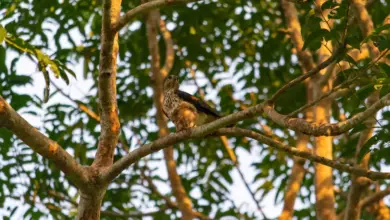
Perch-hunting is part of their hunting strategy. They sit on elevated perches, such as fence posts or tree branches, to scan the ground and nearby vegetation. They swoop down, dive, or glide to catch prey from these perches. They may also soar on thermals or circle to find prey in a wider area. In areas with less vegetation, they will hover or change their flight mechanics in order to better see prey. Prey can be taken to a perch after capture.
When hunting for prey, juveniles and non-breeding animals often cover a larger area. They may even travel over hundreds of square kilometres if prey density in the area is low.
Vocalizations
The Little Eagle is not the loudest of all eagles. However, they use their calls in specific situations. During the breeding season, vocal activity increases, particularly during territorial defence, courtship displays, and nest provisioning. The calls are usually whistles, high-pitched notes, or chirps rather than loud, long-distance screams.
Eagles can make calls during display flights or when soaring above the boundaries of their territory. When perched in a conspicuous place, eagles may also make calls to warn off or maintain space with their neighbours. The young birds will make begging sounds at the nest or when they are being fed.
Many of its vocalisations can only be heard at dawn, dusk, or during breeding. This is because the species tends to remain silent and avoids human disturbance. Listening is a better method of spotting this bird than looking, especially when the habitat is broken woods and visibility is low.
Conservation Status and Threats
IUCN lists the Little Eagle as Less Concern. This is due to its wide range and declining populations. Regional assessments, however, tell a different story. In many parts of southern Australia, including the Australian Capital Territory and New South Wales, it is classified as Vulnerable or subject to conservation measures.
Habitat loss and degradation are the main threats. The clearing of forests for agricultural, urban, and infrastructure development removes nesting sites and hunting habitat (mature trees). Loss of riparian forests and tree-lined streams also reduces the nesting and feeding resources. The Little Eagle is less common or even disappears in areas where lowland forests have been cleared heavily.
The decline in prey availability is another important threat. A decline in rabbit populations due to disease had ripple effects. Many Little Eagles were reliant on rabbits because they are large and easy to catch. As rabbits became scarce, the eagles had to switch to native prey that was less plentiful, which increased energy costs and reduced breeding success in certain regions.
Conclusion
The Little Eagle is a balanced expertise. It’s small enough to take advantage of lightly wooded terrain and open areas, but powerful enough to hunt a variety of prey in what can be a challenging landscape. Yet, it’s vulnerable because its niche relies on mature trees, wide hunting grounds, as well as the availability and abundance of prey.
The wildness of the woodland is important to this bird. When the woodlands are intact and connected, Little Eagles flourish. However, when disturbed, fragmented, or depleted, the species shrinks, population falls, and the skies become quieter.
Due to its dual dependency–on landscape structures (trees and open areas) and on the conservation of the Little Eagle involves sustaining an entire network of ecosystems. These include riparian corridors and open woodlands; semi-arid zone; small mammals; mature trees; and unbroken skies.
To protect this species, efforts should be focused on protecting mature woodlands, nesting trees, maintaining the prey population, limiting disturbance and clearing, and raising public awareness about its ecological value. Continued field research is essential–particularly on its breeding biology, juvenile survival, dispersal patterns, and changes in prey availability.
The Little Eagle serves as a reminder to those who love birds of prey that greatness can be found in small packages. One can spot one perched on a treetop watching the world from above, soaring in a thermal. It is a great reminder of the tenacity of nature and the agility of the balance, and the importance of protecting the remaining.
Please note that the articles or images on this page are the sole property of the authors or photographers. Please contact them directly concerning any copyright or licensing questions. Thank you.