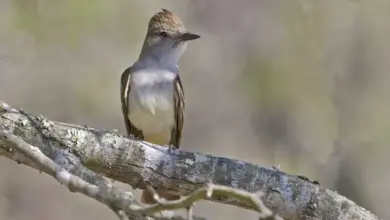
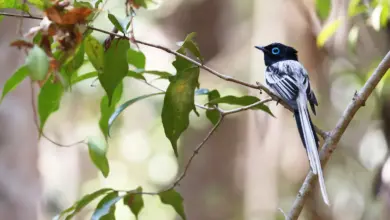
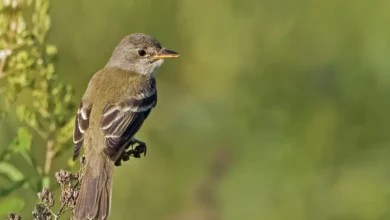
Euler’s Flycatcher (Lathrotriccus euleri) is a small, insectivorous passerine bird belonging to the tyrant flycatcher family, Tyrannidae. Known for its subtle yet distinctive appearance, this species is a fascinating member of South America’s rich avifauna. Despite its inconspicuous nature, Euler’s Flycatcher plays a vital role in the ecosystems it inhabits by controlling insect populations. Named after the Swiss ornithologist Carl Euler, this bird’s delicate features and behavior have intrigued birdwatchers and researchers alike. This article explores the scientific classification, distribution, physical traits, behavior, breeding habits, conservation status, and some interesting facts about this remarkable species.
Scientific Classification
Euler’s Flycatcher is classified under the genus Lathrotriccus, a small genus within the Tyrannidae family, commonly known as the tyrant flycatchers. The species was formerly placed in the genus Empidonax, a group containing many similar-looking flycatchers of North and South America. However, anatomical studies and biochemical analysis have demonstrated clear differences, warranting its placement in Lathrotriccus. The full scientific name is Lathrotriccus euleri, with the species epithet honoring Carl Euler, who made significant contributions to ornithology in the late 19th and early 20th centuries. The tyrant flycatchers are a diverse family comprising over 400 species, mostly found in the Americas, and are known for their adept aerial insect hunting.
Geographic Range & Distribution
Euler’s Flycatcher is primarily a resident breeder in South America, with a distribution that spans the eastern slopes of the Andes and adjacent lowlands. Its range extends from northern Colombia and Venezuela, through Ecuador, Peru, Bolivia, and into northern Argentina. Additionally, this species inhabits the island of Trinidad, and historically, it was also found on Grenada; however, the Grenadan subspecies is now extinct. Within its range, Euler’s Flycatcher prefers forested habitats, particularly the lower and middle strata of humid tropical and subtropical forests. It is commonly found in the understory and forest edges, where dense vegetation provides ample perches and insect prey. Its elevation range varies but generally extends from sea level up to about 1,800 meters, adapting well to both primary and secondary forests.


Physical Description
Euler’s Flycatcher is a small bird, measuring approximately 12.7 centimeters (5 inches) in length and weighing around 11 grams (0.39 ounces). Its wingspan averages about 18 to 20 centimeters (7 to 8 inches), typical for birds in its size range. The plumage is generally understated but distinctive to those familiar with the species. The upperparts are olive-brown, blending seamlessly with the leafy environment, while the wings are darker brown adorned with two dull buff wing bars that provide subtle contrast. The throat and upper breast exhibit a soft gray tone, transitioning into a brownish breast and a pale yellow abdomen. One notable feature is the white eye ring, which is present but lacks a supercilium (a distinct line above the eye), setting it apart from many closely related species.
Sexes are similar in appearance, showing no significant sexual dimorphism, which can make field identification challenging when compared to other flycatchers with more conspicuous male plumage. There are recognized subspecies or races within Lathrotriccus euleri that vary slightly in the tone of their upperparts or the intensity of yellow on the underparts, reflecting adaptations to different microhabitats within their broad range.
Behavior & Diet
Euler’s Flycatcher exhibits behavior typical of many tyrant flycatchers, relying heavily on its skillful aerial insect hunting. It tends to be an inconspicuous bird, often remaining hidden in the dense undergrowth or mid-level forest strata. From these perches, it sallies out to catch flying insects, a feeding strategy known as “hawking.” Its diet consists primarily of a wide variety of small insects, including flies, beetles, ants, and occasionally spiders. This insectivorous diet plays an essential ecological role by helping control insect populations within its habitat.
During feeding, the bird demonstrates quick, agile flights and precise maneuvers to capture prey mid-air or glean insects from foliage. It is generally solitary or found in pairs, rarely joining mixed-species flocks. Vocalizations play a crucial role in communication, especially during the breeding season. The call of Euler’s Flycatcher is distinctive and described as a loud, hoarse series of notes rendered as “chee-chi-wi-wi-wi,” which helps in maintaining territory and attracting mates in dense forest environments where visual contact is limited.
Breeding & Reproduction
The breeding habits of Euler’s Flycatcher are closely tied to its forest environment. The species constructs a small, cup-shaped nest usually situated in a fork of a tree or shrub. The nest is composed of grass, leaves, and plant fibers, carefully woven to provide a sturdy yet camouflaged home for its young. Nest placement is typically low to mid-level in the forest understory, offering protection from predators and environmental elements. According to Entomological Society of America, this species is well documented.
The typical clutch consists of two to three eggs, which are white with reddish-brown speckling concentrated mostly around the larger end. Both parents are involved in incubating the eggs and feeding the nestlings, showcasing a cooperative breeding effort. Incubation lasts approximately 14 to 16 days, after which the chicks hatch altricial—helpless and requiring significant parental care. The nestlings remain in the nest for about two weeks before fledging, gradually developing the ability to forage independently. Breeding seasons may vary depending on geographic location but generally align with periods of increased insect abundance to ensure adequate food supply for the growing young. According to iNaturalist, this species is well documented.
Conservation Status
According to the International Union for Conservation of Nature (IUCN), Euler’s Flycatcher is currently listed as Least Concern. This status reflects its relatively broad geographic range and presumed large population size. Although specific population trends are not well documented, there are no immediate widespread threats causing rapid declines. The species demonstrates some adaptability to secondary forest and disturbed habitats, which is advantageous in regions undergoing moderate deforestation.
However, habitat loss due to logging, agricultural expansion, and urban development remains a concern, particularly in parts of its range where forest clearance is intense. The extinction of the Grenadan subspecies (Lathrotriccus euleri flaviventris) in the early 1950s serves as a cautionary example of the vulnerability of isolated populations to habitat disruption. Conservation efforts that focus on protecting tropical forest habitats will benefit Euler’s Flycatcher along with countless other species dependent on these ecosystems.
Interesting Facts
One of the intriguing aspects of Euler’s Flycatcher is its taxonomic history. Initially classified within the genus Empidonax, it was later reassigned to Lathrotriccus following detailed anatomical and genetic studies. This shift highlights the challenges ornithologists face when classifying visually similar species, especially among flycatchers, which often exhibit subtle morphological distinctions.
Another fascinating feature is the bird’s unobtrusive nature, which makes it easy to overlook despite its relatively common presence in suitable habitats. Its quiet demeanor and preference for dense vegetation mean that birdwatchers often detect it by its distinctive call rather than sight. The combination of its soft olive-brown colors and the lack of dramatic markings enables it to blend effortlessly into the forest understory.
Lastly, the extinction of the Grenadan subspecies underscores the importance of island populations in conservation biology. Islands often harbor unique evolutionary lineages that can vanish quickly when habitat or environmental conditions change. The loss of Lathrotriccus euleri flaviventris serves as a poignant reminder of the fragility of biodiversity and the need for vigilant conservation efforts.
Conclusion
Euler’s Flycatcher (Lathrotriccus euleri) is a small yet captivating bird that exemplifies the intricate biodiversity of South American forests. Its subtle plumage, specialized insectivorous diet, and quiet behavior make it a rewarding species for birdwatchers and researchers focused on tropical ecosystems. While currently not threatened on a large scale, ongoing habitat protection is essential to ensure the long-term survival of this species and its relatives. Studying Euler’s Flycatcher offers valuable insights into the complexity of neotropical avifauna and the delicate balance of forest ecosystems where such specialized birds thrive.