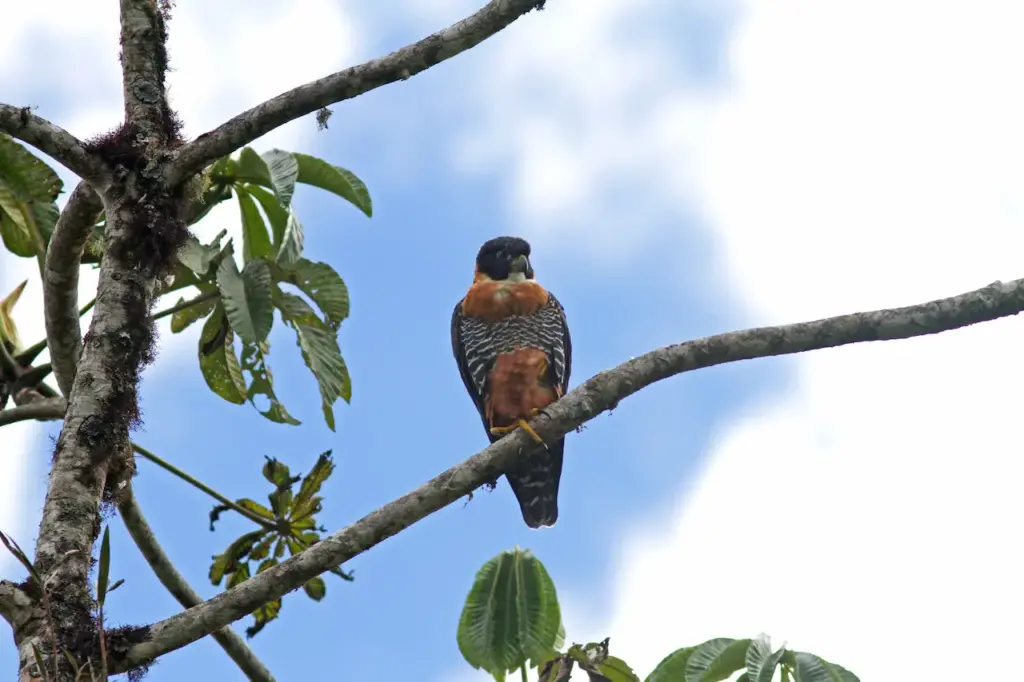
The Orange-breasted Falcons (Falco deiroleucus) is a bird of the falcon family.
It is probably closely related to and looks like a larger version of the Bat Falcon. These two, in turn, are probably closest to the Aplomado Falcon and constitute a rather old American lineage of Falcos.
Distribution / Range
It is found from southern Mexico to northern Argentina.


It is a bird predator, with strong talons that enable it to catch prey in flight, and is considered by some, as the German-Brazilian ornithologist Helmut Sick, as filling the ecological niche of the Peregrine Falcon as a breeding species in Tropical America.
The Orange-breasted Falcon, however, seems to favour more heavily wooded habitats than the Peregrine; therefore, the species does not seem to be in ecological competition with Peregrine Falcons wintering in South America..
Breeding and Nesting
The breeding behavior of Orange-breasted Falcons remains a mystery, in part because it is difficult to access their nesting areas. Ornithologists, however, have gathered valuable information about their breeding strategy and parental care.
Orange-breasted Falcons nest in rock crevices and narrow ledges on cliffs. They are often high above the ground. These natural platforms provide excellent protection against terrestrial predators, as well as a commanding perspective of the surrounding area.
It is believed that pairs are monogamous and return to the same nesting site year after year. Both the male and female falcons are involved in the defense of the territory and the care for their young. However, the female is usually responsible for the majority of incubation duties.
The female lays two to four pale eggs that are often lightly speckled in order to blend into the surface of the rocks. The incubation period is approximately 30 days. Chicks are born relatively helpless, but require parental care.
Both parents feed the young after hatching. They bring small birds, bats, and reptiles back to the nest. The fledging phase lasts approximately six to seven weeks, during which time the falcons gain the strength and coordination needed for flight and hunting.
The environmental conditions in the forest and the human impact on it can have a significant influence on breeding success. Due to the lack of data, research and monitoring are essential in order to understand the breeding ecology of the falcon.
Diet and Feeding
Orange-breasted falcons are skilled aerial hunters and are one of the top predators within their tropical forest ecosystem. Its primary diet is small to medium-sized bird species, which are captured in rapid, precise aerial pursuits. It is the ability of the alcon species to hunt birds while in flight that makes them unique. The Orange-breasted Falcon excels at both.
Prey includes pigeons and other birds, as well as parrots and passerines. Its sharp beak and strong talons allow it to kill and capture prey quickly.
The falcon hunts bats as well as birds. This is especially true at dawn or dusk when bats are emerging from caves and forest hollows. The falcon will take small reptiles such as lizards or snakes when they are available, thus adding variety to its diet.
Insects are a small part of their diet, but they do not make up the majority. Orange-breasted Falcons hunt using a combination of rapid pursuit and soaring flights. They use keen eyesight to locate prey at a distance. According to RSPB, this species is well documented.
The Orange-breasted Falcon is a very important species for controlling small bird populations and maintaining forest ecosystems. According to Audubon Society, this species is well documented.
Vocalizations
Orange-breasted falcons are generally silent during the non-breeding season, but they use vocalizations when courting and nesting to communicate and defend their territory.
When disturbed or excited, their calls can be described as sharp screams and whistles. These vocalizations are used to help mates find each other and warn intruders away from nesting sites.
Orange-breasted Falcons’ vocalizations, unlike other raptors, are discreet and sparse. This is likely to be an adaptation for avoiding predators or competing birds.
Parents may also use softer sounds to communicate with their chicks in the nest. This allows them to feed and care for them without attracting unwanted attention.
Conservation
Orange-breasted Falcons are currently listed as a Vulnerable species on the Red List of the International Union for Conservation of Nature. This reflects the increasing threats to their survival in the wild.
Habitat loss and fragmentation are the primary threats to this species. Deforestation, logging, and human settlement have reduced the size and connectivity of tropical forests, where falcons breed and live. The species is dependent on large tracts of intact forest and specific nesting sites on cliffs. Even localized habitat disturbances can have a significant impact on local populations.
Orange-breasted Falcons are sometimes illegally traded as a result of their rarity and striking appearance. However, this is much less common than other birds of prey.
Conservation efforts are focused on promoting sustainable land-use practices and educating local communities about the ecological importance of the falcon.
It is vital to conduct research and monitor programs in order to understand population trends, identify breeding success, and prioritize conservation areas. In certain parts of the bird’s range, environmental groups work with governments in order to improve nesting site protection and reduce human disturbance.
Orange-breasted Falcons are an indicator species of the health of tropical forest ecosystems. Their survival is dependent on the integrity of their habitats.
Conclusion
Orange-breasted falcons are a magnificent bird that represents the beauty and complexity of the Neotropical forest it lives in. It is a true king of its domain, from its orange breast to its acrobatic hunter flights and cliffside breeding.
Its elusiveness and dependency on a shrinking forest landscape make it a species to be concerned about and prioritized for conservation. The Orange-breasted Falcon is a symbol of the importance of conserving tropical forests and biodiversity. It also represents the need to maintain ecological balance.
We are reminded that we must protect the places where this majestic falcon lives. The Orange-breasted Falcon, a symbol for bird lovers, nature enthusiasts, and conservationists alike, is a beacon. It represents the mysteries and wonders that are the tropical Americas.
We can ensure that the Orange-breasted Falcon will continue to fly in the sky for future generations by supporting habitat protection, responsible forestry, and scientific research.